
A 360-degree camera setup can help you check more of your car’s surroundings when parking, but not every system gives you the same view. Four-channel dash cams record from multiple angles; bird’s-eye kits stitch exterior camera feeds into an overhead display.
These 10 picks cover both approaches. The right choice depends on whether you want recorded coverage, a live parking aid, or a system that can do both.
Best 10 360 Car Camera Systems for Parking Picks for 2026
Parking Kit Included
BOTSLAB 4-Channel 360° Dash Cam

- Hardwire kit and 128GB card included
- Four cameras record at 3K + 1080p × 3
- Three parking-monitoring modes
Best For: Multi-angle parking surveillance with included hardwiring hardware
Adjustable Views
PRUVEEO D90 4-Channel Dash Cam

- Four simultaneous 1080p views
- Three adjustable front-unit lenses
- GPS and 128GB card included
Best For: Adjustable coverage with GPS-backed incident records
Higher-Resolution Coverage

- Four simultaneous 2K recordings
- GPS and dual-band Wi-Fi
- Parking hardwire kit sold separately
Best For: Higher-resolution footage from every camera angle
GPS-Free Option

- Four views, including the interior
- 2.5K front-camera mode; 128GB card
- No GPS; parking kit sold separately
Best For: Multi-angle recording without GPS
Universal Retrofit Pick
Weivision BDV001 Bird-View System

- Four-camera stitched bird’s-eye view
- IP69 cameras with night vision
- Mirror drilling and professional installation required
Best For: Car owners planning a professionally installed retrofit
Android Head-Unit Pick

- Four 1080p cameras with 3D view
- Automatic switching and parking guidelines
- Requires a compatible Android 360-degree app and 12-pin connection
Best For: Drivers with a compatible Android multimedia radio
Recording-Focused Pick
Weivision BDV01-HD Surround DVR
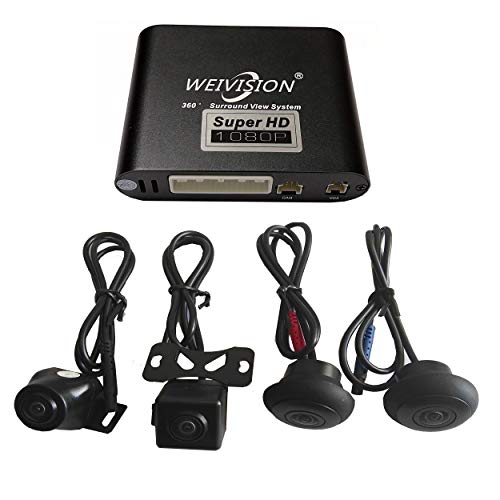
- Four wide-angle surround cameras
- Four-channel 1080p cycle recording
- Listed for vehicles up to 22 feet
Best For: Drivers seeking parking views and four-channel DVR footage
Best Included Storage
ZMOPO D435 Four-Channel Dash Cam

- Four simultaneous 1080p camera feeds
- 128GB card included
- Parking mode needs a separate hardwire kit
Best For: Multi-side recording with included storage
Best Bird’s-Eye Display
Keenso 360° Panoramic Car System

- Selectable 2D, 3D, and 3.5D views
- Audible and visual AI alerts
- Multiple video-output options
Best For: Panoramic parking views with pedestrian and vehicle alerts
Best Built-In GPS
Neideso N300 Four-Channel Dash Cam

- Built-in GPS tracks route and speed
- Three recording configurations
- Parking mode requires a separate hardwire kit
Best For: Multi-angle recordings with GPS trip data
Parking Kit Included – BOTSLAB 4-Channel 360° Dash Cam
Among 360 car camera systems for parking, the BOTSLAB stands out because its hardwire kit and 128GB card are included. Four cameras record the front, rear, and sides simultaneously at 3K + 1080p × 3, while the 3.18-inch touchscreen can show all four views at once.
Best For: Drivers who want multi-angle parking surveillance without buying a separate hardwire kit.
Pros:
- Included hardwire kit supports time-lapse, motion-triggered, and impact-triggered parking modes.
- Four-way split-screen, voice control, GPS, and 5.8GHz Wi-Fi add useful ways to review footage.
- Included 128GB card and detachable magnetic side cameras offer a flexible setup.
Cons:
- Parking surveillance requires hardwiring to vehicle power.
- Four cameras and their mounts take more setup than a basic front-and-rear dash cam.
This is a recording-focused system rather than a stitched overhead parking display. Its included parking hardware makes it a practical choice if you want footage from several angles while the car is unattended.
Adjustable Views – PRUVEEO D90 4-Channel Dash Cam
The PRUVEEO D90 is one of the 360 car camera systems for parking built around four simultaneous 1080p recordings: front, rear, left, and right. Its three adjustable front-unit lenses let you aim coverage toward areas that matter most, including the cabin.
Best For: Drivers who want adjustable camera angles and GPS records alongside parked-car footage.
Pros:
- Four 1080p cameras capture multiple directions at once.
- GPS logs speed, location, and route; Wi-Fi provides phone access to clips.
- Includes a 128GB card, with loop recording and collision-locked footage.
Cons:
- The ACC hardwire kit needed for parking mode is sold separately.
- All four channels are 1080p rather than offering a higher-resolution front recording.
Choose this model if aiming the lenses is more valuable to you than maximum front-camera resolution. Budget for the separate hardwire kit if parked-car monitoring is your main reason to buy.
Higher-Resolution Coverage – IIWEY N6 4-Channel Dash Cam
For shoppers comparing 360 car camera systems for parking, the IIWEY N6 offers simultaneous 2K (1440p) recording from its front, rear, and two side cameras. Adjustable side cameras, infrared lighting, and an included 128GB card round out its multi-angle setup.
Best For: Drivers prioritizing 2K footage across all four views who can add a separate parking-mode hardwire kit.
Pros:
- All four channels record at 2K (1440p), with wide front, rear, and side viewing angles.
- Parking options include selectable time-lapse rates and impact-triggered clip locking.
- Built-in GPS and dual-band Wi-Fi support route review and app access.
Cons:
- The IIWEY hardwire kit required for parking mode is not included.
- The wired camera has no built-in battery and must stay connected to vehicle power.
The N6 is compelling when recording detail across every channel matters. For unattended parking coverage, factor the separately sold hardwire kit into the total cost.
GPS-Free Option – IIWEY N5 4-Channel Dash Cam
The IIWEY N5 gives buyers of 360 car camera systems for parking front, rear, side, and interior recording without paying for a GPS feature they may not need. It offers a four-channel 1080p mode or a 2.5K front-camera mode alongside three 1080p channels, plus an installed 128GB card.
Best For: Drivers who want multi-angle footage and phone access but do not need GPS logs.
Pros:
- Four-channel coverage includes the cabin as well as exterior views.
- Included 128GB card, 3-inch screen, and 5GHz Wi-Fi make footage accessible.
- With the separately sold hardwire kit, parking mode offers time-lapse and impact detection.
Cons:
- No GPS function.
- Parking mode requires a separately sold hardwire kit; for everyday use, the camera requires its original cigarette-lighter charger rather than a USB cable.
The N5 makes sense when broad recording coverage matters more than route data. Check its power requirements before installation, especially if you plan to add parking monitoring later.
Universal Retrofit Pick – Weivision BDV001 Bird-View System
Among 360 car camera systems for parking, the Weivision BDV001 is a universal retrofit option for drivers who want a stitched bird’s-eye view and recording. Its four waterproof, wide-angle cameras are designed to help reveal blind spots around the vehicle.
Best For: Car owners willing to arrange professional installation for a surround-view parking setup.
Pros:
- Four cameras provide a stitched 360-degree bird’s-eye view.
- IP69 waterproof cameras include night-vision capability.
- Shock-sensor parking monitoring and automatic MP4 recording add useful documentation.
Cons:
- Professional installation is recommended, including drilling 20 mm holes in the side mirrors.
- The universal design excludes long vehicles such as buses.
The surround view could make parking and narrow-road maneuvers easier, but confirm that you are comfortable with the mirror modifications before buying.
Android Head-Unit Pick – BY-J 3D 1080p Panoramic Kit
For shoppers comparing 360 car camera systems for parking, the BY-J kit stands out if the vehicle already has a compatible Android multimedia radio. Four 1080p cameras feed a 3D bird’s-eye display, with views that switch in response to turn signals and gear selection.
Best For: Drivers with an Android radio that has a built-in 360-degree panoramic app and the required 12-pin connection.
Pros:
- Four-camera 1080p system supports a 3D bird’s-eye view.
- Automatic view switching and dynamic parking guidelines assist with maneuvering.
- Package includes cables, mounting accessories, a hole opener, and an electronic installation guide.
Cons:
- Not compatible with radios lacking a built-in 360-degree app, CarPlay displays, or rearview-mirror displays.
- The stated maximum vehicle length is 4.8 m; longer vehicles require contacting the seller.
Its head-unit integration is appealing, but check the app, connector, and vehicle length before treating it as a plug-and-play choice.
Recording-Focused Pick – Weivision BDV01-HD Surround DVR
The Weivision BDV01-HD is worth considering among 360 car camera systems for parking when recording matters as much as seeing around the car. Its four fisheye cameras provide a bird’s-eye surround view, while the DVR supports four-channel 1080p recording and cycle recording.
Best For: Drivers who want surround-view assistance plus four-channel DVR recording on a car or pickup within the stated 22-foot vehicle limit.
Pros:
- Four wide-angle cameras help show blind spots during reversing and tight turns.
- Supports four-channel 1080p recording and 1080p video output.
- Cycle recording helps manage stored footage.
Cons:
- The stated fit limit is vehicles up to 22 feet long.
- Recording-capacity details conflict: the notes cite both a 32 GB maximum and support for up to 128 GB.
This is the stronger fit when you want a surround view with DVR functionality; verify storage compatibility before choosing a memory card.
Best Included Storage – ZMOPO D435 Four-Channel Dash Cam
Among 360 car camera systems for parking, the ZMOPO D435 is a recording-focused option: four 1080p cameras capture the front, rear, left, and right sides, and a 128GB card is included. It is designed to document activity around your vehicle rather than display a stitched bird’s-eye parking view.
Best For: Drivers who want multi-side footage with storage included and are willing to add a hardwire kit for parked-car recording.
Pros:
- Four simultaneous 1080p camera feeds cover multiple sides of the vehicle.
- Includes a 128GB card; loop recording and incident locking help manage footage.
- WDR, infrared lights, and 5GHz Wi-Fi support low-light recording and app downloads.
Cons:
- Parking mode requires an optional ACC hardwire kit.
- GPS tracking requires a separately purchased logger.
Choose this for a packaged four-camera recording setup, not for on-screen parking guidance. Budget for the hardwire kit if surveillance while parked is your priority.
Best Bird’s-Eye Display – Keenso 360° Panoramic Car System
If you’re comparing 360 car camera systems for parking because you want a panoramic display, the Keenso system is the closest match here. It offers selectable 2D, 3D, and 3.5D views, plus AI recognition that alerts you to pedestrians and vehicles.
Best For: Drivers seeking selectable around-view parking perspectives and audible as well as visual alerts.
Pros:
- Multiple view modes let you choose a preferred parking perspective.
- AI alerts use visual color changes and sound for detected pedestrians and vehicles.
- Supports several video-output interfaces and compatible USB storage from 16GB to 512GB.
Cons:
- USB storage must meet the stated flash-drive and FAT32 requirements.
- Compatibility is described broadly as “most cars”; confirm fit and display connections before buying.
This is the pick when an around-view display matters more than a standalone dash-cam setup. Check your vehicle’s installation needs and preferred video output before committing.
Best Built-In GPS – Neideso N300 Four-Channel Dash Cam
For shoppers considering 360 car camera systems for parking who also want trip records, the Neideso N300 combines adjustable four-channel coverage with built-in GPS. Its app can display recorded video alongside location, speed, route, and time information; it is a recording system, not a stated stitched bird’s-eye display.
Best For: Drivers who want multi-angle incident footage with GPS data and are prepared to hardwire parking mode.
Pros:
- Offers three recording configurations, including 4K+1080p and 2K+1080p×3 modes.
- Built-in GPS and 5GHz Wi-Fi support route review and phone downloads.
- G-sensor locks collision footage; infrared LEDs and WDR assist in low light.
Cons:
- 24-hour parking mode requires a separately purchased hardwire kit.
- It needs wired power and does not offer cloud storage or remote monitoring.
The built-in GPS distinguishes this model from setups that require an add-on logger. If your main goal is monitoring while parked, include the hardwire kit in your purchase plan.
How We Picked the Best 360 Car Camera Systems for Parking
We focused on the practical differences in this selection: camera layout, live-view capability, recording features, included accessories, and installation demands. We also separated four-channel dash cams from stitched bird’s-eye systems. Both may be marketed as “360-degree” cameras, but they solve different parking problems.
Quick Comparison: Dash Cam or Bird’s-Eye Kit?
Four-channel dash cams typically cover the front, rear, and cabin or side-facing areas while saving footage. They can be a good fit if you want evidence of bumps or activity around a parked vehicle. Check the actual camera positions: a cabin-facing lens is not the same as an exterior side camera.
Bird’s-eye parking kits use cameras mounted around the vehicle to create a stitched, overhead-style view on a compatible display. They are the more direct choice for judging clearance beside curbs or nearby cars. Expect more wiring, mounting, and calibration work than with most dash cams.
Key Buying Factors for 360 Car Camera Systems for Parking
Know What “360” Means
Look at the camera placement and sample display, not just the label. A four-channel recorder may show separate feeds rather than a seamless top-down image. If tight-space maneuvering is your priority, confirm that the system offers a live surround view you can use while reversing or moving slowly.
Check Compatibility and Installation
For a bird’s-eye kit, verify display compatibility, video inputs, vehicle-size suitability, and where each exterior camera must mount. Ask whether calibration materials or professional installation are needed. For a dash cam, plan cable routes to the rear and side cameras and check whether your vehicle’s trim allows a clean fit.
Plan for Parking-Mode Power
“24/7” or parking monitoring claims do not necessarily mean the feature works straight out of the box. Confirm the required hardwire kit or external power source, whether it is included, and how low-voltage protection works. Also check that the system records the views you care about while the car is parked.
Prioritize Usable Images and Storage
Resolution alone does not guarantee clear footage. Consider low-light performance, glare handling, lens placement, and whether the display stays readable at a glance. For recording systems, compare supported card capacity, loop recording, and whether a memory card is supplied.
Who Should Buy Which 360 Car Camera Systems for Parking?
Choose a four-channel dash cam if recorded coverage is your main goal and you want a generally simpler installation. Choose a stitched bird’s-eye kit if live curb and obstacle positioning matters most and you are comfortable with a more involved installation. If you want both reliable parking assistance and footage after an incident, verify that one system genuinely provides both functions—or consider pairing a surround-view kit with a separate dash cam.