
A supercapacitor jump starter can offer an alternative to keeping a conventional battery-powered jump pack charged. But “batteryless” does not always mean it can start a car without an available power source.
These 10 options include portable units and permanently connected systems. The right choice depends on where the starter gets its energy, whether it supports your vehicle, and how you plan to use it.
Best 10 Supercapacitor Jump Starters Picks for 2026
Best Lightweight Portable Pick

- 2-pound portable design
- 800A peak output
- Four charging methods
Best For: Portable 12V emergency backup
Best Permanent High-Output System

- 1300A peak output
- Permanent or clamp connection
- App monitoring and Force Start
Best For: Installed assist with battery monitoring
Best High-Output Portable Pick

- Listed 6285A maximum current
- Screen and upgraded clamps
- 10.5-pound unit
Best For: High-output 12V portable use
Best Automatic Start Assist

- Up to 1000A starting assist
- Automatic connected operation
- App-based battery alerts
Best For: Everyday 12V starting support
Best for App Monitoring
JS300 1000A Permanent-Mount Starter

- 1000A peak output for 12V cars
- App monitors vehicle status and starts
- Requires residual power above 5V
Best For: Installed starting assistance with app-based monitoring
Best Portable Pick
Novus Start NS800 800A Jump Starter

- 800A peak output
- Display and alternator check
- Clamps and storage case included
Best For: Portable use across compatible 12V gas-engine vehicles
Best High-Output Mount
JS400 1300A Permanent-Mount Starter
- 1300A peak discharge rating
- Manual and emergency activation
- Needs residual voltage above 5V
Best For: Higher-output permanent installation on a 12V vehicle
High-Output Pick
KeenPower 6000A Supercapacitor Jump Starter

- Claimed 6000A peak output
- Six 3000F capacitors
- Force-start mode for dead 12V batteries
Best For: Drivers seeking a high-output option for 12V vehicles
Engine-Size Pick
Ultra Cap 800A Supercapacitor Jump Starter

- 800A claimed peak output
- Rated for up to 8.0L gas or 4.0L diesel
- Includes car and USB-C charging cables
Best For: Compatible 12V vehicles needing stated engine-size guidance
Display Pick
1000A Batteryless Jump Starter

- Voltage and status display
- Claimed 1000A peak output
- About three-minute charge claimed
Best For: Drivers who prioritize visible jump-starter status
Best Lightweight Portable Pick – Autowit SuperCap 2
The Autowit SuperCap 2 is a 2-pound option for shoppers comparing supercapacitor jump starters that do not need routine charging at home. It draws energy from a weak battery and can be ready in a few minutes.
Best For: Drivers who want a portable, batteryless backup for a 12V vehicle.
Pros:
- 800A peak output; rated for gasoline engines up to 8.0L and diesel engines up to 4.0L.
- Four charging methods offer alternatives when the vehicle battery is too weak to supply enough energy.
- Specified operating range of -40°C to 70°C.
Cons:
- When charging from the vehicle, it needs some remaining battery energy before it can jump-start.
- Its stated diesel-engine limit is 4.0L.
Choose this one if low carry weight and freedom from a maintenance-charging schedule matter more than permanently installed, automatic assistance.
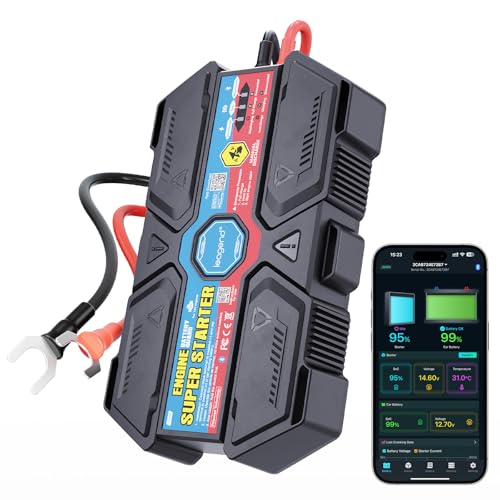
Best Permanent High-Output System – ANCEL BS400 Super Starter
Among supercapacitor jump starters, the ANCEL BS400 takes a different approach: install it under the hood for automatic starting assistance instead of storing it as an emergency-only jump box. Its stated peak output is 1300A for 12V vehicles.
Best For: Drivers who want an installed starting-assist system with app-based battery monitoring.
Pros:
- Can be permanently connected with U-type terminals or used temporarily with the included clamps.
- Companion app displays battery information and start history; a Force Start option is available for critically low batteries.
- Rated for -40°F to 176°F operation, with IP65 protection for engine-bay use.
Cons:
- Permanent use requires installation rather than simply keeping a unit in the trunk.
- A severely depleted battery may require a 5V/2A power bank through the USB-C port to charge the starter first.
The BS400 makes the most sense if you will use its always-connected operation and monitoring. Its USB-C backup charging option is worth remembering before relying on it with a fully depleted battery.
Best High-Output Portable Pick – KeenPower SC6000 PRO
The KeenPower SC6000 PRO targets buyers comparing supercapacitor jump starters who prioritize a high stated output over compact carry weight. Its six 3000F capacitors are listed with a maximum current of 6285A, and the unit weighs 10.5 pounds.
Best For: Owners of 12V vehicles who want a portable, high-output capacitor starter and do not mind a heavier unit.
Pros:
- Charges its capacitors from a weak 12V vehicle battery in a few minutes, without routine pre-charging at home.
- Includes upgraded clamps and a screen.
- Has a force-start function for a completely dead 12V vehicle; the stated operating range is -45°F to 158°F.
Cons:
- At 10.5 pounds, it is less convenient to carry than lighter portable models.
- The supplied specifications do not state separate gasoline- and diesel-engine displacement limits.
Its headline current rating is a reason to consider it, but check vehicle compatibility rather than treating the number alone as a guarantee of starting performance.
Best Automatic Start Assist – ANCEL BS300 Super Starter
The ANCEL BS300 is one of the supercapacitor jump starters built to stay connected to a 12V vehicle. Rather than waiting in storage for a dead battery, it automatically assists engine starts with up to 1000A of stated starting assistance.
Best For: Drivers who want routine start assistance and battery-status alerts from a permanently connected system.
Pros:
- Automatically assists starts and recharges from the vehicle battery when needed.
- Companion app shows voltage, charge level, operating status and startup history, with battery alerts.
- Rated for -40°F to 176°F operation and supplied with clamps for temporary installation.
Cons:
- Permanent operation requires an under-hood installation.
- Unlike the BS400’s supplied description, the BS300 notes do not specify a USB-C backup-charging or app-based Force Start feature.
Pick the BS300 for automatic everyday support and monitoring, while recognizing that its stated 1000A assist rating is lower than the BS400’s 1300A peak rating.
Best for App Monitoring – JS300 1000A Permanent-Mount Starter
Among supercapacitor jump starters, the JS300 is a permanent-mount option for 12V vehicles rather than a portable unit you keep in a case. It draws on the vehicle’s residual power to prepare a starting surge without a built-in chemical battery.
Best For: Drivers who want an installed starting aid with app-based vehicle-status monitoring.
Pros:
- 1000A peak output for 12V passenger cars.
- App tracks voltage, current, temperature, and startup history.
- Rated for -40°F to 176°F operation, with reverse-polarity and overcurrent protection.
Cons:
- Needs more than 5V of residual vehicle power to harvest energy.
- Permanent installation makes it less flexible than a portable jump starter.
The JS300 makes the most sense if you value ongoing monitoring alongside starting assistance. Its residual-voltage requirement is the key limitation to check before relying on it for a deeply discharged vehicle.
Best Portable Pick – Novus Start NS800 800A Jump Starter
The Novus Start NS800 is one of the portable supercapacitor jump starters here: it comes with battery clamps, a 12V charging cable, and a storage case. It has no internal battery to keep charged and is designed to power up from a weak vehicle battery in 1–5 minutes.
Best For: Drivers who prefer a portable starter they can move between 12V vehicles.
Pros:
- 800A peak output with a stated 1–5-minute power-up time.
- 2.5-inch LED display, alternator check, and Force Start mode.
- Includes clamps, a 12V charging cable, and a storage case.
Cons:
- Requires a power-up step before starting rather than remaining installed and ready.
- Its stated engine fit is 12V gas engines, so check compatibility for other applications.
Choose the NS800 if portability and included accessories matter more than an installed setup. Its display and alternator check add useful information during a roadside start.
Best High-Output Mount – JS400 1300A Permanent-Mount Starter
The JS400 has the highest stated peak output of these supercapacitor jump starters at 1300A. It mounts to a 12V vehicle’s terminals and uses residual vehicle energy rather than a built-in chemical battery, making it an installed option for cars and light commercial vehicles.
Best For: Drivers seeking higher stated peak output in a permanent-mount 12V starting aid.
Pros:
- 1300A peak discharge rating.
- Permanent installation requires no routine pre-charging.
- Manual discharge button and emergency start function offer two activation options.
- Rated to operate from -40°F to 176°F.
Cons:
- Needs residual vehicle voltage above 5V to harvest energy.
- Permanent mounting is less convenient if you need to share a starter between vehicles.
The JS400 is the stronger-output installed choice on paper, especially if you want its manual and emergency activation options. As with other residual-energy designs, it is not a substitute for an external power source when the vehicle has insufficient remaining voltage.
High-Output Pick – KeenPower 6000A Supercapacitor Jump Starter
Among supercapacitor jump starters, the KeenPower stands out for its claimed 6000A peak output and six 3000F capacitors. It draws charge from a weak 12V vehicle battery in a few minutes rather than needing to be charged at home.
Best For: Drivers who want a high-output, batteryless jump starter for a range of 12V vehicles.
Pros:
- Claimed 6000A peak output for 12V vehicles, including cars, trucks, tractors, motorcycles, and RVs.
- Force-start function for a completely dead 12V vehicle.
- Manufacturer-stated operating range of -45°F to 158°F.
Cons:
- Normal charging from the vehicle requires a weak battery with enough residual energy; a completely dead battery calls for the force-start function.
- No engine-displacement limits are provided in the supplied specifications.
Its force-start option is a useful distinction, but check your vehicle’s 12V system and starting requirements rather than relying on the peak-current figure alone.
Engine-Size Pick – Ultra Cap 800A Supercapacitor Jump Starter
This entry in the supercapacitor jump starters category offers a more specific compatibility guide: a claimed 800A peak output for gasoline engines up to 8.0L and diesel engines up to 4.0L. It charges from a weak battery in a few minutes without pre-charging at home.
Best For: Drivers with compatible 12V gas or diesel vehicles who want clearly stated engine-size limits.
Pros:
- Lists gas-engine compatibility up to 8.0L and diesel compatibility up to 4.0L.
- Includes jumper cables, a car charger cable, and a USB-C charging cable.
- Lists protection against reverse polarity, overcurrent, overload, and overvoltage.
Cons:
- Its 800A peak rating is lower than the other two products’ stated peak ratings.
- Charging from a vehicle battery depends on that battery retaining usable energy.
The stated engine limits make this easier to match to a vehicle than models listing peak current alone. The supplied notes also mention four charging options, though they do not detail every option.
Display Pick – 1000A Batteryless Jump Starter
For shoppers comparing supercapacitor jump starters, this 12V model pairs a claimed 1000A peak output with a digital display showing voltage, input/output status, and alerts. The listing says it charges in about three minutes, with no routine pre-charging required.
Best For: Drivers who want visible status information on a batteryless 12V jump starter.
Pros:
- Display shows voltage, charging/output status, and alerts.
- Claimed 1000A peak output; title lists compatibility up to 6.0L gas and 4.0L diesel.
- Manufacturer-stated operating range of -40°C to 70°C.
Cons:
- The listing gives conflicting compatibility descriptions, including a claim that it starts all 12V vehicles.
- The supplied specifications inconsistently describe its capacity, so they are not a reliable basis for comparison.
The display is its clearest practical advantage. Before buying, confirm your engine size against the stated limits, since the broader vehicle-compatibility claims lack the same precision.
How We Picked These Supercapacitor Jump Starters
We organized the 10 selected products around the decisions that matter most: portable versus permanent installation, stated 12V compatibility, claimed engine capacity, and how each unit obtains the energy for a jump. We also considered whether the listing gives enough detail to assess its operation. Manufacturer current and engine-size claims are useful starting points, not guarantees of a successful start in every condition.
Quick Comparison: Portable or Permanently Mounted?
Portable units suit drivers who want to carry one starter between compatible vehicles. Models in this group include Autowit, KeenPower, and several generically named batteryless jump boxes. Check their charging instructions before relying on them away from home.
Permanently connected systems suit a dedicated vehicle. The ANCEL BS300 and BS400 and the 1000A and 1300A permanent-mount options prioritize onboard availability, but require installation and vehicle-specific compatibility checks. A permanently connected device is not a substitute for diagnosing a battery or charging system that repeatedly fails.
Key Buying Factors for Supercapacitor Jump Starters
Energy Source and Setup
Supercapacitors store energy for a short period; they are not a conventional long-term battery reserve. Some portable starters draw energy from a weak vehicle battery before delivering a high-current start, while others may accept an external source. Confirm the exact model’s charging method, minimum input requirements, and whether an external backup source is included or needed. Treat “no pre-charge” as a claim to verify in the manual, not a promise that the device works without usable energy.
Vehicle Compatibility
Start with your vehicle’s voltage: the listed options are aimed at 12V applications, not 24V systems. Then compare the maker’s gas and diesel engine limits with your vehicle. Displacement claims and peak-amp numbers do not tell the whole story; battery condition, temperature, cable connection, and engine design can all affect the result. If a listing omits clear limits, ask the seller or choose a better-documented model.
Connections and Installation
For a portable unit, look for clear polarity markings, secure clamps, adequate cable reach, and stated safety protections. For a permanent-mount system, verify mounting space, cable routing, electrical connection requirements, and whether professional installation is appropriate. Follow the vehicle and starter manuals rather than improvising connections.
Who Should Buy Which Supercapacitor Jump Starters?
Choose a portable model if you switch vehicles or want a starter you can store outside the car. Choose a permanently connected system if you want dedicated onboard equipment and are comfortable with the installation requirements. If your priority is a large-engine vehicle, compare stated engine compatibility first rather than selecting solely by the biggest amp figure. And if you need a device that will work when the vehicle battery has virtually no usable energy, confirm the model’s external-power options—or consider a charged battery jump pack instead.