
If you want a compact way to add real low-end weight without giving up cargo space, this 10-inch under-seat car subwoofer is built around that goal.
It targets drivers who need stronger bass, simple integration, and a low-profile enclosure.
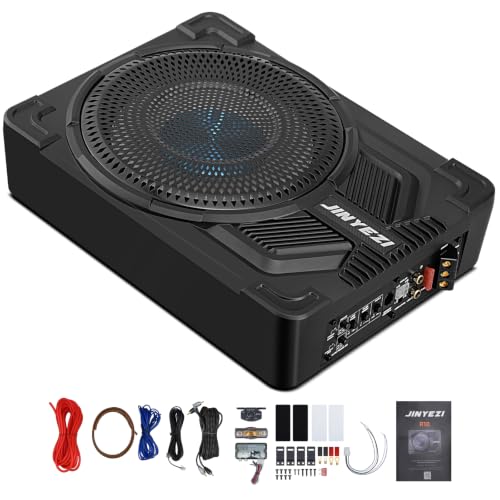
10-inch Under-Seat Car Subwoofer Review Summary
This 10-inch under-seat subwoofer makes sense for buyers who care more about space efficiency and controlled bass than showy system building.
The listing points to a Class D design, built-in amplification, and a compact aluminum housing, which is the right mix for daily drivers, trucks, SUVs, and work vehicles where installation space is limited.
It is especially appealing if you want an easier path into better bass from a factory head unit.
The built-in high-to-low level converter, REM auto-power-on, and protection features reduce the amount of extra gear you need to plan around.
Review Scorecard
| Category | Score | Buyer-focused rationale |
|---|---|---|
| Bass output potential | 8/10 | The 2-ohm woofer, 50mm voice coil, and 1200W marketing position it as a serious compact bass upgrade. |
| Space efficiency | 9/10 | The under-seat format and 13.38 x 10.03 x 3 inch size are the main draw. |
| Integration ease | 8/10 | High-level input support and the built-in converter help with factory systems. |
| Thermal management | 8/10 | Thickened aluminum and dual-sided heat dissipation are designed for sustained use. |
| Electrical practicality | 7/10 | 8AWG cabling, 40A fuse, and protection circuits suggest a sensible install profile, but power demands still matter. |
| Adjustment range | 8/10 | Independent low-pass filtering and bass boost give useful tuning control for a compact unit. |
| Overall value proposition | 8/10 | The strongest case is convenience: built-in amp, compact form, and broad vehicle fit. |
Key Features and Specifications of 10-inch Under-Seat Car Subwoofer
The core appeal here is not raw enclosure size.
It is the combination of a slim under-seat chassis with a built-in Class D amplifier, designed to deliver stronger bass while keeping the cabin usable.
The listing emphasizes an IRS2095 IC plus IRL540N MOSFET amplifier stage, which is presented as an efficiency-focused setup with lower heat output.
Useful listed specifications include:
| Spec | Listed detail |
|---|---|
| Driver size | 10 inches |
| Rated power | 280W RMS listed |
| Impedance | 2 ohms |
| Frequency response | 20Hz-180Hz |
| Low-pass filter | 40Hz-180Hz |
| Bass boost | 0-12dB |
| Fuse | 40A |
| Inputs | High-level and low-level |
| Dimensions | 13.38 x 10.03 x 3 inches |
| Construction | Thickened aluminum housing |
| Protection | Thermal, short-circuit, overload |
The installation-oriented details are just as important as the audio specs.
Oxygen-free copper RCA cables, 8AWG cables, copper terminals, and an auto-power-on remote wire are all listed to support cleaner integration and more stable power delivery.
The manufacturer also highlights compatibility with MPVs, SUVs, trucks, UTVs, and ATVs.
That matters because an under-seat subwoofer is most useful when it can solve a real packaging problem, not just add bass in a vacuum.
Pros and Cons of 10-inch Under-Seat Car Subwoofer
Pros
- Compact under-seat footprint that preserves cabin and cargo space.
- Built-in amplifier reduces the need for separate amp planning.
- High-level input support makes factory-system integration more realistic.
- Independent low-pass and bass boost controls give practical tuning flexibility.
- Aluminum housing and dual-sided cooling are aimed at better thermal stability.
- Protection circuits are included for more forgiving everyday use.
Cons
- The compact format will not behave like a large trunk subwoofer in outright output.
- The listing is focused on technical claims, so buyer expectations should stay grounded in the size class.
- At 2 ohms and with a built-in amplifier, installation and power planning still matter.
- Bass quality will depend heavily on vehicle acoustics, seat clearance, and tuning.
In plain terms, the tradeoff is straightforward: you gain convenience and space savings, but you should not expect the physical authority of a much larger enclosure.
For many drivers, that is the right compromise.
Who Should Buy 10-inch Under-Seat Car Subwoofer?
This is a good fit for drivers who want noticeably better bass without turning the vehicle into an audio project.
It suits people with factory head units, compact cabins, or vehicles where a traditional enclosure would be inconvenient.
It is also a smart option for buyers who want an integrated package rather than piecing together a separate amp, converter, and enclosure.
The listing suggests a system designed for cleaner installation and broad compatibility, which is useful for everyday use.
You should probably skip it if you want theater-level trunk bass, extreme output, or the ability to scale the system around a larger enclosure.
A slim under-seat unit can improve fullness and punch, but it is still bounded by its form factor.
The best buyers are:
- Drivers with limited space under seats or in the trunk.
- Owners of factory stereos who want easier bass integration.
- Truck, SUV, and multi-purpose vehicle owners.
- Anyone who wants a tidy bass upgrade with built-in controls.
Bass Tuning and Installation Considerations for 10-inch Under-Seat Car Subwoofer
Factory Head Unit Compatibility
The built-in high-to-low level converter is one of the most practical features in the listing.
If your vehicle uses a factory radio, that matters more than a flashy power number because it lowers the friction of adding a sub without rebuilding the rest of the system.
Cooling and Continuous Use
The aluminum housing and dual-sided heat dissipation channels are meant to support longer sessions without unnecessary heat buildup.
That does not make the unit immune to thermal limits, but it does suggest the design is trying to handle continuous bass duty more responsibly than a bare-bones compact amp package.
Bass Control and Crossover Setup
The independent low-pass filter and bass boost range give you enough control to adapt the sub to different cabins and speaker setups.
In a small enclosure like this, tuning is not optional.
A little restraint usually produces better integration than pushing boost too hard.
Vehicle Fit and Listening Goals
This type of subwoofer is most attractive when the goal is stronger low-end presence, not wall-shaking output.
In an SUV or truck, the slim enclosure can add punch where you need it.
In smaller cars, the benefit is usually better fullness and impact, especially at moderate listening levels.
Alternatives to 10-inch Under-Seat Car Subwoofer
If you want similar products with different tradeoffs, consider these Amazon search options:
- JBL under-seat car subwoofer
- Rockville under-seat car subwoofer
- Pioneer powered subwoofer
- Kenwood compact powered subwoofer
- Kicker under-seat subwoofer
These are credible alternatives because they cover the same broad category: compact powered bass upgrades for space-limited vehicles.
If you want a safer mainstream brand choice, the JBL, Pioneer, Kenwood, and Kicker searches are the first places to look.
If you want more aggressive feature-per-dollar positioning, Rockville is often worth comparing.
Is 10-inch Under-Seat Car Subwoofer Worth It?
Yes, if your priority is compact, integrated bass rather than maximum output.
The listing supports a strong case for buyers who want a slim powered sub with factory-head-unit compatibility, flexible inputs, thermal protection, and enough tuning to adapt to real-world cabins.
It is not the right pick for someone chasing the deepest or loudest trunk-style system.
But for drivers who need a neat under-seat solution with fewer installation headaches, this looks like a practical buy.
If you value space savings, straightforward integration, and a cleaner daily-driver setup, this is worth considering.
If your first priority is sheer bass authority, look at larger external-subwoofer options instead.