
Finding the right synthesizer under $1,000 means balancing sound character, keyboard feel, polyphony, sequencing, connectivity, and portability. The best choice depends less on price alone and more on how you plan to create and perform.
This roundup covers analog, digital, hybrid, FM, workstation, and compact portable instruments, making it easier to match your budget with the features that matter most.
Best 10 Synthesizers Under 1000 Picks for 2026
Analog Powerhouse

- Two wavefolding VCOs plus sub-oscillator
- 32 full-size keys with velocity and aftertouch
- Sequencer, arpeggiator, CV, MIDI, and USB-C
Best For: Hands-on analog bass, leads, and expressive monophonic performance
Hybrid Sound Explorer

- Six-voice polyphonic hybrid engine
- 37-key portable format
- Includes MiniFreak VST counterpart
Best For: Exploring varied digital-and-analog sounds with polyphonic playability
Portable FM Specialist

- Four-operator FM sound engine
- 37-key mini keyboard with initial touch
- Built-in speakers, battery power, and phrase looper
Best For: Portable FM synthesis, practice, and capturing musical ideas
Polyphonic Analog Favorite

- Four-voice analog polyphony
- 200 presets and hands-on sound editing
- 16-step polyphonic step and motion sequencer
Best For: Affordable analog chords, sequencing, and accessible sound design
Experimental Hybrid Pick
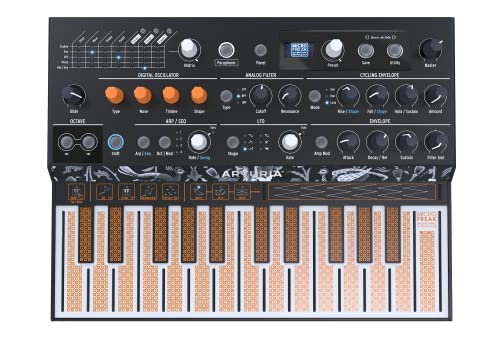
- 17 digital oscillator modes with an analog filter
- 25-key touch keyboard with poly-aftertouch
- CV, USB, MIDI, and creative sequencing tools
Best For: Advanced sound designers and modular-minded producers
Analog Polyphonic Pick

- Four VCOs for thick analog tones
- 37 velocity-sensitive semi-weighted keys
- Mono, unison, paraphonic, and polyphonic modes
Best For: Players wanting hands-on analog bass and lead sounds
Production Workstation Pick

- Motif sound engine with flexible voice-layering tools
- 128-note polyphony for live play and sequences
- Class-compliant USB audio and 16-channel MIDI
Best For: Producers and performers needing broad sounds and computer integration
Versatile Workstation

- 61-key synth-action keyboard
- Step and MIDI sequencers
- Mic/line inputs with audio recording
Best For: Composing, sequencing, and live keyboard performance
Portable Analog Explorer

- Battery operation and built-in speaker
- LFO, filter, envelope, and PWM controls
- CV/Gate outputs for hardware rigs
Best For: Portable sound design and modular experimentation
Retro Pocket Pick
Original Stylophone Synthesizer

- Pocket-sized stylus-controlled design
- Three octaves with optional vibrato
- Battery-powered with speaker and headphones
Best For: Beginners, gifts, and casual portable play
Analog Powerhouse – Moog Messenger
The Moog Messenger is a strong contender among synthesizers under 1000 for players who want hands-on analog sound in a performance-ready format. Its two wavefolding VCOs, flexible ladder filter, full-size keys, and extensive sequencing and connectivity make it suitable for both studio work and live setups.
Best For: Musicians and producers seeking a portable, expressive monophonic analog synthesizer with classic Moog character.
Pros:
- Two continuously variable-shape VCOs with sync, FM, and a sub-oscillator.
- 32 full-size semi-weighted keys with velocity and aftertouch.
- Integrated 64-step sequencer, arpeggiator, and 256 presets.
- Broad connectivity, including CV, MIDI, USB-C, audio input, and pedal connections.
Cons:
- Monophonic design is less suited to playing full chords.
- Its 5.14 kg weight and larger dimensions may limit portability.
The Messenger stands out when tactile control, expressive keyboard performance, and deep analog sound design matter more than polyphonic playing. The RES BASS compensation and flexible filter also help it retain a full sound across the frequency range.
Hybrid Sound Explorer – Arturia MiniFreak
Arturia MiniFreak 37 Key Polyphonic 6-Voice Hybrid Synthesizer Keyboard (Standard, 37 Key)
Check Price On AmazonThe Arturia MiniFreak offers an inviting route into hybrid synthesis for shoppers comparing synthesizers under 1000. With six-voice polyphony, 37 keys, and a digital-and-analog sound profile, it is designed for exploring varied textures while remaining portable.
Best For: Beginners and players who want a compact, portable polyphonic hybrid synthesizer for broad sound experimentation.
Pros:
- Six-voice polyphony supports chords and layered musical parts.
- Hybrid digital-and-analog design encourages diverse sound creation.
- 37-key format balances playability with portability.
- Includes a MiniFreak VST counterpart for software-based use.
Cons:
- The supplied notes provide limited detail about its onboard sequencing and modulation features.
- USB is the listed connectivity option, so users needing traditional MIDI or CV should verify compatibility.
The MiniFreak is a practical choice when polyphony and sonic variety are priorities. Its compact size and included software counterpart make it especially appealing for producers building a flexible hardware-and-computer setup.
Portable FM Specialist – Yamaha REFACE DX
The Yamaha REFACE DX is a portable option for shoppers seeking synthesizers under 1000 with a distinctive FM voice. Its four-operator FM engine, 37-key mini keyboard, phrase looper, built-in speakers, and battery power make it convenient for practice, sketching, and mobile music-making.
Best For: Players who want expressive FM sounds and a self-contained synthesizer for portable playing and idea capture.
Pros:
- Four-operator FM sound engine supports dynamic, expressive tones.
- 37-key HQ mini keyboard offers initial-touch control and a natural playing feel.
- Built-in speakers and battery power support playing in more locations.
- Phrase looper and 32 voice memory locations aid experimentation and recall.
Cons:
- Mini keys may not suit players who prefer full-size keyboards.
- The listed 3.5mm connectivity is more limited than broader MIDI or CV-equipped instruments.
The REFACE DX is particularly appealing for musicians who value portability without giving up a responsive keyboard and distinctive synthesis engine. Its speaker system and looper make it useful for quick sessions away from a larger studio.
Polyphonic Analog Favorite – Korg Minilogue
The Korg Minilogue is a compelling pick among synthesizers under 1000 for players who want warm analog tones and accessible polyphony. Its four-voice architecture, 37 slim keys, 16-step polyphonic sequencer, and 200 presets cover both immediate playing and hands-on sound design.
Best For: Beginners and experienced musicians who want affordable analog polyphony for chords, sequencing, and studio production.
Pros:
- Four-voice analog polyphony supports rich chords and layered arrangements.
- Includes 200 presets alongside editable sound-shaping controls.
- Polyphonic step and motion sequencer supports live and studio workflows.
- Onboard tape-style delay and oscilloscope add useful performance and design tools.
Cons:
- Slim keys may feel less substantial than full-size keys.
- Four voices can be limiting for complex sustained arrangements.
The Minilogue balances approachable controls with genuine analog sound, making it a versatile choice for both learning synthesis and creating finished parts. Its sequencer and delay also give it practical value beyond basic keyboard playing.
Experimental Hybrid Pick – Arturia MicroFreak
For musicians exploring synthesizers under 1000, the Arturia MicroFreak is a compact option focused on unusual textures and hands-on experimentation. Its digital oscillator engines, analog filter, touch-sensitive keybed, modulation matrix, and sequencer provide substantial sound-design flexibility in a lightweight format.
Best For: Advanced users who want experimental sounds, compact hardware, and CV, USB, and MIDI connectivity.
Pros:
- Offers multiple oscillator modes spanning wavetable, physical-modeling, vocoder, noise, and other timbral approaches.
- 25-key touch-plate keyboard supports individual pressure or poly-aftertouch response.
- Includes automation recording, Spice and Dice sequencing, randomization, and a 5×7 modulation matrix.
- Provides CV outputs plus USB and MIDI connectivity for studio and modular setups.
Cons:
- The 25-key touch-plate design may not suit players seeking conventional moving keys.
- Its advanced modulation and experimental features may require a steeper learning curve.
- It has a single 1/4-inch audio output and 3.5mm headphone connection.
The MicroFreak stands out when sound exploration matters more than traditional keyboard feel. Its small footprint and broad connectivity make it a versatile choice for experimental studio work, sequencing, and modular integration.
Analog Polyphonic Pick – Behringer POLY D
Among synthesizers under 1000, the Behringer POLY D is geared toward players who want a large, hands-on analog instrument with substantial low-end character. It combines four VCOs, a classic ladder filter, 37 full-size keys, onboard effects, and sequencing features in a substantial desktop-style keyboard.
Best For: Keyboardists and producers seeking warm, bass-heavy analog tones with mono, unison, paraphonic, and four-voice polyphonic modes.
Pros:
- Four VCOs support thick, full analog sounds.
- Offers mono, unison, paraphonic, and four-voice polyphonic operation.
- 37 semi-weighted full-size keys include velocity functionality.
- Includes a 32-step sequencer, arpeggiator, BBD stereo chorus, and distortion.
Cons:
- At 26.1 pounds and over 31 inches wide, it is less portable than compact synthesizers.
- Its sound profile emphasizes bass-heavy, warm tones rather than broad digital versatility.
- The supplied details do not specify a compact USB or computer-integration workflow.
The POLY D is a strong fit for players who prioritize tactile analog controls, full-size keys, and weighty tones. Its size and weight make it better suited to a permanent studio or performance setup than frequent travel.
Production Workstation Pick – Yamaha MX61
For buyers comparing synthesizers under 1000, the Yamaha MX61 is aimed at broad music production and live-performance duties rather than experimental synthesis alone. Its Motif sound engine, 128-note polyphony, USB audio/MIDI connection, and 16-channel MIDI recording make it a practical centerpiece for a computer-based setup.
Best For: Producers and performers who need wide-ranging sounds, reliable polyphony, and straightforward USB recording and MIDI control.
Pros:
- 128-note polyphony helps support live playing and full 16-track sequences.
- Motif-based voices can layer, zone, switch, cycle, randomize, and control up to eight elements.
- Class-compliant USB supports plug-and-play audio and MIDI connectivity.
- One USB cable can handle stereo audio and 16 channels of MIDI recording and playback.
Cons:
- The supplied details do not identify an onboard sequencer or analog synthesis architecture.
- Its 61-key format is less compact than small synthesizers designed for portable sound design.
- The listed body dimensions indicate a substantial instrument for smaller workspaces.
The MX61 makes the most sense for users who value a broad workstation-style sound set and efficient computer integration. Its high polyphony and USB workflow are especially useful for live arrangements and multitrack production.
Versatile Workstation – Korg Kross 2-61
For musicians seeking synthesizers under 1000, the Korg Kross 2-61 is a full-featured workstation with 61 synth-action keys, sequencing tools, and recording capabilities. Its EDS-i sound engine and mic/line inputs make it suited to composing, practicing, and performing.
Best For: Players who want a capable keyboard workstation for arranging, sequencing, and live use.
Pros:
- 61-key synth-action keybed provides a broad playing range.
- Includes step and MIDI sequencers for composition and arrangement.
- Mic/line inputs and audio recording expand its production utility.
- USB connectivity supports integration with other equipment.
Cons:
- Larger and less pocketable than compact portable synthesizers.
- Its workstation feature set may be more than beginners need.
The Kross 2-61 is the strongest all-around choice here for users who prioritize a conventional keyboard, sequencing, and recording over ultra-portability.
Portable Analog Explorer – Stylophone GENX-2
Among synthesizers under 1000, the Stylophone GENX-2 stands out as a highly portable analog instrument for hands-on sound design. Battery operation, a built-in speaker, CV/Gate outputs, and dedicated synthesis controls make it useful for mobile sessions and hardware setups.
Best For: Experimenters and electronic musicians who want portable analog sounds and modular connectivity.
Pros:
- Battery-powered design and built-in speaker support mobile playing.
- LFO, resonant low-pass filter, envelope, and PWM controls enable tone shaping.
- CV/Gate outputs connect it to modular and semi-modular equipment.
- Built-in analog delay and dual sub-octave switches add weight and character.
Cons:
- The stylus-based keyboard may feel less familiar than a conventional keyboard.
- Its compact two-octave format is less suitable for wide keyboard parts.
The GENX-2 is a creative, tactile option for sound sculpting and portable performance, especially if CV/Gate integration matters more than a traditional keybed.
Retro Pocket Pick – Original Stylophone Synthesizer
The Original Stylophone is one of the most compact choices among synthesizers under 1000, offering a simple stylus-controlled interface and recognizable analog character. Its battery-powered design, built-in speaker, and headphone socket make it easy to use almost anywhere.
Best For: Beginners, gift buyers, and musicians looking for a fun pocket-sized retro instrument.
Pros:
- Compact design measures less than 12 cm wide and fits in a pocket.
- Stylus interface is simple to play by tapping and sliding across the surface.
- Offers three octaves and an optional vibrato effect.
- Built-in speaker, headphone socket, and computer connectivity add flexibility.
Cons:
- Its feature set is considerably simpler than a full workstation synthesizer.
- Requires three AA batteries for portable operation.
The Original Stylophone is best viewed as an accessible retro sound maker rather than a complete production keyboard. Its small size and unusual playing method are its main attractions.
How We Picked the Best Synthesizers Under 1000
We selected instruments that offer strong value across different types of players and workflows. Our comparison considers synthesis capabilities, sound quality, polyphony, hands-on controls, keyboard size, sequencing, effects, connectivity, portability, and overall usefulness for recording or live performance.
The list includes true analog synthesizers, digital and FM instruments, hybrid designs, performance keyboards, workstations, and compact entry-level options. That variety matters because a compact mono synth may be ideal for bass lines, while a workstation or polyphonic keyboard may better suit complete arrangements.
Quick Comparison
| Best For | Recommended Type | What to Look For |
|---|---|---|
| Analog leads and bass | Monophonic or analog synth | Oscillators, filter character, modulation |
| Chord-based playing | Polyphonic or hybrid synth | Voice count, keyboard range, effects |
| Sound design | Hybrid or digital synth | Modulation routing, engines, presets |
| Complete music production | Workstation or production keyboard | Sequencing, sounds, connectivity |
| Portable experimentation | Compact synth | Battery operation, speaker, size |
Key Buying Factors for Synthesizers Under 1000
Synthesis Type and Sound
Analog instruments are often favored for hands-on basses, leads, and evolving filter tones. Digital and FM synthesizers can offer sharper textures, detailed electric-piano sounds, and broader preset libraries. Hybrid models combine analog-style signal paths with digital oscillators or effects, giving you more tonal range.
Polyphony and Keyboard Size
Monophonic synths play one note at a time and work especially well for bass and lead parts. Polyphonic models are more flexible for chords and layered arrangements, but voice count matters when using long releases or heavy effects. A 25- or 37-key layout saves space, while 61 keys are more comfortable for piano-style playing and full-range parts.
Controls, Sequencing, and Effects
Look for dedicated knobs and switches if you want to shape sounds quickly without menu diving. A sequencer, arpeggiator, or motion-based modulation can make a compact synth more inspiring for live use. Built-in chorus, delay, and reverb are also useful when recording directly or performing without external effects.
Connectivity and Workflow
Check for MIDI, USB, audio outputs, sustain-pedal support, and CV/gate connections if you plan to integrate hardware. Workstation-style models are better suited to self-contained production, while simpler synths may be more rewarding when paired with a DAW, drum machine, or modular setup.
Who Should Buy Which Synthesizers Under 1000?
Choose a monophonic analog model if you primarily want expressive basses and leads. A polyphonic analog or hybrid synth is a better fit for players who need chords, pads, and hands-on sound shaping. Digital or FM models suit producers seeking precise, bright, unusual, or keyboard-oriented sounds.
For all-in-one arranging, a workstation offers the widest range of built-in sounds and production tools. If space and portability are priorities, a compact model with a built-in speaker can be more practical than a full-size keyboard. Before buying, prioritize the workflow you will use most often; the most feature-packed instrument is not always the one that inspires the most music.