
Older cars can accumulate dust, smoke residue, pet dander, food odors, and musty smells over years of use. The right cabin air purifier can make daily driving more comfortable, especially when the vehicle’s original ventilation system is dated or underperforming.
This roundup compares 10 compact options, from true HEPA and H13-filter models to ionizers and ozone devices. Focus on the technology, maintenance requirements, power source, and the specific pollutants you want to address before choosing.
Best 10 Car Air Purifiers for Older Cars Picks for 2026
Best Cordless Pick
PureZone Mini Portable Air Purifier

- Cordless battery lasts up to 12 hours on low
- Carbon pre-filter plus True HEPA filtration
- Lightweight design with three fan speeds
Best For: Personal air cleaning without relying on a car outlet
Best for Deep Odor Treatment

- Designed for strong car and pet odors
- 45,000 mg/h ozone output
- Must be used in unoccupied spaces and followed by ventilation
Best For: Occasional treatment of severe odors in an empty vehicle
Best Filtered Cabin Option

- Four-stage filtration targets fumes, VOCs, and odors
- Automatic engine-ignition operation
- Ozone-free, CARB certified, and ETL certified
Best For: Everyday filtered air in cars with exhaust or VOC concerns
Cup-Holder HEPA Pick

- H13 HEPA filtration
- Optional perfume or essential-oil diffuser
- Compact, quiet USB-powered design
Best For: Drivers wanting filtration and fragrance in a cup-holder unit
12V Odor-Fighting Pick
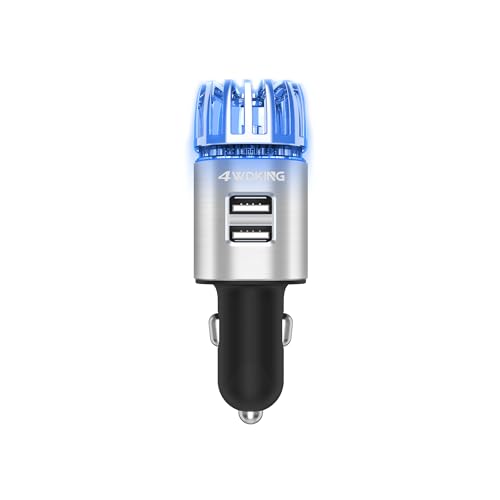
- Targets smoke and common odors
- Direct 12V plug-in installation
- Adds two 2.1A USB charging ports
Best For: Older cars with a 12V outlet and smoke-odor concerns
Smart Filtration Pick
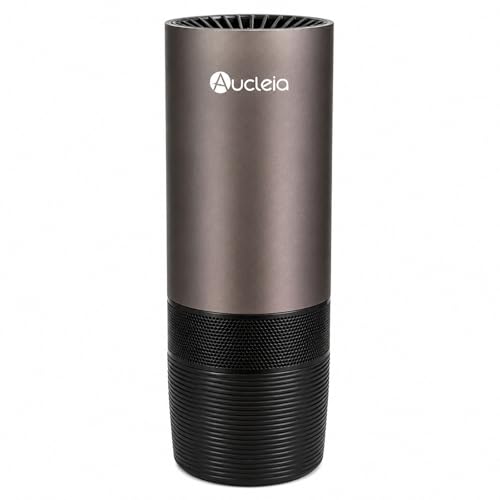
- Automatic VOC detection and fan adjustment
- H13 HEPA plus carbon-cotton filtration
- Three speeds with 22 dB operation
Best For: Drivers wanting automatic sensing and adjustable filtration
Filtered Everyday Pick

- H13 HEPA filtration
- Cup-holder and USB-powered design
- Quiet 22dB operation
Best For: Daily commuting with dust, pollen, smoke, or pet debris
Low-Maintenance Pick
Rechargeable Filterless Ion Air Cleaner

- Filterless and rechargeable
- Cup-holder base for vehicle use
- Quiet and portable across spaces
Best For: Cord-free everyday odor refreshing with minimal maintenance
Best Cordless Pick – PureZone Mini Portable Air Purifier
For older cars without convenient modern USB or accessory layouts, the PureZone Mini is a flexible choice among car air purifiers for older cars. Its rechargeable battery, compact design, and two-stage filtration make it practical for personal-space use during commutes or travel.
Best For: Drivers who want a lightweight, cordless purifier for personal air cleaning in the car.
Pros:
- Rechargeable battery lasts up to 12 hours on the low setting.
- Activated carbon pre-filter helps address odors, while the True HEPA filter captures dust, dander, pollen, mold spores, and smoke.
- Adjustable handle supports upright or sideways placement, and the handle can be removed.
- Offers three fan speeds and includes a five-year manufacturer’s warranty.
Cons:
- Designed for personal-space coverage rather than whole-car purification.
- Requires periodic USB charging when used away from an outlet.
The cordless design is especially useful in an older vehicle with limited or inconvenient power access. It is a sensible everyday option for nearby allergens and odors, though its small coverage area is best suited to the occupants’ immediate space.
Best for Deep Odor Treatment – 45,000 mg/h Ozone Generator
This ozone generator is a specialized odor-treatment device, not a running cabin purifier. For car air purifiers for older cars, it may help address persistent smoke, pet, or other strong odors, but it must be used only in an unoccupied vehicle and followed by ventilation.
Best For: Owners treating severe, embedded odors in an empty car between uses.
Pros:
- Produces a listed 45,000 mg/h ozone output for strong odor treatment.
- Designed for cars and other spaces including boats, basements, and pet areas.
- Does not require complex replacement parts beyond its pre-installed fuses.
Cons:
- Emits ozone and is a health hazard when people or pets are present.
- Requires cleaning the odor source first and ventilating for one hour after treatment.
- Not suitable for continuous in-car use while driving.
Consider this a periodic deodorizing tool rather than a passenger-safe air purifier. Its operating restrictions are significant, but it can be relevant when an older car has stubborn odors that ordinary filtration does not address.
Best Filtered Cabin Option – LUFTRUM H13 HEPA Car Purifier
The LUFTRUM C401A is a strong fit for drivers comparing car air purifiers for older cars and wanting filtered air rather than an odor-only device. Its four-stage system, automatic ignition behavior, and built-in PM2.5 sensor add useful everyday features for an older vehicle.
Best For: Drivers seeking a plug-in HEPA purifier for exhaust fumes, VOCs, smoke, and odors.
Pros:
- Four-stage filtration is designed for exhaust fumes, VOCs, toluene, formaldehyde, and odors.
- Automatic operation can turn the purifier on and off with the car engine ignition.
- Includes three fan speeds, a PM2.5 sensor, and a 3-meter power cord for flexible placement.
- Listed as ozone-free, CARB certified, and ETL certified.
Cons:
- Requires a vehicle power connection and is not cordless.
- The supplied dimensions and 2.2-pound weight make it less minimal than the smallest plug-in options.
Among these options, this is the most complete match for routine in-car filtration. It combines particle and gaseous-contaminant claims with convenient automatic operation, making it particularly appealing when an older car has noticeable exhaust or interior-material odors.
Best Space-Saving Plug-In – 12V Ionic Car Purifier with USB Charger
For an older car with limited cabin space, this 12V ionizer provides a compact way to address airborne particles and stale smells. It plugs into the vehicle socket and adds two USB charging ports, making it a practical accessory for drivers who want purification without placing a larger unit on a seat or console.
Best For: Drivers who prioritize a tiny 12V device and built-in phone or tablet charging.
Pros:
- Compact 40-gram design requires very little cabin space.
- Uses negative-ion technology for dust, pollen, smoke, mold spores, pet dander, and odors.
- Built-in dual USB ports provide 2.1A charging for compatible devices.
- Listed with CARB certification and a claimed ozone concentration of no more than 0.05 ppm.
Cons:
- Ionization causes particles to settle on nearby surfaces rather than filtering them into a replaceable HEPA filter.
- The notes indicate that odor improvement may take five to seven days of daily use.
- It occupies the 12V socket, although its USB ports provide charging.
This is a convenient, low-profile choice when space and socket utility matter most. Its ionizer approach differs from HEPA filtration, so buyers should expect gradual odor improvement and the need to keep cabin surfaces clean.
Cup-Holder HEPA Pick – Fragrance Car Air Purifier
For older cars that need a compact way to address dust and lingering smells, this cup-holder air purifier combines a true H13 HEPA filter with a built-in fragrance platform. Its USB-powered, 3-watt design is easy to place without blocking the driver’s view.
Best For: Drivers who want particle filtration plus optional essential-oil or perfume fragrance in a quiet, cup-holder-friendly unit.
Pros:
- H13 HEPA filtration is specified to retain particles as small as 0.3 micron.
- Built-in diffuser platform lets you add perfume oil or spray.
- Compact 2.8-inch design fits a car cup holder and operates at a listed 25 dB.
Cons:
- Requires a USB connection for power.
- The fragrance feature may not suit drivers who prefer unscented air.
- Replacement filter availability should be planned for after approximately six months, according to the product notes.
This is a practical choice among car air purifiers for older cars when you want a small HEPA unit that also freshens the cabin. Check that your vehicle has a convenient USB power source and that the cup holder accommodates its dimensions.
12V Odor-Fighting Pick – Dual-USB Ionic Purifier
This 12V plug-in ionizer is a straightforward option for older cars with a cigarette-lighter outlet. It is designed to run continuously in the background, target smoke and common odors, and add two USB charging ports without taking up much cabin space.
Best For: Drivers prioritizing cigarette-smoke and odor control, continuous operation, and convenient device charging.
Pros:
- Releases up to 5.6 million negative ions per cm³, according to the product notes.
- Targets cigarette smoke, dust, odors, pollen, and PM2.5-related particulate matter.
- Plugs directly into a 12V outlet and includes two 2.1A USB ports for charging.
- Compact 1.38-inch design operates at a listed 30 dB.
Cons:
- Uses ionic air purification rather than a replaceable HEPA filter.
- Produces a light ozone-like scent, which may not appeal to every user.
- Its fit depends on having an accessible 12V socket.
Among car air purifiers for older cars, this model stands out for simple 12V installation and built-in charging. It is best suited to odor-focused buyers who are comfortable with ionizer technology rather than seeking conventional filter-based purification.
Smart Filtration Pick – VOC-Sensing H13 Purifier
For older cars where cabin odors, smoke, and dust are recurring concerns, this compact purifier adds H13 HEPA and carbon-cotton filtration with automatic VOC detection. Its three fan speeds and cup-holder form make it a flexible option for daily driving and travel.
Best For: Drivers who want automatic VOC sensing, multi-layer filtration, and adjustable airflow in a premium metal-bodied unit.
Pros:
- Combines H13 HEPA and carbon-cotton filters for smoke, odors, dust, pet dander, and pollen.
- Built-in VOC detection automatically adjusts fan speed, according to the product notes.
- Offers three fan speeds and a listed 22 dB quiet operating level.
- Aluminum-alloy construction is designed for heat dissipation in hot cars.
Cons:
- At 7.8 inches tall and 1.5 pounds, it is larger and heavier than some compact car units.
- Only the KQ-11 replacement filter is compatible, according to the notes.
- Uses a data cable and requires a suitable power connection.
This is one of the more feature-rich car air purifiers for older cars, especially for buyers who want automatic adjustment instead of constant manual control. Confirm its height fits your cup holder and check ongoing KQ-11 filter availability before buying.
Odor-Focused Pick – Timeage 2-in-1 Ozone and Ionizer
For older cars with persistent cigarette smoke, pet odors, or stale air, this compact Timeage unit combines an ozone generator with a negative-ion mode. It is a filterless, rechargeable option, but its ozone settings require careful use only when the vehicle is unoccupied.
Best For: Drivers who need intensive odor treatment for an empty car and a separate ionizer mode for everyday use.
Pros:
- Combines ozone deodorization with negative-ion air cleaning.
- Rechargeable 10,000mAh battery supports portable, cord-free use.
- Compact design and several operating modes, including a quiet mode.
Cons:
- Ozone modes must be used only in an unoccupied, closed vehicle.
- It has no replaceable particle filter.
- Ozone treatment is intended for short-term, high-intensity deodorization rather than occupied driving.
The Timeage is most useful as an occasional odor-treatment tool for older interiors, especially when strong smells are the main concern. Choose its ionizer mode for occupied spaces and reserve ozone modes for carefully controlled treatments.
Filtered Everyday Pick – Aucleia H13 HEPA Car Purifier
The Aucleia is a practical choice among car air purifiers for older cars when you want actual particle filtration for dust, pollen, smoke, and pet debris. Its cup-holder design, USB power, and automatic operation make it suited to regular commuting.
Best For: Older-car owners who prioritize filtered air, low noise, and routine protection from dust, pollen, smoke, and pet-related particles.
Pros:
- True H13 HEPA filter is rated to capture 99.97% of 0.3-micron particles.
- Fits standard cup holders and can turn on or off automatically with the car.
- Quiet 22dB operation with three adjustable cleaning modes.
- Includes an aromatherapy pad and filter-replacement indicator.
Cons:
- Requires USB/DC power rather than operating solely on an internal battery.
- The filter needs replacement after the indicator signals maintenance.
- Its small cabin-focused design is less suited to larger spaces.
For everyday driving, the Aucleia offers the clearest maintenance-based approach of these options: trap airborne particles with a HEPA filter and monitor replacement timing. It is a strong fit when filtration matters more than filterless convenience.
Low-Maintenance Pick – Rechargeable Filterless Ion Air Cleaner
This rechargeable, filterless purifier suits older cars where convenience and odor management are priorities. It can sit in a cup holder, run quietly, and move between a vehicle, RV, desk, or bedside table without requiring replacement filters.
Best For: People wanting a portable, low-maintenance air refresher for car odors, smoke, dust, and pollen.
Pros:
- Filterless design avoids routine filter replacement.
- Rechargeable battery enables cord-free use and operation while charging.
- Offers quiet negative-ion operation plus 15- and 30-minute intensive modes.
- Includes a cup-holder base for greater stability in a vehicle.
Cons:
- It does not provide replaceable HEPA filtration.
- Intensive refresh modes should be used only in an unoccupied space with doors and windows closed.
- Coverage and performance claims are not a substitute for removing odor sources or cleaning the vehicle interior.
The main appeal is easy, flexible use: charge it, place it securely, and move it wherever needed. It is best viewed as a low-maintenance ion air cleaner and odor refresher rather than a conventional particulate filter.
How We Picked the Best Car Air Purifiers for Older Cars
We evaluated these models by focusing on the needs that commonly come with aging vehicles: lingering smoke and food odors, accumulated dust, pet dander, exhaust concerns, limited cabin space, and inconsistent factory filtration. We also considered filter type, portability, power options, controls, claimed coverage, charging convenience, and replacement-part requirements.
Because product technologies work differently, this list includes both particle-focused HEPA purifiers and odor-focused ionizing or ozone devices. Claims such as “99.97% filtration” generally refer to specific particle sizes under controlled conditions, not total removal of every odor or gas inside a moving vehicle.
Quick Comparison
- Best for dust and allergens: Choose a true HEPA or H13 HEPA model.
- Best for smoke and persistent odors: Look for a purifier with odor-control media, while checking whether it produces ions or ozone.
- Best for portability: Cordless and rechargeable models can move between vehicles and other small spaces.
- Best for simple installation: 12V plug-in units are convenient, but they occupy a power socket.
- Best for heavy odor treatment: Ozone generators are intended for unoccupied treatment only, not continuous use while people or pets are inside.
Key Buying Factors for Car Air Purifiers for Older Cars
Filtration Technology
HEPA filters physically capture airborne particles such as dust, pollen, and some fine particulate matter. H13 models are often marketed as a higher-grade option, but real-world performance also depends on airflow, sealing, and filter size. Ionizers may reduce airborne particles by electrically charging them, though they do not replace a mechanical filter and can produce byproducts depending on design.
Odor and VOC Control
Odors from upholstery, tobacco, mildew, and older plastics can be difficult to remove with particle filtration alone. Activated carbon or another gas-adsorbing material is more relevant for many smells and volatile compounds. Ozone machines require particular caution: never operate one with occupants or animals present, and ventilate the vehicle thoroughly afterward according to the manufacturer’s instructions.
Power, Size, and Upkeep
Check whether the purifier uses USB, a 12V outlet, a built-in battery, or a combination. Measure the intended placement so it does not block visibility, vents, controls, or airbags. Filter-based units need periodic replacement, while filterless models may require cleaning of collection plates or other components.
Who Should Buy Which Car Air Purifiers for Older Cars?
Drivers mainly concerned about dust, pollen, or pet dander should start with a compact true HEPA or H13 model. Drivers dealing with smoke or embedded cabin odors should prioritize carbon-assisted filtration and sensible ventilation, using ozone only as an unoccupied treatment tool. Choose a rechargeable purifier if you switch vehicles or want cordless placement; choose a 12V model for straightforward daily use. For older cars with limited outlets, a USB-powered unit or model with dual charging ports may be the most practical fit.