
The right car ramps can make routine maintenance easier by creating working room beneath your vehicle without requiring a full-size lift. However, ramp height, weight capacity, traction, and vehicle clearance all matter.
This roundup compares 10 options for different garage setups and vehicle types, from portable plastic ramps to heavy-duty steel and extendable designs. Check your vehicle weight, tire width, and approach clearance before buying.
Best 10 Car Ramps Picks for 2026
Heavy-Duty Pick
MaxxHaul 50515 6.25-Inch Lift Car Ramps

- 6.25-inch lift for underbody access
- 6,500-pound capacity per pair
- Ridged surface and rubber base stops
Best For: Routine maintenance on vehicles within the rated capacity
High-Capacity Choice

- 12,000-pound capacity per pair
- High-impact, corrosion-resistant poly construction
- Non-skid tread and rubber feet
Best For: Trucks, SUVs, vans, and heavier vehicles
Low-Car Specialist
Race Ramps Two-Piece Service Ramps

- Gradual 6.8-degree approach
- 8-inch lift for low-profile cars
- Lightweight foam construction with carrying straps
Best For: Low cars and display or garage use
Most Flexible Design
MaxxHaul 50709 Detachable Extendable Car Ramps

- Detachable sections improve underbody access
- Extensions can increase ramp length
- 6,500-pound capacity per matched pair
Best For: Portable, adjustable setups on hard, level surfaces
Heavy-Duty Plastic Pick

- 12,000-pound total capacity
- 6.7-inch lift with 17-degree incline
- Anti-slip base and portable plastic build
Best For: Home-garage maintenance on vehicles with tires up to 9 inches wide
Storage-Friendly Choice
Stackable 6.7-Inch Vehicle Ramps

- 6,500-pound capacity per pair
- Stackable polypropylene construction
- Handles and ribbed surface aid usability
Best For: DIY maintenance where compact storage and portability matter
Steel Heavy-Duty Pick

- 8,000-pound total capacity
- Solid steel construction with 8-inch lift
- Anti-slip design for car, truck, and SUV service
Best For: Maintenance tasks requiring extra clearance and a steel ramp build
Best Overall
Amazon Basics Low Profile Car Ramps
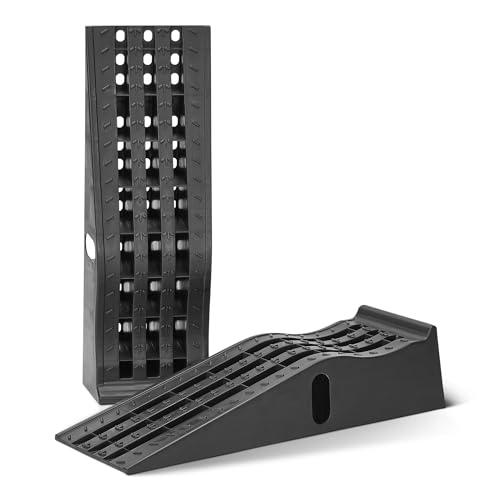
- 3,250-lb capacity per ramp
- Textured traction surface
- Lightweight reinforced plastic design
Best For: Routine home-garage maintenance
Best Simple Pick
Florety 20,000-Lb Vehicle Ramps

- 20,000-lb stated capacity
- 5.5-inch lift height
- Built-in handles and serrated bases
Best For: Trucks, SUVs, RVs, and tandem-axle trailers
Best Adjustable Option

- Adjusts from 11.61 to 16.21 inches
- 5-ton stated capacity
- Includes hydraulic jack
Best For: Repairs needing variable undercarriage clearance
Heavy-Duty Pick – MaxxHaul 50515 6.25-Inch Lift Car Ramps
These car ramps offer a practical balance of lift, traction, and capacity for routine vehicle maintenance. The 6.25-inch lift provides useful underbody access, while the ridged surface and rubber base stops help support a steady setup.
Best For: Oil changes, inspections, and repairs on cars, trucks, and other vehicles within the rated capacity.
Pros:
- Supports up to 6,500 pounds per pair, with a 3,250-pound rating per ramp.
- Provides a 6.25-inch lift for underbody access.
- Ridged traction surface and rubber stops help reduce slipping.
- Heavy-duty plastic construction is sturdy while remaining portable at 20.1 pounds per pair.
Cons:
- The 90-day manufacturer warranty is relatively short.
- The pair capacity is lower than some heavy-duty alternatives.
The MaxxHaul 50515 is a straightforward choice when you want dependable car ramps for common maintenance tasks without moving to a more specialized design.
High-Capacity Choice – Ironton Poly Car Ramp Set
For shoppers comparing high-capacity car ramps, this Ironton set stands out with a 12,000-pound gross vehicle weight rating. Its high-impact poly construction keeps the pair relatively light, while the tread pattern and rubber feet support confident positioning.
Best For: Cars, trucks, SUVs, and vans, including 3/4-ton and 1-ton trucks, when used within the stated capacity.
Pros:
- Rated for 6,000 pounds per ramp and 12,000 pounds per pair.
- High-impact poly construction is corrosion-resistant and weighs 20.6 pounds per pair.
- Non-skid tread helps keep tires firmly positioned.
- Rubber feet help prevent shifting on suitable surfaces.
Cons:
- The 8.5-inch height may provide more lift than some low-clearance jobs require.
- Use requires a suitable surface and careful positioning, as with any vehicle ramp.
With its unusually high stated capacity and broad vehicle compatibility, the Ironton set is a strong option for buyers who prioritize load rating and versatility.
Low-Car Specialist – Race Ramps Two-Piece Service Ramps
These Race Ramps are designed for low cars that may be difficult to approach with steeper car ramps. The long, lightweight foam design creates a gradual incline, while the traction coating helps provide a stable, floor-friendly setup.
Best For: Low-profile cars, home garages, showrooms, and car shows where a gradual approach and easy transport matter.
Pros:
- Long ramp design eases the initial approach with a listed 6.8-degree incline.
- Provides an 8-inch lift and supports up to 1,500 pounds per ramp.
- High-density foam with polyurea coating is lightweight at 10 pounds per ramp.
- Carrying straps make transport and storage easier.
Cons:
- The 1,500-pound-per-ramp capacity is much lower than heavy-duty poly ramp options.
- Its specialized low-car design may be unnecessary for taller vehicles.
Choose the Race Ramps when approach angle and portability are more important than maximum load capacity. Verify your vehicle’s tire load and ramp requirements before use.
Most Flexible Design – MaxxHaul 50709 Detachable Extendable Car Ramps
These MaxxHaul car ramps are built for shoppers who want more setup flexibility. Their detachable sections can open up space beneath a vehicle, while the compatible extendable design and built-in handles make positioning and storage more convenient.
Best For: Drivers who need a portable, adjustable ramp setup for vehicles within the 6,500-pound pair capacity.
Pros:
- Detachable sections can help free space beneath the vehicle.
- Compatible with separately sold extensions for a longer ramp configuration.
- Supports 3,250 pounds per ramp and 6,500 pounds per matched pair.
- Built-in handles simplify carrying, positioning, and storage.
Cons:
- Extensions are sold separately.
- Must be used on a hard, level, stable surface; loose or sloped surfaces are not suitable.
- The 90-day manufacturer warranty is short.
The MaxxHaul 50709 makes the most sense when detachable sections and future length flexibility are priorities. Its surface restrictions require more setup discipline than a general-purpose garage ramp.
Heavy-Duty Plastic Pick – Portable 6.7-Inch Car Ramps
These car ramps are a practical option for home-garage maintenance when you want substantial capacity without the weight of steel. The plastic pair supports up to 12,000 pounds total and provides 6.7 inches of lift for oil changes, tire work, and other routine tasks.
Best For: Drivers seeking portable, high-capacity ramps for vehicles with tires up to 9 inches wide.
Pros:
- Supports up to 12,000 pounds total.
- High-strength plastic construction keeps the ramps portable.
- Anti-slip bases and a 17-degree incline help provide stable, smooth positioning.
- Offers 6.7 inches of clearance for maintenance access.
Cons:
- The stated tire-width limit is 9 inches or less.
- Plastic construction may not appeal to shoppers specifically seeking steel ramps.
With its unusually high stated capacity, anti-slip base, and low-profile approach, this pair is well suited to routine vehicle service. Confirm your tire width and vehicle loading requirements before use.
Storage-Friendly Choice – Stackable 6.7-Inch Vehicle Ramps
MaxxHaul 50947 Lift Stackable Vehicle Car Ramp 6500 LBS Capacity Per Pair 3250 LBS Per Ramp 2 Pack
Check Price On AmazonFor shoppers comparing car ramps with storage and portability in mind, the MaxxHaul 50947 offers a stackable polypropylene design and 6.7 inches of lift. The pair is rated for 6,500 pounds total, making it suited to a range of routine vehicle maintenance jobs.
Best For: DIY mechanics and automotive enthusiasts who want stackable ramps that are easier to transport and store.
Pros:
- Rated for 6,500 pounds per pair, or 3,250 pounds per ramp.
- Stackable design helps simplify storage and transportation.
- Built-in side handles improve portability.
- Ribbed platform surface provides increased traction.
Cons:
- Its 6,500-pound pair capacity is lower than some higher-capacity options.
- The 6.7-inch lift may provide less clearance than taller ramps.
This is a convenient middle-ground choice: the polypropylene construction and handles make it manageable, while the stackable format is useful when garage space is limited. Check the per-ramp and combined capacity against your vehicle before buying.
Steel Heavy-Duty Pick – 8-Inch Car and Truck Ramps
These solid-steel car ramps are designed for shoppers who prioritize a taller lift and metal construction. The two-ramp set provides 8 inches of working height and is rated for up to 8,000 pounds total for maintenance on cars, trucks, and SUVs.
Best For: Home garages or repair spaces needing steel ramps with extra clearance for oil changes, inspections, and general service.
Pros:
- Solid alloy-steel construction supports up to 8,000 pounds total.
- Eight-inch lift creates more working space underneath the vehicle.
- Anti-slip structure is designed to improve stability.
- Black coating helps resist rust and wear for indoor or outdoor use.
Cons:
- At 32.7 pounds per set, it is heavier than the plastic alternatives.
- The stated capacity is 2,000 pounds per ramp, so loading requirements should be checked carefully.
Choose this pair when the added clearance and steel construction are more important than minimizing weight. Its broad vehicle compatibility and protective coating make it a versatile option for recurring maintenance.
Best Overall – Amazon Basics Low Profile Car Ramps
For routine oil changes and home-garage work, these car ramps offer a practical balance of capacity, traction, and manageable weight. Each ramp supports up to 3,250 pounds, while the 8.07-inch height and textured surface help provide stable vehicle access on solid, level surfaces.
Best For: DIY oil changes, underbody access, and general maintenance on compatible vehicles.
Pros:
- Supports up to 3,250 pounds per ramp, or 6,500 pounds per pair.
- Rubber base stops, anti-slip features, and a textured traction surface promote stable positioning.
- Reinforced plastic construction keeps each ramp relatively lightweight at 9.24 pounds.
Cons:
- Designed specifically for solid, level surfaces.
- The fixed 8.07-inch height is less adjustable than a hydraulic ramp.
These are a sensible choice when you want straightforward, portable car ramps for common garage maintenance. Check your vehicle’s weight and approach clearance before use.
Best Simple Pick – Florety 20,000-Lb Vehicle Ramps
These heavy-duty car ramps are built for larger vehicles and tandem-wheel applications, with a stated 20,000-pound load capacity. Their 5.5-inch lift, textured concave surface, serrated underside, and built-in handle make them geared toward portable service work.
Best For: Trucks, SUVs, RVs, campers, and tandem-axle trailers needing moderate undercarriage clearance.
Pros:
- Rated for up to 20,000 pounds.
- Provides 5.5 inches of lift for tasks such as oil changes and inspections.
- Wear-resistant PP construction is designed to resist sun, rain, and temperature changes.
- Built-in handles and serrated bottoms support portability and ground grip.
Cons:
- The 5.5-inch lift may provide less clearance than taller hydraulic ramps.
- The listed manufacturer warranty is 90 days from purchase.
Choose this pair when high stated capacity matters more than maximum lift height. As with any ramp, verify the vehicle, tire, and surface compatibility before loading.
Best Adjustable Option – Garvee Hydraulic Car Ramps
For maintenance jobs that benefit from variable clearance, these hydraulic car ramps pair dual hydraulic cylinders with a hydraulic jack. The height adjusts from 11.61 to 16.21 inches, and the 9.5-inch-wide platforms are intended for cars, trucks, and trailers in home or professional garages.
Best For: Vehicle repairs and inspections requiring adjustable undercarriage access.
Pros:
- Supports up to 5 tons, with the listing also stating an 11,000-pound capacity.
- Hydraulic adjustment provides a height range from 11.61 to 16.21 inches.
- Includes two ramps and a hydraulic jack for a flexible maintenance setup.
- Compact design is intended to fit tight garage spaces.
Cons:
- At 83.8 pounds, this set is substantially heavier than basic plastic ramps.
- The hydraulic system adds complexity compared with fixed-height ramps.
This is the most adaptable option of the three when changing lift height is important. Its greater weight and hydraulic design make it better suited to a dedicated garage workspace than quick portable use.
How We Picked These Car Ramps
We focused on ramps suited to common home-garage tasks such as oil changes, inspections, underbody cleaning, and light repairs. The selection represents several construction types and lift heights, including plastic, steel, low-profile, stackable, extendable, and hydraulic designs.
We also considered advertised load capacity, traction features, portability, storage convenience, and compatibility with cars, SUVs, trucks, trailers, and RVs. Capacity ratings should be treated as a starting point: always confirm the manufacturer’s instructions and use the pair on a firm, level surface.
Quick Comparison
| Best For | What to Look For |
|---|---|
| Low-clearance sports cars | Gentle approach angle and low-profile design |
| Routine oil changes | Stable traction surface and a practical lift height |
| Trucks and heavier vehicles | High verified capacity and wide tire support |
| Limited garage storage | Lightweight, stackable, or detachable construction |
| Flexible working height | Extendable or hydraulic adjustment |
Key Buying Factors for Car Ramps
Weight Capacity
Compare the ramp rating with your vehicle’s loaded weight, not just its curb weight. A pair rating may be stated for both ramps together, while some products list capacity per ramp. Leave a meaningful safety margin and never exceed the manufacturer’s limit.
Lift Height and Approach Angle
More height can provide useful access, but a steep ramp may contact a low bumper, splitter, or undercarriage. Low-profile models are generally easier to approach, while taller ramps may better suit trucks and jobs requiring additional clearance.
Surface, Width, and Stability
Look for molded grooves, textured traction, or another slip-resistant surface. The ramp should comfortably support the tire’s width and remain stable as the vehicle climbs. Chock the wheels that stay on the ground and follow all included safety instructions.
Material and Storage
Plastic ramps are often easier to carry and resist corrosion, while steel ramps can offer a rigid, heavy-duty feel at the cost of greater weight. Stackable, detachable, and portable designs are useful when floor space is limited.
Who Should Buy Which Car Ramps?
Choose a low-profile ramp if you drive a sports car, sedan, or another vehicle with limited ground clearance. Choose a heavy-duty steel or high-capacity ramp for trucks, larger SUVs, trailers, or frequent service work. Choose a lightweight plastic model for occasional maintenance and easy storage.
An extendable or hydraulic option makes sense when you want more setup flexibility or adjustable working height, but these designs may cost more and require closer attention to locking and positioning. For basic home maintenance, prioritize a secure fit, adequate capacity, and a manageable lift height over maximum elevation.