
A weak battery can look like a starter or charging problem. A good tester helps you check battery health, cranking performance, and charging behavior before recommending a repair.
These 10 options cover everyday 12V service, mixed-voltage work, and features such as wider CCA ranges and shareable reports. The right choice depends on what comes through your bay and how you document the results.
Best 10 Battery Testers for Mechanics Picks for 2026
Best for 12V/24V Shop Testing
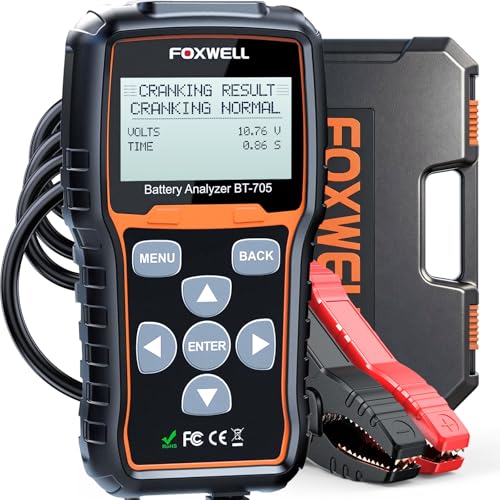
- Tests 12V/24V battery, cranking, and charging systems
- 5.9-foot cable supports solo cranking checks
- Includes a hard carrying case
Best For: Shops servicing mixed 12V and 24V lead-acid vehicles
Best for Shareable Test Reports
ACCLOPE BT60 PRO Battery Tester
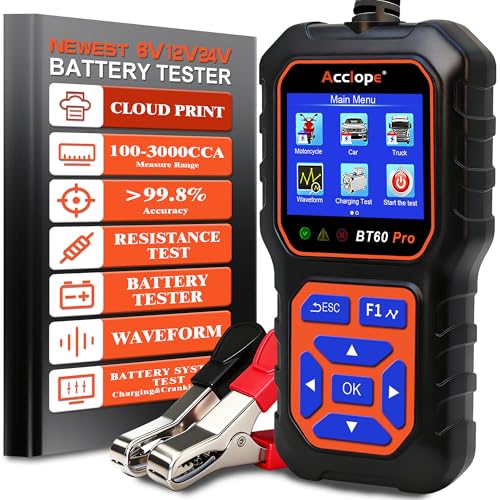
- Tests supported 6V, 12V, and 24V lead-acid batteries
- QR reports open in a phone browser without an app
- LiFePO4 CCA accuracy is not guaranteed
Best For: Service providers needing shareable battery-test records
Best for Broad Lead-Acid CCA Coverage

- Supports 6V, 12V, and 24V lead-acid batteries
- Stated testing range spans 5–3000 CCA
- Adds cranking and charging-system checks
Best For: Mixed-vehicle garages testing compatible lead-acid batteries
Best for Solo 12V Checks

- Checks 12V battery, cranking, and charging systems
- 6.5-foot cable helps with one-person testing
- Color screen shows clear battery-condition results
Best For: Solo testing of compatible 12V lead-acid vehicles
Best for 12V Diagnostics

- Battery, cranking, and charging tests
- Backlit, adjustable-contrast display
- 12V lead-acid only; 100–2000 CCA
Best For: Routine 12V battery diagnostics
Best Glove-Box Option

- Battery, cranking, and charging checks
- Compact body with three-color LEDs
- Supports 12V, 100–2000 CCA batteries
Best For: Portable checks on common 12V vehicles
Best for Multiple Voltages

- Tests 6V, 12V, and 24V batteries
- Shows SOH, SOC, and internal resistance
- Not suitable for deep-cycle batteries
Best For: Battery-condition checks across multiple voltages
Best for Mixed Fleets
TOPDON BT200 12V/24V Battery Tester

- Tests 12V/24V batteries from 100–2000 CCA
- Checks battery, cranking, and charging systems
- Color screen and last-test memory
Best For: Mechanics servicing both 12V and 24V vehicles
Best Compact 12V Option

- Tests 12V batteries from 100–2000 CCA
- Checks starter cranking and alternator charging
- Compact and usable in or out of the vehicle
Best For: Mechanics focused on 12V diagnostics
Best for Printed Results

- Built-in thermal printer for test receipts
- Tests 12V battery health from 100–2000 CCA
- Checks 12V/24V cranking and charging systems
Best For: Shops that need printed diagnostic records
Best for 12V/24V Shop Testing – FOXWELL BT705 Battery Tester
Among battery testers for mechanics, the FOXWELL BT705 suits shops that service both 12V and 24V vehicles. It checks battery health, cranking performance, and charging output, with guided prompts and straightforward GOOD, RECHARGE, or REPLACE results.
Best For: Mechanics maintaining cars, trucks, RVs, or fleet vehicles with 12V and 24V lead-acid batteries.
Pros:
- Supports 100–2000 CCA Flooded, AGM, GEL, and EFB batteries.
- 5.9-foot cable helps one person view cranking results from the driver’s seat.
- Includes durable clamps, protective housing, and a hard carrying case.
Cons:
- Not specified for 6V or lithium batteries.
- Its 100–2000 CCA range may not suit batteries outside those ratings.
Choose the BT705 when dual-voltage coverage and a longer test cable matter more than 6V capability. Its guided screen also makes results easier to communicate during routine service.
Best for Shareable Test Reports – ACCLOPE BT60 PRO Battery Tester
The ACCLOPE BT60 PRO stands out among battery testers for mechanics who need to share results with customers. Its QR-based cloud printing lets you open a test report in a phone browser, then save, print, or share it without an app.
Best For: Service providers testing 6V, 12V, and 24V batteries who want shareable records.
Pros:
- Checks SOH, SOC, voltage, resistance, and CCA on supported lead-acid batteries.
- Dedicated 6V motorcycle mode adds flexibility alongside 12V and 24V testing.
- 3.2-inch screen and QR reports make results easier to review and share.
Cons:
- LiFePO4 checks are limited to voltage and health; precise CCA measurement is not guaranteed.
- Does not support 48V systems or read and clear OBD2 trouble codes.
This is the reporting-focused pick of the group. Select it for varied battery voltages and customer-facing documentation, but use its lead-acid modes when CCA readings are essential.
Best for Broad Lead-Acid CCA Coverage – VDIAGTOOL BT500
For mechanics working across motorcycles, cars, and trucks, the VDIAGTOOL BT500 covers 6V, 12V, and 24V lead-acid batteries with a stated 5–3000 CCA range. It also checks cranking and charging systems to help narrow down starting problems.
Best For: Mechanics who need broad stated CCA coverage across compatible lead-acid vehicle batteries.
Pros:
- Reports voltage, resistance, state of health, and state of charge.
- Tests starting and alternator charging performance as well as the battery.
- Includes a dedicated 6V motorcycle mode and reverse-polarity and short-circuit protections.
Cons:
- Not suitable for lithium, deep-cycle, or golf-cart batteries.
- Accurate results depend on entering the correct battery type, standard, and CCA rating.
Its wide stated range makes the BT500 a practical option for mixed-vehicle garages. Check battery compatibility first, particularly for non-automotive or deep-cycle applications.
Best for Solo 12V Checks – FOXWELL BT301 Battery Tester
Among battery testers for mechanics focused on 12V vehicles, the FOXWELL BT301 offers an especially useful 6.5-foot cable. You can keep its clamps under the hood while moving the screen closer to the driver’s seat for cranking checks.
Best For: Solo battery, starting, and charging checks on compatible 12V lead-acid vehicles.
Pros:
- Displays SOH, SOC, CCA, voltage, and internal resistance with clear condition results.
- Tests 100–2000 CCA Flooded, AGM, EFB, and GEL 12V batteries.
- 2.8-inch color screen and long cable simplify one-person testing.
Cons:
- Designed for 12V battery testing rather than 24V systems.
- Not designed for lithium batteries.
Pick the BT301 if 12V lead-acid coverage meets your needs and convenient solo testing takes priority. Mechanics regularly servicing 24V vehicles should consider a dual-voltage model instead.
Best for 12V Diagnostics – ANCEL BA101
For mechanics comparing battery testers for mechanics, the ANCEL BA101 covers 12V battery health, cranking, and charging checks in one handheld tool. It supports 100–2000 CCA batteries and displays state of health, state of charge, voltage, and CCA.
Best For: Shops and home garages that work mainly on 12V lead-acid vehicle batteries.
Pros:
- Tests flooded, AGM, GEL, and EFB batteries across multiple rating standards.
- Backlit display with adjustable contrast helps in varied lighting.
- Battery-powered operation requires no separate charging or internal batteries.
- Includes reverse-polarity, short-circuit, overcurrent, and overvoltage protection.
Cons:
- Does not support 6V, 24V, or lithium batteries.
- Not intended for motorcycles with batteries below 30Ah.
The BA101 is a practical pick if its 12V-only range matches your workload. Enter the battery type, rating, and temperature from the label to get the most useful results.
Best Glove-Box Option – TOPDON BT100
The compact TOPDON BT100 suits buyers looking at battery testers for mechanics who want a tool they can keep close at hand. It checks 12V battery health, cranking performance, and the charging system, with readings for state of health, state of charge, voltage, and rating.
Best For: Mechanics and DIY users who want a compact tester for common 12V vehicles.
Pros:
- Supports 100–2000 CCA flooded, AGM, EFB, and GEL batteries.
- Three-color LEDs and menu controls make results straightforward to review.
- Small enough to store in a glove box or center console.
- Copper clamps include reverse-polarity prevention and spark-proof features.
Cons:
- Limited to 12V lead-acid battery testing.
- Must be properly connected to a battery to power on.
The BT100 offers the core tests in an easy-to-store package. Choose it if portability matters more than support for other battery voltages.
Best for Multiple Voltages – KINGBOLEN BM550
Among battery testers for mechanics, the KINGBOLEN BM550 stands out for supporting 6V, 12V, and 24V batteries. It reports state of health, state of charge, CCA, internal resistance, and voltage on a 1.8-inch screen.
Best For: Mechanics who need battery-condition checks across 6V, 12V, and 24V systems.
Pros:
- Supports 100–2000 CCA flooded, AGM, GEL, and EFB batteries.
- Works with batteries in or out of a vehicle.
- Displays battery condition and internal resistance.
- Reverse-connection protection prevents operation if clamps are reversed.
Cons:
- Not suitable for deep-cycle batteries.
- The supplied features do not specify cranking or charging-system tests.
The BM550 is the more flexible voltage choice here for battery-condition testing. Check your battery’s CCA rating before use, since the tester requires that value to be entered.
Best for Mixed Fleets – TOPDON BT200 12V/24V Battery Tester
For mechanics checking batteries across different vehicles, the TOPDON BT200 is a versatile choice among battery testers for mechanics. It tests 12V and 24V batteries rated from 100 to 2000 CCA and also checks cranking and charging systems.
Best For: Mechanics who need one tester for 12V and 24V batteries across cars, trucks, RVs, and other equipment.
Pros:
- Supports flooded, AGM, GEL, and deep-cycle batteries.
- Runs battery health, cranking, and charging-system tests.
- Has a 2.4-inch color display and recalls the last test.
Cons:
- No built-in printer for handing customers a test receipt.
The BT200 makes sense if 24V battery testing matters as much as everyday 12V work. Its color screen and last-test memory are useful at the vehicle, while shops that need printed results should consider a printer-equipped model.
Best Compact 12V Option – KONNWEI KW208 Battery Tester
The KONNWEI KW208 is a compact option among battery testers for mechanics whose work is limited to 12V systems. It checks 100–2000 CCA batteries and provides battery-condition readings alongside starter-cranking and alternator-charging tests.
Best For: Mechanics who want a small, straightforward tester for 12V batteries and starting or charging checks.
Pros:
- Reports voltage, internal resistance, CCA, health, and charge status.
- Tests batteries in or out of the vehicle.
- Supports flooded, AGM flat-plate, AGM spiral, and gel batteries.
Cons:
- Does not support 24V battery testing.
- No built-in printer for test receipts.
Choose the KW208 if you need the core checks in a unit small enough to keep in a glove box or garage. Its 12V-only scope is the main reason to look elsewhere for mixed-voltage vehicle work.
Best for Printed Results – TOPDON BT300P Battery Tester
For shops that want a paper record of each check, the TOPDON BT300P stands out among battery testers for mechanics. Its built-in thermal printer produces diagnostic receipts, while the tester checks 12V battery health and 12V/24V cranking and charging systems.
Best For: Mechanics who need printed battery-test results for customers or service records.
Pros:
- Prints results using standard thermal paper, with no ink or ribbon required.
- Tests 12V flooded, AGM, gel, and EFB batteries rated 100–2000 CCA.
- Includes a 2.4-inch color screen and reverse-polarity protection.
Cons:
- Battery-health testing is limited to 12V batteries; 24V support applies to cranking and charging tests.
- Printed receipts require replacement thermal paper.
The BT300P is the practical pick when a documented result matters. Check its voltage distinction before buying: it supports 24V starting and charging diagnostics, but its battery-health test is for 12V batteries.
How We Picked These Battery Testers for Mechanics
We focused on practical shop needs: supported battery voltages, stated CCA ranges, cranking and charging checks, screen usability, and whether results can be shared with customers. The lineup includes simple 12V tools as well as models listed for 6V and/or 24V systems. Listed specifications are a starting point, not proof of measurement accuracy or durability; confirm battery-type support and operating limits in the current manual before buying.
Quick Comparison: Match the Tester to the Job
For routine passenger-car service, a 12V-focused option such as the ANCEL BA101, TOPDON BT100, KONNWEI KW208, or FOXWELL BT301 may cover the core workflow. If your shop also handles 24V systems, compare the FOXWELL BT705, TOPDON BT200, TOPDON BT300P, KINGBOLEN BM550, VDIAGTOOL BT500, and BT60 PRO. For 6V work, look first at the models explicitly listed with 6V support: BT60 PRO, VDIAGTOOL BT500, and KINGBOLEN BM550.
If customer documentation matters, the BT60 PRO’s listed QR report is worth investigating. If on-tool readability is the priority, consider the FOXWELL BT301’s listed 2.8-inch color screen. Verify the exact functions on the listing you purchase, since voltage support alone does not tell you which tests work at each voltage.
Key Buying Factors for Battery Testers for Mechanics
Vehicle and Battery Compatibility
Start with the systems you actually service: 12V cars, 24V vehicles, or occasional 6V batteries. Then check support for the battery chemistries and constructions you encounter, such as flooded lead-acid, AGM, and gel. Do not assume a tester supports lithium batteries or every battery type at every voltage unless its documentation says so.
Rating Range and Test Workflow
Make sure the stated CCA range covers your customers’ batteries. A tester that reads battery condition and also checks cranking and charging can reduce tool changes during diagnosis, but these are distinct tests. Check whether the tool requires you to enter the battery’s rated standard and value, and whether its menu makes that step easy to repeat accurately.
Results You Can Use
Readable results help at the vehicle; saved or shareable results help at the counter. Decide whether a clear screen is sufficient or whether your shop needs a report for estimates and records. Also consider lead reach, clamp access, and how readily a technician can use the tool around an installed battery.
Who Should Buy Which Battery Testers for Mechanics?
Choose a straightforward 12V model if you mainly service passenger vehicles and want quick battery, starting, and charging checks. Choose a 12V/24V model if those vehicles regularly share your bays. Prioritize explicit 6V support for restoration or specialty work, and reporting features if you routinely show customers test results. Whatever you choose, confirm its supported battery types and test modes against your workload before treating it as your shop’s primary diagnostic tool.