
A five-channel amplifier can power four cabin speakers and a subwoofer from one chassis, simplifying an upgrade that would otherwise need multiple amps. The best choice is not necessarily the one with the biggest advertised wattage—it is the one that matches your speakers, sub, wiring, and available space.
These 10 picks span compact everyday options and higher-output models. Use the buying guide below to narrow them down by usable power, impedance, controls, and installation demands.
Best 10 5 Channel Car Amplifiers Picks for 2026
High-Power Subwoofer Pick

- 1-ohm-stable mono channel
- 140W x 4 plus 600W x 1 at 4 ohms
- Remote bass knob included
Best For: Subwoofer-focused builds needing 1-ohm flexibility
Marine-Ready Pick

- Conformal-coated circuit board
- Up to 125W x 4 plus 600W x 1 at 2 ohms
- 5-, 4-, or 2-channel operation
Best For: Flexible installs needing marine-oriented construction
Factory-Stereo Integration Pick
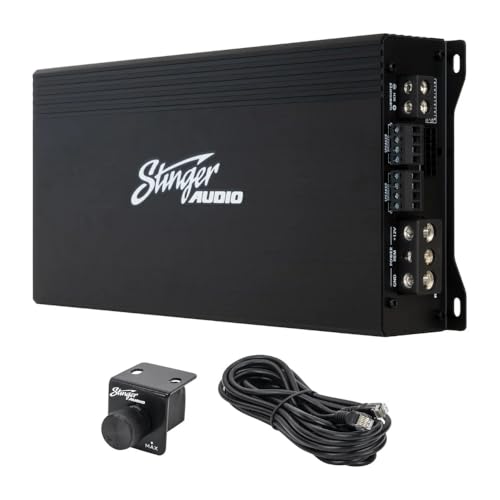
- High- or low-level input options
- Subwoofer channel rated up to 700W at 1 ohm
- Remote bass knob with mounting options
Best For: Factory-stereo upgrades needing speaker-level input
Monitoring-Focused Pick

- Built-in voltmeter and clip indicator
- 800W total RMS rating
- Remote bass knob included
Best For: Buyers wanting visible voltage and clipping indicators
Best for AudioControl Integration

- 1100W listed output
- Includes ACR-E sub level control
- EPICENTER Link for optional processor
Best For: Aftermarket-head-unit systems using AudioControl accessories
Best for 1-Ohm Subwoofers

- 770W RMS sub channel at 1 ohm
- 125W RMS x 4 at 2 ohms
- Compact 8.11 x 6.1 x 1.81-inch chassis
Best For: Compact four-speaker builds with a 1-ohm sub load
High-Output Pick

- Up to 1,000W RMS on the sub channel at 1 ohm
- Four speaker channels rated at 120W RMS each at 4 ohms
- Remote bass knob and four-way protection
Best For: Systems needing a high-output subwoofer channel
Sound-Control Pick

- Onboard equalizer and bass remote
- DC signal-sensing turn-on
- No per-channel RMS breakdown in supplied specs
Best For: Buyers prioritizing sound controls and signal-sensing turn-on
Bridgeable Pick

- Bridgeable five-channel design
- Maximum output listed at 2 and 4 ohms
- Aluminum-alloy housing and built-in fuse
Best For: 12V systems needing bridgeable output options
High-Power Subwoofer Pick – Recoil RED1800.5
Among 5 channel car amplifiers, the Recoil RED1800.5 stands out for its 1-ohm-stable subwoofer channel. It pairs four speaker channels with a dedicated mono channel and includes a remote bass knob for quick adjustments.
Best For: Builds that need a 1-ohm subwoofer option and adjustable bass from the driver’s seat.
Pros:
- Rated at 140W x 4 plus 600W x 1 at 4 ohms; the mono channel is rated at 1,280W at 1 ohm.
- Includes a remote bass knob, bass EQ, and adjustable gain, low-pass, and subsonic filters.
- Class-D design includes a MOSFET power supply and four-way protection circuitry.
Cons:
- Its 14.6 x 7.6-inch footprint requires mounting space.
- The 1,800W headline figure is a maximum rating, not an RMS rating.
Choose this one if subwoofer wiring flexibility matters most; compare its RMS ratings at your intended impedance rather than shopping by max power alone.
Marine-Ready Pick – NVX VAD11005 v2
The NVX VAD11005 v2 is one of the more versatile 5 channel car amplifiers here, with a conformal-coated circuit board intended for marine environments and support for 5-, 4-, or 2-channel operation. Its listed RMS output is 80W x 4 plus 350W x 1 at 4 ohms, or 125W x 4 plus 600W x 1 at 2 ohms.
Best For: Car, truck, or recreational-vehicle installs where marine-oriented construction and flexible channel configurations are priorities.
Pros:
- Conformal-coated circuit board is designed for marine use.
- Variable high-pass, low-pass, and subsonic filters offer tuning flexibility.
- Includes a remote subwoofer bass knob and thermal, overload, and short-circuit protection.
Cons:
- Listed stability is 2 or 4 ohms; the supplied specifications do not claim 1-ohm operation.
- The 2,200W peak figure should not be confused with its 1,100W RMS rating.
This is a practical choice when installation flexibility matters as much as output. Match your speakers and subwoofer to its stated 2- or 4-ohm ratings.
Factory-Stereo Integration Pick – Stinger Audio MT-1000.5
If you’re comparing 5 channel car amplifiers for a factory-stereo upgrade, the Stinger Audio MT-1000.5 is worth a look for its high- and low-level input options. Its 13.23 x 6.10 x 2.09-inch chassis also gives you clear dimensions to check against your mounting area.
Best For: Five-channel upgrades that need speaker-level input capability and a 1-ohm-stable subwoofer channel.
Pros:
- Supports high-level speaker-wire input or low-level preamp input using the described RCA connections.
- Lists 75W x 4 plus 300W x 1 at 4 ohms, with up to 700W on channel five at 1 ohm.
- Includes a remote bass knob with bracket or flush-mount options.
Cons:
- High-level hookup requires cutting the RCA connectors as described in the supplied notes.
- The 13.23-inch length still needs to be checked against the available mounting space.
The combination of input options and subwoofer impedance flexibility makes this a useful option for mixed factory and aftermarket setups. Plan the input wiring before installation.
Monitoring-Focused Pick – Rockville Krypton F5
The Rockville Krypton F5 takes a monitoring-focused approach to 5 channel car amplifiers, adding a built-in voltmeter and clip indicator. Its listed 800W total RMS rating includes 75W x 4 for speakers at 4 ohms and 400W for a subwoofer at 2 ohms.
Best For: Buyers who want visible voltage and clipping indicators alongside a five-channel speaker-and-subwoofer setup.
Pros:
- Built-in voltmeter and clip indicator help you monitor system conditions.
- Includes a remote bass knob and cable for on-the-fly subwoofer adjustment.
- Supplied RMS figures distinguish speaker and subwoofer output from the 3,200W peak rating.
Cons:
- At 15.35 x 8.66 x 2.2 inches, fitment needs careful checking.
- Factory-stereo installations may require a separately sold line output converter and RCA cables.
This model makes sense if you value at-a-glance monitoring. Base your power comparison on its 800W total RMS specification rather than its peak figure.
Best for AudioControl Integration – AudioControl EPICFIVE
Among 5 channel car amplifiers, the AudioControl EPICFIVE is a practical choice if you want one low-profile Class D unit for speakers and a subwoofer, with a direct link for an optional EPICENTER processor. Its chassis measures 6.1 x 13.35 x 2.01 inches.
Best For: Aftermarket-head-unit setups that benefit from an included subwoofer level control and AudioControl integration.
Pros:
- Includes an ACR-E dash or flush-mount subwoofer level control.
- Offers variable 0–12 dB bass EQ and 12 dB/octave Linkwitz-Riley crossovers.
- Built-in electrical and thermal protection; EPICENTER Link simplifies connection to a compatible processor.
Cons:
- Uses line-level inputs, so confirm your source unit has compatible outputs.
- Recommended 150A fuse and EPICENTER processor are sold separately.
The included control knob and crossover options make this a flexible single-amp upgrade. Check available mounting length and budget for the separately sold installation parts you need.
Best for Adjustable Tuning – Rockville dB55
The Rockville dB55 stands out among 5 channel car amplifiers for its published per-channel ratings and tuning controls. It is rated at 120W x 4 plus 500W for the sub channel at 2 ohms, or 80W x 4 plus 300W at 4 ohms; the advertised 4000W figure is peak power.
Best For: Buyers who want adjustable crossover, subsonic filtering, and bass EQ in a single speaker-and-subwoofer amplifier.
Pros:
- Provides stated 2-ohm and 4-ohm output ratings for all five channels.
- Includes an adjustable 12 dB/octave crossover, subsonic filter, and 12 dB bass EQ.
- Comes with dashboard subwoofer control and RCA line input/output.
Cons:
- The 4000W headline rating is peak, not continuous output.
- At 10.8 pounds, it is heavier than the RECOIL model in this roundup.
Choose the dB55 for hands-on sound adjustment, and use its load-specific channel ratings—not the peak figure—when matching speakers and a subwoofer.
Best for 1-Ohm Subwoofers – RECOIL DI1300.5
If you are comparing 5 channel car amplifiers for a low-impedance subwoofer, the compact RECOIL DI1300.5 is worth a look. Its listed ratings include 125W RMS to each of four speaker channels at 2 ohms and 770W RMS to the sub channel at 1 ohm.
Best For: A four-speaker system paired with a 1-ohm subwoofer load, where mounting space is limited.
Pros:
- 1-ohm-stable sub channel is rated at 770W RMS.
- HPF/Full/LPF crossover options, variable bass controls, and a clip indicator aid setup.
- Measures 8.11 x 6.1 x 1.81 inches for flexible placement.
Cons:
- The supplied ratings do not specify output at every possible speaker and subwoofer impedance.
- Gain and crossover settings require careful adjustment to suit your speakers.
Its small footprint and stated 1-ohm sub-channel capability are the main draws. Confirm your complete speaker and subwoofer loads against the amplifier’s ratings before installing it.
High-Output Pick – CT Sounds CT-1500.5D
Among 5 channel car amplifiers, the CT Sounds CT-1500.5D stands out for its stated RMS ratings: four speaker channels deliver 120W each at 4 ohms or 210W each at 2 ohms, while the subwoofer channel delivers 300W at 4 ohms, 600W at 2 ohms, or 1,000W at 1 ohm.
Best For: Systems that need a dedicated, high-output subwoofer channel alongside four speaker channels.
Pros:
- Provides RMS ratings for all five channels at specified impedances.
- Includes a remote bass knob.
- Protection circuitry covers high voltage, low voltage, overcurrent, and high temperature.
Cons:
- The stated 1,000W subwoofer rating requires a 1-ohm load; at 4 ohms, that channel is rated for 300W RMS.
This is the clearest choice of the three when stated RMS output is the priority. Match your speakers and subwoofer to the listed load ratings before buying.
For shoppers comparing 5 channel car amplifiers on controls and connections, the MB Quart Formula FA2-900.5 offers an onboard electronic equalizer, a bass remote, DC signal-sensing turn-on, and nickel-plated RCA inputs. It is listed as a 900W, 1-ohm-stable Class Q1 amplifier.
Best For: Buyers who want built-in sound adjustment and automatic signal-sensing turn-on.
Pros:
- Onboard equalizer and included bass remote provide adjustment options.
- DC signal sensing can turn the amplifier on automatically.
- Includes a heat sink and indicators for overload and speaker-short protection.
Cons:
- The supplied specifications do not break down RMS output by channel and impedance.
Its controls and installation features are the main draw. If precise power matching matters to your build, confirm the per-channel RMS ratings before choosing it.
The VEVOR MXD1200.5 is one of the 5 channel car amplifiers to consider if bridgeable channels matter to your setup. Its listed maximum outputs are 4 × 100W at 4 ohms or 4 × 200W at 2 ohms for the speaker channels, plus 500W at 4 ohms or 1,000W at 2 ohms for the subwoofer channel.
Best For: A 12V vehicle system that calls for five channels and bridgeable output options.
Pros:
- Bridgeable channels offer an additional wiring option.
- Lists maximum output at both 4- and 2-ohm loads.
- Aluminum-alloy housing aids heat dissipation; a built-in fuse provides current control.
Cons:
- The supplied power figures are maximum ratings, not per-channel RMS ratings.
- Confirm the supported bridged load and wiring configuration before installation.
VEVOR supplies useful maximum-output figures and a bridgeable design, but those figures should not be compared directly with another amplifier’s RMS ratings. Check the wiring requirements for your intended speaker and subwoofer loads.
How We Picked These 5 Channel Car Amplifiers
We considered the listed channel layouts, published power claims, impedance ratings, form factors, and features that matter when powering four speakers plus a subwoofer. The selection covers compact amps, moderate-power upgrades, and higher-output options rather than treating maximum-watt figures as a ranking. Published specifications can use different test conditions; confirm each model’s RMS output at the impedance you plan to run before buying.
Quick Comparison: Which Type Fits Your Build?
- Limited mounting space: Start with a compact model such as the Stinger MT-1000.5, then check its actual dimensions and required ventilation clearance.
- Everyday speaker-and-sub upgrade: Compare the NVX VAD11005 v2, AudioControl EPICFIVE, Rockville Krypton F5, and Rockville dB55 by RMS output at your speakers’ and sub’s final loads.
- More ambitious output goals: Look closely at the CT Sounds CT-1500.5D, Recoil RED1800.5, and RECOIL DI1300.5, while budgeting for appropriate electrical and wiring capacity.
- Specific installation needs: The MB Quart FA2-900.5 lists a bass remote and 1-ohm stability; the VEVOR lists bridgeable full-range channels. Verify the relevant ratings and supported configurations in the manuals.
Key Buying Factors for 5 Channel Car Amplifiers
RMS Power and Impedance
Match continuous (RMS) power, not peak or max power, to each speaker’s recommended range. Check channels 1–4 and the sub channel separately at the loads you will actually use. A sub’s final impedance depends on its voice coils and wiring; do not assume an amp supports a 1-ohm load just because another model does. If you plan to bridge channels, confirm that the amp allows it and follow its minimum bridged-impedance rating.
System Controls and Signal Sources
Look for adjustable high-pass filters for door speakers and a low-pass filter for the sub. Gain controls help match the amp to the head unit; they are not volume knobs. If you are keeping a factory radio, check for compatible speaker-level inputs or plan on a suitable line-output converter. A remote bass control can be convenient, but it does not replace correct gain and crossover setup.
Fit, Wiring, and Heat
Measure the mounting area, leave space for cables and airflow, and check the amp’s fuse and wiring recommendations. Higher output can mean more current draw, so make sure the power cable, fuse, ground, and vehicle electrical system suit the installation.
Who Should Buy Which 5 Channel Car Amplifiers?
Choose a compact five-channel amp if space and a tidy single-amp install matter most. Choose by verified RMS ratings if you already own speakers and a sub: their power needs and final impedance should drive the decision. If your goal is louder, sustained output, prioritize adequate electrical support and cooling alongside amp power. When comparing two close options, the clearer manual, suitable input connections, and usable crossover controls may matter more than a larger peak-watt number.