
Voltage dips can interrupt sensitive car audio electronics, but the right fix depends on what you’re powering. A 12V regulator can provide a steadier output for compatible accessories; a power capacitor serves a different purpose and won’t replace an undersized charging system.
These seven picks span compact regulators, higher-current converters, and a car audio capacitor. Use the guide below to match their electrical ratings to your equipment before you buy.
Best 7 Car Audio Voltage Stabilizers Picks for 2026
Compact 5A Pick
DROK 12V Buck-Boost Stabilizer

- 9–36V input; fixed 12V output
- 5A/60W rated capacity
- Potted housing with current and temperature protection
Best For: Smaller 12V audio electronics needing regulated power
Inline Audio Pick

- 10A DC rating
- Specified 10–16V supply range
- Slim housing; hardware included
Best For: Inline mobile audio installations within its supply range
Higher-Output Sealed Pick
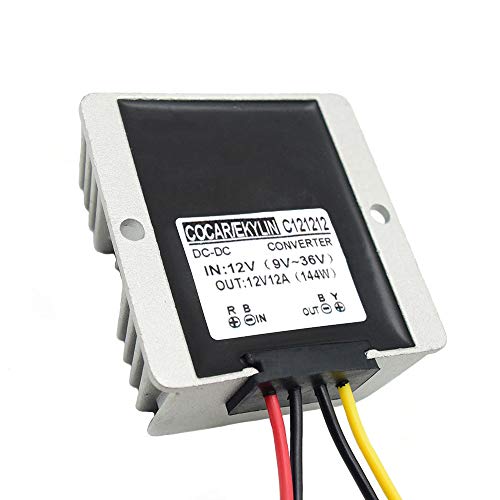
- 10–36V input; fixed 12V output
- 12A/144W rating
- IP67 sealed housing
Best For: Higher-draw 12V electronics in exposed installations
Capacitor Alternative
Pyle 3.2F Digital Power Capacitor

- 3.2F energy storage
- Blue digital voltage display
- Protection circuits and mounting hardware
Best For: Amplifier setups needing a capacitor and voltage display
Compact Weatherproof Pick

- 10–36V input; 12V, 4A output
- IP67-rated alloy housing
- Multiple electrical protections
Best For: Small 12V accessories in exposed locations
Higher-Capacity Pick

- 9–36V input; 12V, 25A output
- Listed for car radio and audio use
- Potted construction and thermal protection
Best For: 12V audio equipment needing more than 4A
Fused Low-Power Pick

- 10–36V input; 12V, 4A output
- Fuse and IP67-rated sealing
- Requires careful polarity and ground wiring
Best For: Low-power 12V accessories needing a fused regulator
Compact 5A Pick – DROK 12V Buck-Boost Stabilizer
Among car audio voltage stabilizers, this DROK converter is a compact option for a 12V car radio or other audio load within its 5A, 60W rating. It accepts 9–36V DC input and regulates the output to 12V.
Best For: Smaller 12V audio electronics that need a regulated supply in a space-conscious installation.
Pros:
- Handles input voltages from 9–36V DC.
- Potted housing is described as waterproof, dust-proof, moisture-proof, and shock-proof.
- Includes over-current and over-temperature protection.
Cons:
- 5A/60W output is not suited to loads that exceed that rating.
- The manufacturer advises leaving a power margin for sustained operation.
Choose it when the load is comfortably below 60W and a sealed, fixed-12V converter makes more sense than a higher-capacity unit.
Inline Audio Pick – InstallBay 10A DC Stabilizer
InstallBay by Metra DC Voltage Stabilizer, 10 Amp, Black, 4.72x8.11x0.55 Inches
Check Price On AmazonFor shoppers comparing car audio voltage stabilizers, the InstallBay unit offers a 10A inline option designed for mobile audio components. Its specified supply range is 10–16V, so it is intended for systems operating within that window.
Best For: Mobile audio installations needing an inline 10A stabilizer with included mounting hardware.
Pros:
- Rated for 10A DC operation.
- Slim 0.55-inch profile can help with placement in tight spaces.
- Includes mounting hardware and installation instructions.
Cons:
- Specified supply range is limited to 10–16V.
- Its 8.11-by-4.72-inch footprint still needs installation space.
This is a practical fit when an inline car-audio accessory is the priority; check the connected components’ current needs and the available mounting area before choosing it.
Higher-Output Sealed Pick – EKYLIN 12V 144W Regulator
The EKYLIN regulator stands out among car audio voltage stabilizers for its 12A, 144W rating and 10–36V DC input range. It provides a fixed 12V output and has an IP67 sealed housing for installations where exposure is a concern.
Best For: 12V audio or other electronics requiring more capacity than a 5A converter, including installations exposed to the elements.
Pros:
- Rated for up to 12A and 144W at 12V.
- Accepts 10–36V DC input.
- IP67 sealed housing supports outdoor use.
Cons:
- Its fixed 12V output is not adjustable.
- Loads above 12A or 144W exceed its stated rating.
It offers a useful step up in stated output capacity while remaining a DC-to-DC regulator; size the connected equipment to its continuous rating before installing it.
Capacitor Alternative – Pyle 3.2F Digital Power Capacitor
Not all car audio voltage stabilizers work the same way: this Pyle unit is a 3.2-farad power capacitor rather than a DC-to-DC converter. It adds energy storage for an amplifier installation and has a blue digital voltage display for monitoring.
Best For: Car audio buyers specifically seeking a capacitor with a voltage display, rather than a fixed-12V regulator.
Pros:
- 3.2-farad capacitance with a stated ±5% tolerance.
- Blue digital display shows voltage.
- Includes polarity and over-voltage protection circuits, brackets, and charging hardware.
Cons:
- Does not provide the fixed 12V output specified for the DC-to-DC converters in this roundup.
- At 3.4 pounds, it requires a secure mounting location.
Choose this for capacitor-style support and voltage visibility, not as a substitute for a regulator when your equipment requires a controlled 12V supply.
Compact Weatherproof Pick – Cocar 12V 4A Regulator
Among car audio voltage stabilizers, this Cocar unit suits modest 12V electronics rather than high-draw audio equipment. It accepts 10–36V DC and supplies a regulated 12V output rated at 4A (48W).
Best For: Small 12V accessories needing steady power in a car, truck, RV, or boat.
Pros:
- Wide 10–36V input range accommodates varying DC supplies.
- IP67-rated alloy housing is designed for wet or dusty installations.
- Includes over-voltage, under-voltage, overload, overheating, and short-circuit protection.
Cons:
- Its 4A/48W ceiling is unsuitable for equipment that draws more power.
- Short 4.7-inch leads may require extending for some mounting locations.
Check your accessory’s current draw before buying. For a low-power 12V device in an exposed location, the compact sealed housing is the main attraction.
Higher-Capacity Pick – XWST 12V 25A Converter
If your search for car audio voltage stabilizers calls for more capacity, this XWST buck-boost converter is rated for a 12V, 25A (300W) output from a 9–36V DC input. The listed applications include car radios and audio systems.
Best For: 12V car audio or display equipment whose power requirements fit within the converter’s rated output.
Pros:
- 25A/300W rating offers more capacity than the 4A models in this roundup.
- 9–36V input range supports both step-up and step-down conversion to 12V.
- Potted construction is described as waterproof, dust-proof, moisture-proof, and shock-proof.
- Includes over-current and over-temperature protection.
Cons:
- The manufacturer advises leaving a power margin for stable long-term operation rather than planning to run continuously at the full rating.
- The supplied notes do not specify an IP rating.
This is the capacity-focused option, but size it against your equipment’s actual draw and leave the recommended headroom.
Fused Low-Power Pick – THLY 12V 4A Stabilizer
This THLY model is one of the car audio voltage stabilizers aimed at smaller 12V loads: it accepts 10–36V DC and delivers up to 4A (48W) at 12V. Its distinguishing feature is a fuse alongside its sealed construction.
Best For: Low-power 12V car audio or accessories where a fused, weather-resistant regulator is preferred.
Pros:
- Fuse provides an additional circuit-interruption measure under abnormal conditions.
- IP67-rated, silica-gel-sealed construction resists water, dust, and moisture.
- Four-wire connection keeps the basic installation straightforward.
Cons:
- Limited to 4A/48W output, so it is not a match for higher-draw audio gear.
- Wiring requires care: the notes specify correct polarity and a connected input negative/GND for proper regulation.
Choose this over an unfused 4A option if the added fuse matters to your setup, but verify polarity and output voltage before connecting your device.
How We Picked These Car Audio Voltage Stabilizers
We compared the listed input ranges, output specifications, current and wattage ratings, and installation features. The seven selections include boost-buck converters, 12V regulators, and one power capacitor. Those are not interchangeable: a regulator is intended to deliver a specified output voltage within its operating limits, while a capacitor stores a limited amount of energy for brief demands. Published ratings are a starting point, not proof that a device can continuously power every amplifier or cure voltage drops elsewhere in a vehicle.
Quick Comparison by Intended Use
- Small 12V accessories: The listed 4A/48W regulators suit loads that stay below their ratings, with margin for startup current.
- Moderate accessory loads: The DROK 5A/60W converter and InstallBay 10A stabilizer offer different current classes; verify each unit’s input and output requirements.
- Higher-current 12V loads: The listed 25A/300W boost-buck converter offers the highest advertised output rating here, but installation, heat, and actual sustained capacity still matter.
- Brief amplifier demands: The Pyle 3.2-farad capacitor is a different approach. It is not a regulated 12V supply or a substitute for adequate alternator and wiring capacity.
The 144W IP67 converter is another midrange option; check its specified output current and voltage before comparing it directly with the others.
Key Buying Factors for Car Audio Voltage Stabilizers
Input Range and Output Voltage
Check whether the device accepts the voltages your vehicle can produce during engine-off operation, startup, and charging. Then confirm that its regulated output matches the equipment you intend to connect. A fixed 12V output may be appropriate for a 12V accessory but not for an amplifier designed to run directly from the vehicle’s charging system.
Current, Wattage, and Heat
Add up the connected loads and allow headroom for peaks. At 12V, a 5A rating equals 60W; do not assume the full advertised rating is available continuously in every temperature or mounting location. Check the manufacturer’s continuous-duty guidance, ventilation needs, and wiring requirements.
Protection and Installation
Look for clearly specified overcurrent, short-circuit, and thermal protection rather than relying on “surge protector” wording alone. Use an appropriately sized fuse near the power source, suitable wire gauge, secure connections, and a mounting location consistent with the product’s environmental rating. IP67 or waterproof labeling does not make connectors or an entire installation waterproof.
Who Should Buy Which Car Audio Voltage Stabilizers?
Choose a compact regulator if a low-power accessory needs a stable, compatible 12V supply. Consider a higher-current converter only when its verified continuous rating covers your intended load and your wiring can support it. Consider the capacitor if you specifically want short-duration energy storage and already have a sound charging system. If headlights dim or amplifier voltage falls substantially under sustained bass, diagnose the battery, alternator, grounds, and cable losses first: none of these products creates additional charging capacity.