
A check engine light can signal anything from a loose gas cap to a repair that needs prompt attention. The right scanner helps you read the code, check readiness for emissions testing, and decide what to investigate next.
These 10 picks range from straightforward handheld code readers to tools with live data, battery testing, or access to systems beyond the engine. The best fit depends on your vehicle and how much troubleshooting you plan to do.
Best 10 Car Diagnostic Scanners Picks for 2026
Best for Multi-System Checks

- Scans engine, ABS, SRS, and transmission systems
- Includes live data and emissions readiness
- No oil resets, ABS bleeding, or relearns
Best For: Investigating multiple warning lights before repairs
Best for App-Guided Repairs

- Engine codes plus battery and alternator checks
- Free app provides verified repair guidance
- ABS and oil-reset coverage vary by vehicle
Best For: DIY repairs with app guidance and electrical checks
Best for Engine Live Data

- Reads and clears engine trouble codes
- Graphs live data and checks I/M readiness
- Vehicle-specific functions vary
Best For: Check-engine troubleshooting and emissions checks
Best for Battery Troubleshooting

- Tests battery, cranking, and charging systems
- Shows engine codes, live data, and freeze frames
- No ABS, SRS, or transmission diagnostics
Best For: Engine-code checks and 12V starting-system tests
Simple Check-Engine Pick

- Reads and clears emission-related codes
- Shows live data and I/M readiness
- Port-powered with labeled controls
Best For: Basic check-engine and emissions checks
Large-Screen Code Reader

- Backlit screen with contrast adjustment
- Built-in engine-code lookup
- Live data and I/M readiness
Best For: On-device code lookup and routine OBD-II checks
Emissions-Testing Pick

- Checks I/M readiness before inspection
- Includes O2 sensor and EVAP tests
- Color display with built-in code definitions
Best For: Emissions readiness and app-free engine diagnostics
DIY Essentials
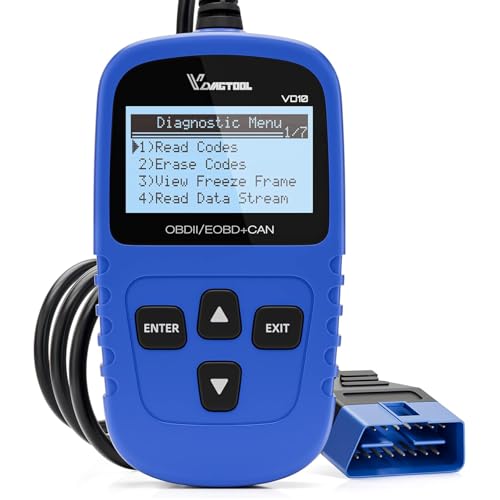
VDIAGTOOL VD10 OBD2 Code Reader
- Standalone, plug-in operation
- Code definitions and live data
- Freeze frame and I/M readiness
Best For: DIY engine-code checks without a phone
Wireless Diagnostics
BlueDriver Bluetooth OBD2 Scanner

- Bluetooth app for iOS and Android
- Enhanced codes on supported vehicles
- Repair reports; no subscription
Best For: Phone-based diagnostics with repair guidance
Basic Emissions Check

- Plug-and-play handheld reader
- On-screen code definitions
- I/M readiness and freeze frame
Best For: Basic check-engine and emissions checks
Best for Multi-System Checks – FOXWELL NT604 Elite
Among car diagnostic scanners, the FOXWELL NT604 Elite is a practical choice when a check-engine light is not your only concern. It scans engine, ABS, SRS, and transmission systems, with software installed for use out of the box.
Best For: Owners who want to investigate warning lights across several vehicle systems before arranging repairs.
Pros:
- Reads and clears supported engine, ABS, SRS, and transmission fault codes.
- Includes live data, I/M readiness, a built-in code library, and a protective case.
- Offers updates without an extra software fee.
Cons:
- Does not perform service functions such as oil resets, ABS bleeding, or relearns.
- Cannot clear SRS crash data; vehicle and AutoVIN compatibility vary.
Choose this model for broader fault-code coverage rather than maintenance work. Check support for your exact vehicle before buying, and remember that clearing a code does not fix the underlying problem.
Best for App-Guided Repairs – Innova 5210
The Innova 5210 stands out among car diagnostic scanners by pairing engine-code checks with a battery and alternator test. Its compatible RepairSolutions2 app adds repair guidance for owners who want help deciding what to do next.
Best For: DIY drivers who want code reading, electrical-system checks, and app-based repair guidance in one tool.
Pros:
- Reads and clears engine codes and supported ABS codes.
- Displays live engine data and I/M readiness status.
- Includes an oil-light reset feature and a free app with verified fixes.
Cons:
- ABS and oil-reset coverage vary by vehicle.
- Use Innova’s coverage checker to confirm the functions you need.
This is a useful pick if repair guidance matters as much as seeing the code itself. Verify your vehicle’s coverage first, especially if ABS diagnostics or an oil reset is a priority.
Best for Engine Live Data – FOXWELL NT301
For shoppers comparing car diagnostic scanners primarily for check-engine problems, the FOXWELL NT301 provides engine-code reading alongside live sensor data. Its dedicated I/M readiness keys also make pre-inspection checks straightforward.
Best For: Drivers who want a plug-in engine-code reader with live-data graphs and emissions-readiness indicators.
Pros:
- Reads and clears engine trouble codes after repairs.
- Graphs live sensor readings and supports oxygen-sensor and EVAP tests.
- Has one-touch I/M readiness keys and color-coded status LEDs.
Cons:
- Focused on OBD2 engine diagnostics rather than the multi-system coverage listed for some alternatives.
- Available functions depend on the vehicle; check compatibility before purchase.
The NT301 makes sense when you want more insight than a basic code read without choosing a broader system scanner. A cleared light can return if the fault has not been repaired.
Best for Battery Troubleshooting – ANCEL AD410 PRO
The ANCEL AD410 PRO combines two common jobs for car diagnostic scanners: investigating check-engine lights and testing a 12V starting and charging system. It is a sensible option if hard starts are as much of a concern as engine codes.
Best For: Owners who want engine diagnostics and battery, cranking, and charging tests in one handheld device.
Pros:
- Tests battery health, cranking performance, and the charging system.
- Reads engine codes and displays live data, graphs, and freeze-frame information.
- Provides I/M readiness checks without requiring an app or computer.
Cons:
- Does not diagnose ABS, SRS, or transmission systems.
- Not intended for EVs; confirm vehicle compatibility before buying.
Pick this model if you would otherwise buy separate engine-code and 12V battery-testing tools. For brake, airbag, or transmission warnings, look for a scanner with coverage for those systems instead.
Simple Check-Engine Pick – ANCEL AD310
Among car diagnostic scanners, the ANCEL AD310 is a straightforward choice for checking emission-related engine faults without a phone or batteries. It reads and clears codes, displays live data and freeze-frame information, and checks I/M readiness.
Best For: Drivers who want a compact, plug-in reader for basic check-engine and emissions checks.
Pros:
- Supports major OBD-II protocols, including CAN.
- Clearly labeled buttons and a readable screen simplify operation.
- Runs from the vehicle’s OBD-II port; no charger is needed.
Cons:
- Limited to emission-related OBD-II diagnostics; it does not read ABS, SRS, or transmission faults.
- Does not diagnose OBD-I vehicles, even with an adapter.
Choose the AD310 if you mainly need to investigate a check-engine light and check readiness after a repair. Look elsewhere if you need diagnostics beyond the emissions system.
The MOTOPOWER MP69033 stands out among car diagnostic scanners for its large backlit display and dedicated buttons for looking up fault codes and vehicle information. It handles check-engine codes, live data, freeze frames, and I/M readiness through the OBD-II port.
Best For: Drivers who want on-device code lookup and a clear screen for routine OBD-II checks.
Pros:
- Built-in DTC lookup library helps explain engine codes.
- Displays live data and real-time curves.
- Supports six interface languages and draws power from the vehicle’s OBD-II port.
Cons:
- Does not read ABS, airbag, or oil-service systems.
- Vehicle compatibility should be checked before purchase.
This is a useful fit for reading engine faults directly on the scanner, particularly if you value a larger display. It is not a substitute for a tool that diagnoses non-OBD-II vehicle systems.
For shoppers comparing car diagnostic scanners ahead of an emissions inspection, the ANCEL AD410 offers I/M readiness checks alongside code reading, live data, and freeze-frame information. Its color screen and built-in code definitions keep basic engine diagnostics on the device.
Best For: Drivers who want to check emissions readiness and review engine data without an app.
Pros:
- Provides I/M readiness, O2 sensor, and EVAP test functions.
- Built-in DTC lookups help interpret check-engine codes.
- Port-powered operation requires no phone, batteries, or charger.
Cons:
- Limited to engine and emission-related codes; no ABS, SRS, or transmission diagnostics.
- Does not provide bidirectional controls or service resets.
The AD410 offers a broader set of OBD-II checks than a bare-bones code reader, especially for emissions-related troubleshooting. Confirm vehicle compatibility and choose a different tool if you need other vehicle systems covered.
DIY Essentials – VDIAGTOOL VD10 OBD2 Code Reader
Among car diagnostic scanners, the VDIAGTOOL VD10 is a straightforward, plug-in choice for checking why the check-engine light is on. It displays trouble-code definitions on its own screen, so you can get started without a phone.
Best For: DIY drivers who want basic engine-code checks and emissions-readiness information in a standalone reader.
Pros:
- Reads and clears codes, with a built-in database of more than 3,000 definitions.
- Shows live sensor data and freeze-frame information.
- Checks I/M readiness and retrieves vehicle information, including VIN where available.
Cons:
- Small two-line display offers limited room for viewing results.
- Listed functions focus on OBD-II diagnostics rather than ABS, airbag, or service functions.
The VD10 makes the most sense if you want useful engine diagnostics without pairing an app. Check that your vehicle is OBD-II compliant before buying.
Wireless Diagnostics – BlueDriver Bluetooth OBD2 Scanner
BlueDriver stands out among car diagnostic scanners by pairing a plug-in Bluetooth sensor with an iOS or Android app. It combines code reading with repair reports and enhanced diagnostics for supported vehicle systems.
Best For: Drivers who prefer phone-based diagnostics and want more than basic check-engine codes.
Pros:
- Offers enhanced code access for systems including ABS, SRS, TPMS, and transmission, where supported.
- Includes VIN-matched, technician-verified repair reports, live data, and freeze frames.
- One-time purchase includes app features and updates without subscription fees.
Cons:
- Requires a compatible phone or tablet to view results.
- Enhanced diagnostic coverage varies by make and model; stated vehicle compatibility is for gas vehicles from 1996 onward sold in North America.
Choose BlueDriver if repair guidance and wireless access matter more to you than a self-contained handheld screen. Verify your vehicle’s enhanced-system coverage before relying on a particular function.
Basic Emissions Check – Autel MS309 Code Reader
For shoppers comparing basic car diagnostic scanners, the Autel MS309 keeps the focus on engine trouble codes and emissions-monitor status. Its plug-and-play handheld design displays code meanings without requiring registration.
Best For: Drivers who want a simple reader for check-engine codes and I/M readiness checks.
Pros:
- Reads and clears generic, manufacturer-specific, and pending OBD-II codes.
- Displays definitions from a built-in database of more than 1,000 codes.
- Retrieves freeze-frame data, vehicle information, and I/M readiness status.
Cons:
- Does not support TPMS or other service functions.
- Cannot access OBD-II modules to clear codes on post-2017 FCA vehicles with a secure gateway; other secure-gateway vehicles are also unsupported.
The MS309 is a sensible option when basic code and readiness information is enough. Its stated compatibility limits are important, especially for owners of newer secure-gateway vehicles.
How We Picked These Car Diagnostic Scanners
We focused on the differences that matter when you plug in a scanner: the systems it can access, the information it displays, ease of use, and features beyond basic code reading. The selection includes inexpensive handheld readers, models with live data or battery testing, a multi-system option, and a Bluetooth scanner for phone-based diagnostics. Features listed for a product are not a guarantee of coverage on every vehicle; confirm compatibility with your specific year, make, model, and system before buying.
Quick Comparison
For a simple check engine light or emissions-readiness check, start with an engine-code reader such as the ANCEL AD310, MOTOPOWER MP69033, VDIAGTOOL VD10, or Autel MS309. The FOXWELL NT301 and ANCEL AD410 add options for buyers who want more diagnostic information, including live data. If checking 12V battery condition matters, compare the ANCEL AD410 PRO and Innova 5210. Look at the FOXWELL NT604 Elite or BlueDriver when access to systems beyond the engine is a priority, but verify the exact functions supported on your vehicle.
Key Buying Factors for Car Diagnostic Scanners
Vehicle and System Coverage
OBD-II compatibility does not mean every scanner can read every module. Basic readers typically handle powertrain trouble codes and emissions information; ABS, airbag/SRS, transmission, and TPMS functions require additional support that varies by tool and vehicle. Check the manufacturer’s compatibility information, especially if one warning light is the reason you are shopping.
Useful Data and Tests
Code definitions are a starting point, not a confirmed diagnosis. Live data can help you observe sensor readings while troubleshooting, while freeze-frame data can show conditions when a fault was recorded, where supported. Emissions readiness is useful before an inspection. Battery analysis and maintenance functions, such as an oil-service reset, are worth paying for only if you expect to use them and they work with your car.
Handheld or Bluetooth
A standalone scanner is convenient if you want a dedicated screen and no phone pairing. A Bluetooth model can make results easier to view on a phone, but check app requirements, device compatibility, and whether the functions you need require any ongoing payment. Also consider screen readability, cable reach, and update policies.
Who Should Buy Which Car Diagnostic Scanners?
Choose a basic wired reader if you mainly want to investigate a check engine light and check emissions status. Step up to live data if you plan to troubleshoot recurring faults rather than just record codes. A scanner with battery testing suits drivers maintaining an aging 12V battery, while a multi-system tool makes more sense for ABS, SRS, or transmission warnings. Whichever you choose, diagnose the cause before clearing a code: erasing it can reset readiness monitors without fixing the underlying problem.