
A car wireless charging pad can keep your phone topped up without making you plug it in at every stop. The right one also stays put through turns and fits the space you actually have.
These six options cover simple non-slip mats, pads with included adapters, and designs with longer cables. Here’s what to check before choosing one for your car and phone.
Best 6 Car Wireless Charging Pads Picks for 2026
Best for Mixed Devices

- Broad listed iPhone and Android support
- Washable silicone-rubber tray
- Includes a 3.1-foot USB cable
Best For: Drivers sharing a charger across compatible phone models
Best Adapter-Included Pick

- 20W car adapter and cable included
- Non-slip silicone charging surface
- Supports many slim phone cases
Best For: Drivers who want the car adapter bundled with the pad
Best for Raised-Camera Phones
LOOSAU C5Y Non-Slip Charging Pad
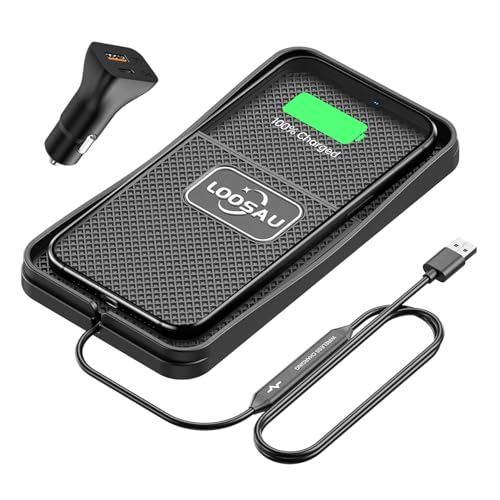
- Raised design accommodates camera bumps
- Case-friendly up to 4mm
- Includes car power adapter
Best For: Phones with prominent cameras and roomy consoles
Most Versatile Placement
Portable Qi Silicone Charging Mat

- Moves between car and home
- Non-slip silicone-rubber base
- Listed IPX5 splash resistance
Best For: A shared car-and-desk charging mat
Best for Flexible Cable Routing

- Includes 70cm USB-C extension
- Rubberized surfaces and adhesive pads
- Bundled dual-port 40W car charger
Best For: Consoles far from a power socket
Best Portable Pick – LANSEMKU Non-Slip Charging Pad
If you want car wireless charging pads you can move between vehicles and desks, this slim LANSEMKU model is worth considering. Its silicone surface is designed to help keep a phone in place on a flat dashboard or center console.
Best For: Drivers who want a simple, portable pad for the car and occasional use at a desk or while traveling.
Pros:
- Non-slip silicone surface needs no complicated installation on a flat surface.
- Supports Qi-enabled iPhones and other compatible phones, with a listed maximum of 15W.
- Slim, lightweight design is easy to move between locations.
Cons:
- Requires a flat spot in the vehicle rather than attaching to a vent or windshield.
- The listed 15W maximum does not mean every compatible phone charges at 15W; the notes specify 7.5W fast charging for supported iPhones.
Choose this one for portability and uncomplicated placement. Check your phone’s wireless-charging support and your vehicle’s available flat space before buying.
Best for Mixed Devices – Non-Slip Qi Charging Tray
For households juggling different phones, this is one of the car wireless charging pads with a particularly broad device list. The silicone-rubber tray doubles as a resting place for a phone on a flat dashboard or desk.
Best For: Drivers who share a charger across compatible iPhone and Android models and want a reusable, non-slip tray.
Pros:
- Lists multiple charging tiers, including 15W for select compatible models and 7.5W for listed iPhones.
- Washable silicone-rubber base is designed to resist slipping.
- Includes a 3.1-foot USB charging cable and lists IPX5 water resistance.
Cons:
- Needs a flat dashboard or other suitable surface; it is not an elevated viewing mount.
- Charging speed varies by phone model, so the 15W rating is not universal.
This tray makes the most sense when device flexibility matters more than mounting a phone at eye level. Match your specific handset to the listed charging tier before choosing it.
Best Adapter-Included Pick – 15W Pad with 20W Car Adapter
Among car wireless charging pads, this model stands out for including both a charging cable and a 20W car adapter. Set the silicone pad on a flat dashboard or console, connect it, and place a compatible Qi-enabled phone on top.
Best For: Drivers who want a non-slip charging pad with a car power adapter included.
Pros:
- Includes a 20W car adapter and cable for a more complete in-car setup.
- Lists up to 15W wireless charging for compatible devices.
- Works through many slim or standard TPU phone cases.
Cons:
- Thick rugged cases or metal accessories may interfere with charging.
- Requires a suitable flat surface; it does not position the phone like a raised mount.
The included adapter is the practical reason to pick this pad over a cable-only option. Keep expectations phone-specific: its 15W wireless rating is a maximum, not a guaranteed speed for every device.
Best for Raised-Camera Phones – LOOSAU C5Y Non-Slip Charging Pad
Among car wireless charging pads, the LOOSAU C5Y stands out for its raised design, which helps phones with protruding cameras sit properly on the charging surface. Its silicone top and raised edges help keep a phone in place on bumpy roads.
Best For: Drivers with Qi-compatible phones that have prominent camera bumps and who have room for a larger console or dashboard pad.
Pros:
- Supports up to 15W for compatible Pixel and LG phones, 10W for Samsung, and 7.5W for iPhone.
- Works through compatible cases up to 4mm thick.
- Includes a car power adapter for charging on the road.
Cons:
- At 180 × 94 × 14mm, it may not fit smaller consoles or armrests.
- Metal cases, magnetic accessories, and cards between the phone and pad can interfere with charging.
Measure your intended placement area before buying. If it fits, the raised charging surface makes this a practical choice for phones whose cameras prevent them from lying flat on ordinary pads.
Most Versatile Placement – Portable Qi Silicone Charging Mat
If you want car wireless charging pads that can also serve on a desk or nightstand, this portable Qi mat is worth considering. Its silicone-rubber base is designed to resist slipping, whether you place it in a car storage area or on another flat surface.
Best For: Drivers who want one movable charging mat for both their vehicle and indoor spaces.
Pros:
- Supports Qi-compatible phones and earbuds, with device-dependent charging rates up to 15W.
- Washable, reusable silicone-rubber base helps keep the pad from sliding.
- Listed IPX5 water resistance offers protection against splashes.
Cons:
- Its flat mat design is best suited to a suitable flat placement area.
- iPhones are listed at up to 7.5W, rather than the pad’s maximum 15W.
The appeal here is flexibility rather than a vehicle-specific installation: move it between compatible flat spots as needed, and check your device’s listed charging rate before expecting maximum speed.
Best for Flexible Cable Routing – aubenai C1 USB-C Charging Pad
For car wireless charging pads that need to reach an awkwardly placed power socket, the aubenai C1 includes a 30cm built-in USB-C cable and a 70cm extension. Its rubberized top and base help resist slipping, while included adhesive pads offer another way to secure it to a dashboard or console.
Best For: Drivers who need extra cable reach or want to position a charging pad away from the vehicle’s power socket.
Pros:
- Includes a 70cm USB-C extension cable and a dual-port 40W car charger.
- Supports charging through compatible phone cases up to 4mm thick.
- LED indicator distinguishes powered-on status from active charging.
Cons:
- Charges one device wirelessly at a time.
- Maximum wireless output varies by device: the listed iPhone rate is up to 7.5W, versus up to 15W for compatible Pixel and LG phones.
This is the most installation-flexible option of the three if cable reach is your main concern. The bundled power adapter and extension make it easier to plan a tidy location before attaching the pad.
How We Picked These Car Wireless Charging Pads
We focused on practical differences a buyer can check before ordering: stated wireless power, phone compatibility, non-slip design, included power accessories, cable length, and dashboard or console fit. Product titles can promise “fast” charging without explaining the conditions required, so treat wattage claims as a starting point rather than a guaranteed speed. We did not use unverified charging times or assume that every pad includes a car adapter.
Quick Comparison: Which Setup Fits Your Car?
Start with what is already in your vehicle. If you have a reliable USB power source, a basic charging mat may be enough. If you do not, a package that explicitly includes a car adapter could save a separate purchase. For a console far from the outlet, look at the listed cable length and where the cable exits the pad. All six selected options are pad-style chargers, so compare the usable charging area and available placement space rather than expecting a vent- or windshield-mounted phone holder.
Key Buying Factors for Car Wireless Charging Pads
Phone Compatibility and Alignment
Check that your phone supports Qi wireless charging and that its size allows its charging coil to sit over the pad’s active area. A long device-compatibility list is helpful, but it does not guarantee the same speed for every model. Thick cases, metal accessories, and some magnetic attachments can interfere with charging; remove them if charging is inconsistent.
Power Supply and Realistic Speed
The advertised 15W figure is usually a maximum supported output, not what every phone will receive. Actual charging depends on the phone, the pad, and the power adapter supplying it. Confirm the required input and whether a suitable adapter is included. A car USB port may not supply enough power for the pad’s highest stated output, and wireless charging may slow when the phone gets warm.
Grip, Placement, and Cable Routing
A non-slip surface matters most where braking and cornering could shift the phone off the charging area. Check that the pad sits flat on your intended dashboard or console surface, does not obstruct controls or your view, and lets you reach the phone safely. Measure the route to your power outlet before buying, especially if the listing specifies a fixed cable length.
Who Should Buy Which Car Wireless Charging Pads?
Choose an adapter-included option if you need a complete power setup and have confirmed its plug suits your car. Pick a pad with a clearly specified longer cable when the outlet is farther away. A simple non-slip mat makes sense if you already own a suitable adapter and want minimal hardware. If you rely on your phone for navigation, prioritize a stable, visible location—but use a proper mount instead if the pad cannot hold the phone securely where you need to see it. Whatever you choose, confirm the listing’s included accessories and return terms before checkout.