
The right engine stand makes disassembly, cleaning, inspection, and rebuilding far easier than working on a floor or improvised support. The models in this roundup cover common workshop needs, from compact 750-pound stands to heavy-duty options rated for 2,000 pounds.
Use the comparison and buying advice below to match capacity, head design, caster layout, and storage features to your engine and workspace.
Best 10 Engine Stands Picks for 2026
Best Value Engine Stand

- 750-pound tested capacity
- 360-degree rotating head
- H-shaped base with lockable caster
Best For: DIY mechanics and general workshop repairs
Heavy-Duty Engine Stand
JEGS 1500 lb Geared Rotating Stand
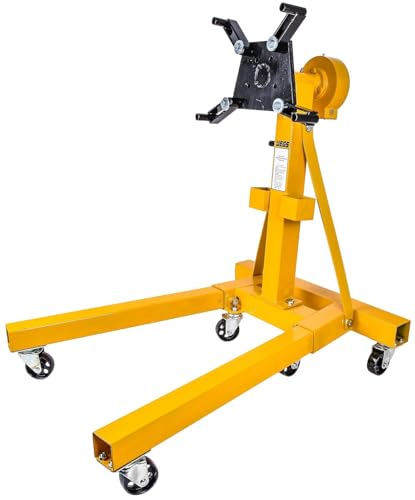
- 1,500-pound capacity
- Geared rotating mechanism
- Designed for automotive applications
Best For: Heavy engines and professional automotive shops
Best Chevrolet Engine Stand
TUFFIOM 1000 lb Rolling Cradle

- Customized for Chevrolet engines
- Steel frame with powder coating
- Rolling design with universal wheels
Best For: Chevrolet repair, rebuilding, and garage storage
Most Versatile Engine Stand

- 1,000-pound capacity
- 360-degree rotating head
- Adjustable arms and universal wheels
Best For: Mixed car and motorcycle maintenance
Heavy-Duty Choice
2000 lb Foldable Rotating Engine Stand

- Supports engines up to 2,000 pounds
- 360-degree rotating head with four adjustable arms
- Stable U/H-shaped base and foldable design
Best For: Heavy engines and space-conscious workshops
Value Workshop Pick
Pro 1000 lb Steel Rotating Engine Stand

- 1,000-pound alloy steel load capacity
- Rotating head and four adjustable mounting arms
- Swivel casters and disassembly for transport
Best For: Routine automotive repair and drivetrain work
Mobility-Focused Pick
MAXSA 2000 lb Six-Wheel Engine Stand

- Supports engines up to 2,000 pounds
- Six-wheel base with 360-degree swivel casters
- Rotating head, adjustable arms, and quick folding
Best For: Heavy-engine projects requiring frequent repositioning
Best with Extra Features
VEVOR 1500-Lb Folding Engine Stand

- 1,500-pound tested capacity
- 360-degree adjustable mounting arms
- Five casters and foldable storage
Best For: Large-engine maintenance in space-conscious garages
Lightweight Value
RIAHNEAH 1000-Lb Rotating Engine Stand

- 1,000-pound load capacity
- 41.2-pound listed item weight
- Tool-free 360-degree head adjustment
Best For: DIY mechanics needing a lighter, mobile stand
Workshop Flexibility
IDEALHOUSE 1500-Lb Engine Stand

- 1,500-pound tested capacity
- U/H-style anti-shake base
- Foldable design with swivel casters
Best For: Versatile garage and workshop engine servicing
Best Value Engine Stand – VEVOR 750 lb Rotating Stand
For DIY repairs and general shop work, this VEVOR engine stand combines a 750-pound capacity with a rotating head and adjustable mounting arms. Its H-shaped base and lockable caster setup make it a practical choice when stability and maneuverability matter.
Best For: DIY mechanics and professional users who need a mobile, rotating engine stand for routine repair work.
Pros:
- Supports engines weighing up to 750 pounds.
- 360-degree rotating head with four adjustable mounting arms.
- H-shaped base, four casters, and one braked wheel improve stability and positioning.
- Electrostatic coating helps protect the alloy-steel frame against rust.
Cons:
- Its 750-pound capacity is lower than that of heavier-duty options.
- At 41.4 pounds, it may require more effort to move than lighter cradles.
This is a well-rounded engine stand for users who want rotating access, adjustable fitment, and workshop mobility without stepping up to a higher-capacity geared model.
Heavy-Duty Engine Stand – JEGS 1500 lb Geared Rotating Stand
The JEGS geared rotating engine stand is built for automotive applications that demand a substantial 1,500-pound capacity. Its geared rotating design is suited to users who prioritize controlled engine positioning and a heavy-duty platform.
Best For: Automotive workshops and mechanics handling heavier engines that need a high-capacity rotating stand.
Pros:
- Rated for loads up to 1,500 pounds.
- Geared rotating design supports controlled positioning.
- Designed specifically for automotive applications.
Cons:
- At 97.7 pounds, it is considerably heavier than several portable engine stands.
- The supplied information provides fewer details about casters, mounting arms, and included hardware.
Choose this JEGS model when capacity is the deciding factor. Its geared swivel design and high load rating make it the most appropriate option here for heavier automotive engine work.
Best Chevrolet Engine Stand – TUFFIOM 1000 lb Rolling Cradle
This TUFFIOM engine stand is customized for Chevrolet engines and uses a steel rolling-cradle design for workshop mobility. Its stated 1,000-pound support rating, powder-coated finish, and modular assembly make it a focused option for Chevrolet repair and rebuild projects.
Best For: Chevrolet owners and mechanics who want a rolling engine cradle matched to compatible Chevrolet engine models.
Pros:
- Designed to fit most Chevrolet engine models.
- Supports up to 1,000 pounds according to the product details.
- Universal wheels make movement easier in garages and workshops.
- Modular design is intended for quick assembly without professional tools.
Cons:
- Its Chevrolet-specific design may limit compatibility with other engine families.
- The supplied information describes a rolling cradle rather than a rotating engine head.
- The listed capacity differs between the title and specifications, so buyers should verify the rating before use.
This is a sensible pick for a Chevrolet-focused project where a low-profile rolling cradle is more useful than a universal rotating stand. Confirm engine compatibility and the applicable load rating before assembly.
Most Versatile Engine Stand – MOTOOS 1000 lb Rotating Stand
The MOTOOS rotating engine stand offers a 1,000-pound capacity, four adjustable mounting arms, and a 360-degree rotating head. With four universal wheels and a carbon-steel frame, it is designed for flexible positioning across a range of car and motorcycle maintenance tasks.
Best For: Users who need a versatile rotating engine stand for different engine sizes and vehicle types.
Pros:
- Supports engines up to 1,000 pounds.
- Four adjustable arms and hexagonal bolts accommodate various engine blocks.
- 360-degree rotating head improves access during maintenance.
- Four universal wheels allow smooth movement around the workspace.
Cons:
- The supplied dimensions appear unusually narrow, so buyers should verify the measurements before ordering.
- The notes do not specify a wheel brake or locking mechanism.
- Its 45.4-pound weight may be less convenient to reposition than a lighter cradle.
For broad compatibility and rotating access, this MOTOOS model is a strong all-purpose choice. Verify the listed dimensions and workspace fit before purchasing, especially if garage space is limited.
Heavy-Duty Choice – 2000 lb Foldable Rotating Engine Stand
For demanding garage projects, this 2000-lb engine stand combines a high-strength steel frame with a rotating mounting head and a stable U/H-shaped base. Its adjustable arms, swivel casters, and folding design make it a practical option when you need engine stands that can handle substantial loads while remaining movable and easy to store.
Best For: Home garages and workshops handling heavier engines that need flexible positioning and compact storage.
Pros:
- Supports up to 2,000 pounds and has a rust-resistant powder-coated finish.
- Four adjustable arms and a 360-degree rotating head provide access to different engine areas.
- U/H-shaped base, 360-degree casters, and quick-folding construction improve stability and storage.
Cons:
- At 79.4 pounds, it is relatively heavy to move without using its casters.
- Its larger 43.9-by-27.56-by-35.83-inch footprint may require dedicated storage space.
Choose this stand if load capacity and stability are priorities. The rotating head and adjustable mounting arms add useful flexibility, while the folding frame helps offset its substantial size.
Value Workshop Pick – Pro 1000 lb Steel Rotating Engine Stand
This 1,000-lb steel engine stand is designed for raising, lowering, transporting, and positioning engines, differentials, transmissions, and other heavy loads. Its wide base, four adjustable mounting arms, and 360-degree rotating head make it a straightforward choice among engine stands for general automotive work.
Best For: Automotive DIYers who need a capable rotating stand for engines and related drivetrain components.
Pros:
- High-grade alloy steel construction supports engine blocks up to 1,000 pounds.
- Four adjustable arms and a 360-degree mounting head improve access during service.
- Rolling swivel casters aid movement, and the stand disassembles for storage or transport.
Cons:
- Its 1,000-pound capacity is lower than the 2,000-pound alternatives in this roundup.
- Disassembly is required for storage or transport rather than quick folding.
This model offers the essential features for routine engine work without the higher capacity of the heavier-duty options. It is a sensible fit when a wide base, rotating access, and easier transport matter more than maximum load rating.
Mobility-Focused Pick – MAXSA 2000 lb Six-Wheel Engine Stand
The MAXSA 2000-lb engine stand pairs high load capacity with a six-wheel base and fully rotating mounting head. For garages comparing engine stands, its adjustable arms, swivel casters, rust-resistant finish, and quick-folding design offer a useful balance of positioning control, mobility, and storage convenience.
Best For: Workshops that need to reposition heavy engines frequently and store the stand between projects.
Pros:
- High-strength steel construction supports up to 2,000 pounds.
- 360-degree rotating head and four adjustable arms accommodate varied engine positions and configurations.
- Six wheels, swivel casters, a U/H-shaped base, and quick folding support movement and storage.
Cons:
- Its 79.4-pound weight makes it substantial to handle when not rolling.
- The 43.9-by-27.56-by-35.83-inch dimensions may be large for smaller workspaces.
This is a strong choice for users who value mobility alongside a 2,000-pound rating. The six-wheel configuration and folding frame are especially helpful when the stand must move around a workshop or be put away after use.
Best with Extra Features – VEVOR 1500-Lb Folding Engine Stand
For demanding garage work, this VEVOR engine stand combines a 1,500-pound tested capacity with a 360-degree rotating head. Its H-shaped base, secure mounting hardware, and five-wheel layout make it a practical choice for supporting and repositioning large engines during maintenance.
Best For: Home garages and repair shops that need high capacity, stability, mobility, and compact storage.
Pros:
- Supports up to 1,500 pounds with an upgraded H-shaped base.
- 360-degree adjustable mounting arms use 1.1-inch hex head bolts for a secure hold.
- Five swivel casters, four with brakes, support controlled movement and positioning.
- Folds to approximately 14.8 inches wide for easier storage.
Cons:
- At 62.2 pounds, it is relatively heavy to move when not on its casters.
- Its larger capacity and heavy-duty construction may be more than needed for lighter engines.
Choose this model if stability and load capacity matter more than minimizing weight. The folding frame is especially useful when garage floor space is limited.
Lightweight Value – RIAHNEAH 1000-Lb Rotating Engine Stand
This RIAHNEAH engine stand is a comparatively lightweight option for engine maintenance, with a 1,000-pound capacity and a 360-degree rotating head. Its adjustable arms and four universal wheels provide flexibility for positioning and access around the engine.
Best For: DIY mechanics who want a maneuverable, lower-weight stand for engines up to 1,000 pounds.
Pros:
- High-strength carbon steel construction is designed to resist rust, corrosion, shaking, and deformation.
- Supports engine loads up to 1,000 pounds.
- Four adjustable mounting arms accommodate different engine blocks.
- Rear handles allow 360-degree head adjustment without additional tools.
Cons:
- Its 1,000-pound capacity is lower than the two 1,500-pound alternatives in this roundup.
- Four wheels provide mobility, but the notes do not specify locking brakes.
With a listed weight of 41.2 pounds, this stand may appeal to users who value easier handling. It is a sensible fit when a 1,000-pound rating covers the engine being serviced.
Workshop Flexibility – IDEALHOUSE 1500-Lb Engine Stand
The IDEALHOUSE engine stand is built for versatile workshop use, pairing a 1,500-pound tested capacity with four adjustable rotating arms and a 360-degree head. Its widened U/H-style base is designed to reduce shaking, while the folding structure helps preserve garage space.
Best For: Workshop users who need broad engine compatibility, stable support, and foldable storage.
Pros:
- High-strength steel construction supports up to 1,500 pounds.
- Widened U/H-style base is designed to resist wobble, tilt, and displacement.
- Four adjustable arms and 1.1-inch hex head bolts support secure, flexible mounting.
- Swivel casters, a 15-inch handle, and quick-folding storage improve workshop practicality.
Cons:
- Its 61.7-pound listed weight makes it one of the heavier options here.
- The larger frame may require more floor space during use than a lighter-duty stand.
This model stands out for combining heavy-duty capacity with storage and positioning features. It is particularly useful when one stand needs to accommodate different engines and fit into an organized workshop.
How We Picked These Engine Stands
We focused on the specifications that matter during real engine work: rated load capacity, rotating-head design, mounting adjustability, caster configuration, frame construction, and storage convenience. The selection includes lighter-duty stands for occasional home-garage use alongside higher-capacity models intended for heavier engines or more frequent projects.
Capacity ratings are only one part of the decision. A stand must also remain stable while the engine is rotated, provide secure mounting points, and roll predictably across the type of floor in your workspace. Always verify the stand’s instructions and hardware requirements before installation.
Quick Comparison
| Capacity range | Best suited for | Features to prioritize |
|---|---|---|
| 750–1,000 lb | Small and mid-size engines, occasional projects | Rigid frame, adjustable mounting arms, four or more casters |
| 1,500 lb | Most passenger-car and light-truck rebuilds | Strong rotating head, broad base, secure locking mechanism |
| 2,000 lb | Heavy engines and demanding workshop use | Reinforced construction, six-wheel stability, quality casters |
Key Buying Factors for Engine Stands
Capacity and Safety Margin
Choose a rated capacity comfortably above the fully dressed engine’s weight. Include accessories, brackets, fluids, and any components that will remain attached. Avoid treating the maximum rating as a target load.
Rotation and Locking
A 360-degree rotating head can expose the underside and sides of an engine without repeated lifting. Look for a positive locking pin or similarly secure mechanism, plus mounting arms that can position the engine’s center of gravity near the pivot.
Frame, Casters, and Floor Conditions
Steel construction and a wide wheelbase improve stability. Four casters may suit a compact garage, while six-wheel designs can distribute heavy loads and reduce rocking. Check wheel material, swivel behavior, and compatibility with uneven or rough floors.
Storage and Assembly
Foldable designs are useful when floor space is limited, but confirm that the folded structure does not compromise rigidity during use. Review assembly instructions, included hardware, and the tools required before buying.
Who Should Buy Which Engine Stands?
Choose a 750- or 1,000-pound model if you work on lighter engines and want a straightforward, budget-conscious stand for occasional repairs. A 1,500-pound rotating stand is the most versatile choice for many home mechanics, especially when it combines adjustable arms with several casters.
Heavy-duty 2,000-pound models are better for large engines, frequent rebuilding, or users who want a greater capacity margin. If mobility is a priority, favor a stand with multiple quality casters and a stable wheelbase. Regardless of the model, mount the engine using properly rated fasteners, keep the load balanced, and lock the rotating head before applying force.