
The best handheld field recorders make it easier to capture clean audio away from a studio, whether you are recording rehearsals, interviews, film sets, podcasts, or outdoor sound.
This roundup compares 10 popular models, including compact stereo recorders, 32-bit float options, and multitrack units with external microphone inputs.
Best 10 Handheld Field Recorders Picks for 2026
Best for Expandable Setups

- Four-track recorder with 32-bit float audio
- Two XLR/TRS inputs plus built-in stereo mics
- USB-C recording or streaming with SD backup
Best For: Musicians and creators needing flexible inputs
Best Simple 32-Bit Option

- 32-bit float, WAV, and MP3 recording modes
- Omnidirectional mics support sources up to 125dB SPL
- Up to 17.5 hours on two AA batteries
Best For: Portable stereo recording and USB-C computer work
Best Lightweight Creator Recorder

- Lightweight 92 g design with X/Y stereo mics
- 32-bit float recording for clip-free audio
- USB-C microphone mode for calls and streaming
Best For: Creators needing portable, easy stereo capture
Best Adjustable-Mic Value

- Adjustable AB/XY stereo condenser microphones
- 32-bit float recording plus WAV and MP3
- External mic input and 2-in/2-out USB-C interface
Best For: Stereo recordists wanting microphone-position flexibility
Budget-Friendly Pick

- Over 20 hours on two AA batteries
- WAV up to 24-bit/96kHz and MP3 up to 320kbps
- Includes gain, filtering, editing, and playback tools
Best For: Affordable portable stereo recording and everyday field use
Flexible 4-Channel Pick
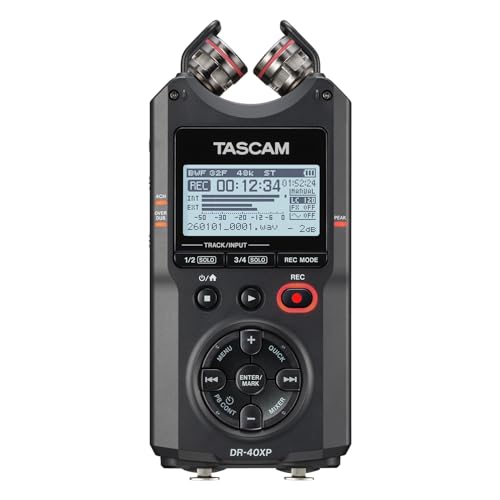
- 32-bit float recording with four-channel capture
- Adjustable A-B/X-Y microphones rated to 125 dB SPL
- USB-C 2-in/2-out audio interface functionality
Best For: Music, video, and interview setups using multiple sources
Advanced Multitrack Pick

- Six-track 32-bit float recording
- Four XLR/TRS inputs plus built-in X/Y mics
- Interchangeable capsules and USB interface mode
Best For: Multitrack music, podcast, film, and live-event recording
Flexible 32-Bit Float Pick
Xvive XV1-R Portable Stereo Recorder

- 32-bit float recording reduces gain-setting concerns.
- X/Y microphones handle sources up to 130 dB SPL.
- USB microphone mode and AAC support add flexibility.
Best For: Portable stereo recording and space-conscious sessions
Expandable Multitrack Choice
Zoom H5 4-Track Handheld Recorder
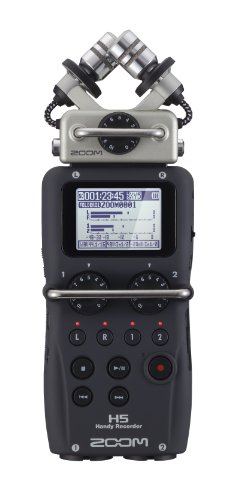
- Four-track simultaneous recording supports layered production.
- Two XLR/TRS inputs offer phantom power and -20 dB pads.
- Interchangeable capsules broaden recording options.
Best For: Filmmakers and musicians using external microphones
Most Versatile Pattern Selection

- Three microphones provide nine selectable recording patterns.
- 32-bit float recording reduces the need for gain adjustments.
- USB microphone mode can record a simultaneous SD backup.
Best For: Interviews, podcasts, and varied field recording patterns
Best for Expandable Setups – Zoom H4 Essential
The Zoom H4 Essential is a versatile choice among handheld field recorders when you need more than a basic stereo capture. Its built-in microphones, dual XLR/TRS inputs, four-track recording, and 32-bit float support make it suitable for music, interviews, podcasts, video audio, and live performances.
Best For: Musicians, podcasters, filmmakers, and creators who need built-in microphones plus connections for external mics, instruments, mixers, or soundboards.
Pros:
- Four-track recording supports larger projects.
- 32-bit float recording helps provide clip-free audio.
- Built-in stereo microphones and two XLR/TRS inputs offer flexible recording options.
- USB-C supports recording or streaming while saving a backup to an SD card.
Cons:
- Uses two AA batteries and has a listed recording time of up to 10 hours.
- Its expanded inputs and controls may be more than needed for simple stereo recordings.
Choose the H4 Essential if your projects may grow from quick field recordings into multitrack music, interview, or production work. Spoken menu guidance is also a useful accessibility feature.
Best Simple 32-Bit Option – TASCAM DR-05XP
The TASCAM DR-05XP is a straightforward option for handheld field recorders, using built-in omnidirectional condenser microphones to capture music, voice, meetings, dictation, and audio for video. It offers 32-bit float recording as well as conventional WAV and MP3 modes.
Best For: Buyers who want a compact stereo recorder with simple operation, USB-C computer connectivity, and long battery operation.
Pros:
- Supports 32-bit float, 24-bit, and 16-bit recording at multiple sample rates.
- Built-in microphones handle sources up to 125dB SPL.
- Functions as a 2-in/2-out USB-C audio interface.
- Offers up to 17.5 hours of operation with two AA alkaline batteries.
Cons:
- SD card and batteries are not included.
- Built-in stereo microphones do not provide the input flexibility of a recorder with XLR connectors.
The DR-05XP is a practical pick for portable stereo recording and computer-based work. Its long stated battery life makes it especially convenient for extended sessions away from an outlet.
Best Lightweight Creator Recorder – Zoom H1 Essential
The Zoom H1 Essential is a compact entry in the handheld field recorders category, built for clear stereo capture in a small package. Its X/Y microphones and 32-bit float recording suit videos, podcasts, interviews, rehearsals, ambience, sound effects, and everyday documentation.
Best For: Content creators, students, musicians, and travelers who want a lightweight recorder that can also work as a USB microphone.
Pros:
- Weighs 92 g for easy carrying.
- X/Y stereo microphones capture voices, music, and environmental sound.
- 32-bit float recording supports clip-free audio.
- USB-C microphone mode works for livestreams, calls, voiceovers, and podcasts.
Cons:
- Uses two AAA batteries with a listed 10-hour recording time.
- It has a simpler microphone and connectivity setup than models with external XLR inputs.
The H1 Essential makes sense when portability and quick setup matter more than multitrack expansion. It is a flexible grab-and-go tool for improving sound beyond a phone or camera alone.
Best Adjustable-Mic Value – TASCAM DR-07XP
The TASCAM DR-07XP is one of the more adaptable handheld field recorders for stereo work because its condenser microphones can be configured in AB or XY arrangements. It also combines 32-bit float recording, an external microphone input, headphone output, and USB-C interface functionality.
Best For: Recordists who want adjustable stereo microphone positioning for music, voice, video audio, meetings, or field sound.
Pros:
- Adjustable AB/XY stereo condenser microphones offer recording flexibility.
- Supports 32-bit float, 24-bit, 16-bit, WAV, and MP3 recording.
- Includes a 3.5mm mic/external input with plug-in power.
- Provides up to 17.5 hours of operation with two AA alkaline batteries.
Cons:
- MicroSD, microSDHC, and microSDXC cards are not included.
- Two AA batteries are sold separately.
The DR-07XP is a strong middle ground for users who want more control over stereo imaging without moving to a larger recorder with professional XLR inputs. Its USB-C interface also supports direct computer recording.
Budget-Friendly Pick – Zoom H2n Handy Recorder
The renewed Zoom H2n is a practical choice for shoppers comparing handheld field recorders for basic stereo recording, interviews, rehearsals, and portable note-taking. It records WAV files up to 24-bit/96kHz or MP3 files up to 320kbps, while its AA-battery design supports over 20 hours of operation.
Best For: Buyers who want an affordable, straightforward recorder with long battery life and flexible recording formats.
Pros:
- Over 20 hours of operation from two standard AA batteries
- Records high-resolution WAV and compressed MP3 audio
- Includes useful tools such as a lo-cut filter, compressor/limiter, auto gain, tuner, and metronome
- Supports practical editing and playback functions, including markers, file dividing, normalization, and variable-speed playback
Cons:
- This is a renewed product rather than a new unit
- Its listed 1.8-inch display is relatively compact
- The supplied specifications list analog signal format and do not mention XLR/TRS inputs
The H2n makes the most sense when portability, battery endurance, and recording flexibility matter more than advanced multitrack connectivity. Its broad set of built-in utilities also makes it useful for everyday field recording.
Flexible 4-Channel Pick – TASCAM DR-40XP Field Recorder
The TASCAM DR-40XP stands out among handheld field recorders for creators who need both built-in microphones and external inputs. Its adjustable stereo mics, four-channel recording, 32-bit float support, and USB-C interface make it suited to music, video, and interview workflows.
Best For: Musicians, videographers, and interview creators who need multiple recording sources and computer or mobile connectivity.
Pros:
- 32-bit float recording helps support clip-free capture
- Records four channels from the built-in microphones and external inputs simultaneously
- Adjustable A-B or X-Y microphones handle up to 125 dB SPL
- Works as a 2-in/2-out USB-C audio interface
Cons:
- microSD card and batteries are not included
- The four-channel workflow may be more than casual users need
- The supplied notes do not specify the included battery runtime
The DR-40XP is a strong middle-ground option for portable production. It offers considerably more routing and input flexibility than a basic stereo recorder without requiring a separate interface for computer-based recording.
Advanced Multitrack Pick – Zoom H6 Essential Recorder
The Zoom H6 Essential is one of the more capable handheld field recorders in this lineup, combining six-track 32-bit float recording with four XLR/TRS combo inputs and built-in X/Y microphones. It is designed for musicians, podcasters, and filmmakers who need to capture several sources while retaining a flexible computer interface.
Best For: Multitrack recording of bands, interviews, film audio, and live events where multiple inputs and clip-free capture are important.
Pros:
- Six-track 32-bit float recording supports distortion-free capture across multiple sources
- Four XLR/TRS inputs complement built-in X/Y microphones rated up to 135 dB SPL
- Interchangeable 3.0 mic capsule system supports different recording scenarios
- Can function as a USB audio interface while recording to an SD card for backup
Cons:
- Requires four AAA batteries
- Its larger feature set may be unnecessary for simple stereo recording
- Optional capsules are needed to expand beyond the included microphone configuration
The H6 Essential is the best fit when a portable recorder needs to handle several microphones or instruments at once. Audio guidance and broad USB compatibility add useful accessibility and workflow flexibility for both field and studio-style production.
Flexible 32-Bit Float Pick – Xvive XV1-R Portable Stereo Recorder
The Xvive XV1-R is a compact choice among handheld field recorders for musicians, podcasters, filmmakers, and anyone recording changing sound levels. Its 32-bit float capture, X/Y microphones, and auto-record features help simplify mobile recording, while AAC support provides a space-saving option for longer sessions.
Best For: Portable stereo recording, high-dynamic-range sources, meetings, voice memos, and USB microphone use.
Pros:
- 32-bit float recording helps avoid gain-setting problems and distortion from unexpected volume changes.
- X/Y microphones capture up to 130 dB SPL and support stereo recording for concerts, speeches, and ambient sound.
- Works as a USB microphone with PCs, Macs, iOS devices, and Android devices.
- AAC recording can reduce file sizes, with up to 12 hours of recording time.
Cons:
- No headphone jack is listed in the supplied specifications.
- Records to compatible microSD cards, with individual files limited to 4GB before automatic splitting.
The XV1-R stands out for users who want modern 32-bit float recording in a lightweight package. Its flexible WAV and AAC options make it practical for both high-quality production and storage-conscious recording.
Expandable Multitrack Choice – Zoom H5 4-Track Handheld Recorder
The Zoom H5 is a versatile option among handheld field recorders for filmmakers and musicians who need more input control than a basic stereo recorder provides. Its interchangeable capsule system, two XLR/TRS inputs, and four-track recording support a range of mobile production setups.
Best For: Filmmaking, music recording, external microphones, and multitrack mobile production.
Pros:
- Records up to four tracks simultaneously.
- Two XLR/TRS combo inputs include selectable phantom power and -20 dB pads.
- Interchangeable input capsules allow the recorder to adapt to different recording needs.
- Functions as a multichannel or stereo USB audio interface for PC, Mac, and iPad.
Cons:
- Recording support is limited to SD/SDHC cards up to 32GB.
- Its feature set and external-input design may be more than needed for simple voice memos.
The H5 is a strong fit when expandability and physical inputs matter more than the simplest point-and-shoot workflow. The included shock-mounted X/Y capsule also helps reduce handling noise during handheld use.
Most Versatile Pattern Selection – Zoom H2 Essential Recorder
The Zoom H2 Essential is a flexible pick among handheld field recorders, combining three built-in microphones with nine selectable recording patterns. Its 32-bit float/96kHz recording, simultaneous USB microphone and SD recording, and long stated battery life make it suitable for changing field and studio-style applications.
Best For: Interviews, podcasts, musicians, stereo or surround recording, and accessible field workflows.
Pros:
- Three built-in microphones and nine patterns support mono, stereo, and surround recording.
- 32-bit float recording captures clip-free audio without requiring constant gain adjustments.
- Can operate as a USB microphone while recording a backup to the SD card.
- Bluetooth timecode can wirelessly sync multiple H2 Essential units.
Cons:
- The supplied specifications list a 1.3-inch screen, which may feel compact for menu navigation.
- Bluetooth timecode functionality requires multiple compatible H2 Essential units for multi-recorder syncing.
The H2 Essential is particularly appealing when one recorder needs to cover several pickup patterns. Its simultaneous USB and SD recording adds useful redundancy, while audible menus in seven languages improve accessibility.
How We Picked the Best Handheld Field Recorders
We focused on practical features that affect real-world recording: microphone quality, recording formats, input flexibility, portability, battery operation, monitoring, storage, and computer connectivity. The selection includes simple stereo models for quick recordings, 32-bit float recorders that reduce the risk of clipped takes, and multitrack options for musicians and filmmakers.
Because recording needs vary, we considered both ease of use and expansion potential. A compact recorder may be ideal for interviews or location notes, while a model with XLR/TRS inputs is better suited to professional microphones, instruments, or small production setups.
Quick Comparison
| Best For | Look For | Typical Advantage |
|---|---|---|
| Interviews and notes | Compact design, simple controls, built-in stereo microphones | Fast setup and easy carrying |
| Music and rehearsals | High sound-pressure handling, adjustable microphone patterns, overdub features | More recording flexibility |
| Film and video | External inputs, headphone monitoring, low-cut filtering, reliable mounting | Better control over production audio |
| Unpredictable volume levels | 32-bit float recording and a safety-oriented workflow | More recovery room when levels change |
Key Buying Factors for Handheld Field Recorders
Microphones and Pickup Pattern
Built-in X/Y microphones are convenient for focused stereo recordings, while adjustable capsules or broader pickup patterns can help capture a room, ensemble, or ambient environment. Check whether the microphone angle and sensitivity suit your intended source.
32-Bit Float Recording
32-bit float can make level management easier when loudness is difficult to predict, but it does not replace good microphone placement or eliminate unwanted noise. Confirm that your editing software supports the format and that the recorder’s workflow fits your projects.
Inputs and Track Capacity
Choose a basic stereo recorder for built-in microphone work, or select a unit with XLR/TRS inputs if you need external microphones, line-level sources, phantom power, or instruments. Multitrack models are useful when recording several sources independently.
Handling, Power, and Connectivity
Look for a comfortable grip, physical controls, a clear display, headphone output, and a dependable power option. USB-C connectivity can simplify file transfer and may allow the recorder to function as a USB audio interface. Also check memory-card compatibility and expected battery life.
Who Should Buy Which Handheld Field Recorders?
Choose a compact stereo recorder if you want quick interviews, lectures, rehearsals, travel recordings, or personal notes with minimal setup.
Choose a 32-bit float model if you record changing sound levels, live events, outdoor ambience, or video where retakes are costly.
Choose a recorder with XLR/TRS inputs if you use professional microphones, record instruments, need phantom power, or want to expand beyond the built-in microphones.
Choose a multitrack model if you need separate control over several sources during music production, filmmaking, or live recording. Before buying, verify the included accessories, microphone configuration, input count, and whether the recorder’s editing and transfer workflow matches your existing setup.