
A headphone amplifier with optical input can add cleaner digital connectivity to a desktop, gaming setup, TV, or powered-speaker system. The right model can also provide stronger headphone output, useful volume control, and more connection flexibility than a basic computer or console jack.
We selected 10 options ranging from compact budget DAC amps to balanced desktop units with USB, Bluetooth, tone controls, preamp outputs, and high-resolution audio support. Use the guide below to match features, power, and connections to the way you actually listen.
Best 10 Headphone Amplifiers with Optical Input Picks for 2026
Best Balanced Desktop Pick

- Optical, USB, coaxial, and RCA inputs
- 4.4mm balanced and 6.35mm outputs
- Up to 2000mW stable output power
Best For: Desktop listeners wanting balanced connectivity and strong headphone drive
Best Budget Tone-Control Option

- Optical, coaxial, and USB inputs
- Bass and treble adjustment knobs
- 24-bit/192kHz optical and coaxial support
Best For: Compact PC, TV, and gaming audio setups
Best Feature-Rich Preamp
- Optical, USB, coaxial, and RCA inputs
- XLR, RCA, 4.4mm, and 6.35mm outputs
- Balanced output up to 2570mW at 32 ohms
Best For: Flexible desktop HiFi systems with headphones and active equipment
Best for Gaming Controls
- Optical and coaxial support up to 24-bit/192kHz
- Bass, treble, and master volume controls
- Microphone input for gaming setups
Best For: PS5, PC, and Mac gamers needing simple audio controls
Versatile Hi-Fi Pick

- USB and optical inputs with multiple outputs
- 560mW per channel at 32Ω
- High/low gain and tone controls
Best For: Flexible desktop headphone and DAC setups
Gaming and Balanced Power Pick

- 10-band PEQ with left/right tuning
- 1000mW x2 balanced output
- Optical I/O and PS5/Switch support
Best For: Customizable console and PC gaming audio
Compact Tone-Control Pick

- USB, optical, and coaxial inputs
- Bass and treble adjustment
- Compact aluminum desktop design
Best For: Simple home and desktop audio systems
Versatile Powerhouse

- Optical, USB-C, coaxial, Bluetooth, and mic input
- 2100mW output with balanced and single-ended options
- High-resolution PCM 384kHz/32bit and DSD256 support
Best For: Flexible desktop gaming and music systems
Simple Value Pick

- Optical, USB, and coaxial inputs
- Bass and treble adjustment controls
- Compact metal design with 3.5mm and RCA outputs
Best For: Entry-level PC, TV, and home stereo setups
Balanced Desktop Specialist

- Optical and USB-C inputs with plug-and-play operation
- 4.4mm balanced and 3.5mm headphone outputs
- Works as a headphone amp or preamp
Best For: Compact balanced headphone and IEM systems
Best Balanced Desktop Pick – FiiO K7
The FiiO K7 is a strong choice for anyone shopping for headphone amplifiers with optical input and wanting a versatile desktop setup. Its optical, coaxial, USB, and RCA inputs pair with balanced and single-ended headphone outputs, while its high power reserve suits many full-size headphones.
Best For: Desktop listeners who want balanced connectivity, high output power, and flexible source selection.
Pros:
- Optical input is joined by USB, coaxial, and RCA connectivity.
- Offers 4.4mm balanced plus 6.35mm and 3.5mm single-ended outputs.
- Provides up to 2000mW stable output power and two gain levels.
- RGB indicators show operating status and sampling rates.
Cons:
- Its desktop design and 1.18 kg weight are less suited to portable use.
- Some features may be more than casual listeners need.
With broad input support and substantial amplification, the K7 is a well-rounded option for a dedicated desktop audio system, especially if balanced output is important.
Best Budget Tone-Control Option – AIYIMA DAC-A2
The AIYIMA DAC-A2 is a compact option for shoppers seeking headphone amplifiers with optical input for a PC, television, or gaming setup. It converts optical, coaxial, and USB sources to RCA or 3.5mm analog output and adds convenient bass and treble controls.
Best For: Users who want plug-and-play digital audio conversion, simple tone adjustment, and a compact desktop form factor.
Pros:
- Supports optical, coaxial, and USB inputs with no driver downloads required.
- Provides RCA and 3.5mm analog outputs for headphones or desktop audio gear.
- Bass and treble knobs allow quick front-panel sound adjustments.
- Supports up to 24-bit/192kHz through optical or coaxial inputs.
Cons:
- Its 160mW RMS output at 32 ohms is less powerful than larger desktop amplifiers.
- The supplied specifications identify the chassis material as plastic.
The DAC-A2 emphasizes convenience and flexibility rather than premium balanced connectivity, making it a practical fit for everyday computer, TV, and gaming audio.
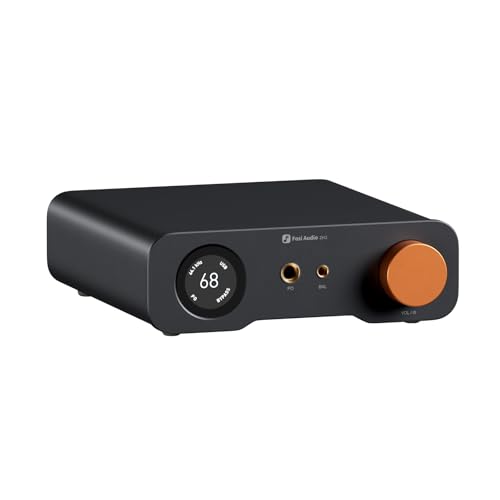
Best Feature-Rich Preamp – Fosi Audio ZH3
The Fosi Audio ZH3 is a feature-rich choice among headphone amplifiers with optical input, combining DAC, headphone amp, and preamp functions in one desktop unit. It supports optical, coaxial, USB, and RCA sources, along with balanced and single-ended outputs.
Best For: HiFi desktop systems that need extensive connectivity, remote control, balanced output, and preamp functionality.
Pros:
- Includes optical, coaxial, USB, and RCA inputs.
- Offers 4.4mm, 6.35mm, RCA, and XLR outputs.
- Delivers up to 2570mW at 32 ohms through balanced output.
- Includes three gain levels, EQ controls, filters, and a remote.
Cons:
- EQ adjustments apply only to headphone output.
- RCA and XLR output levels differ significantly, so system matching requires care.
- Its extensive features may be unnecessary for a simple headphone-only setup.
The ZH3 stands out when a system needs to feed headphones and other audio equipment, though buyers should pay attention to output selection and the limits of its EQ function.
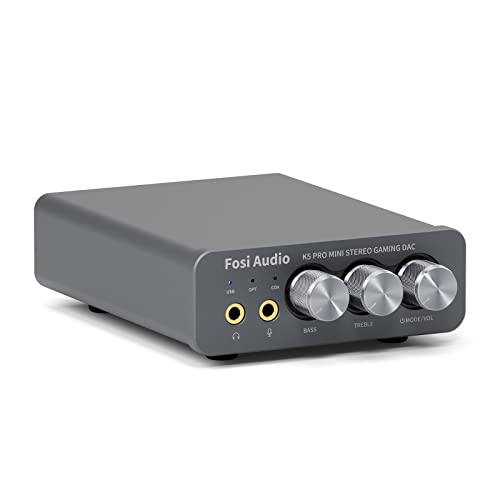
Best for Gaming Controls – Fosi Audio K5 Pro
The Fosi Audio K5 Pro is a gaming-focused pick for shoppers comparing headphone amplifiers with optical input. It accepts USB-C, optical, and coaxial signals, provides bass and treble controls, and includes a microphone input for console and computer setups.
Best For: Gamers using PS5, PC, or Mac who want straightforward source switching, microphone support, and adjustable sound.
Pros:
- Supports optical and coaxial audio up to 24-bit/192kHz.
- Includes USB-C input, 3.5mm headphone output, RCA output, and microphone connectivity.
- Bass, treble, and master volume controls are easy to access.
- Rated output ranges from 1000mW at 16 ohms to 80mW at 300 ohms.
Cons:
- USB-C audio is limited to up to 24-bit/96kHz.
- It uses single-ended 3.5mm headphone connectivity rather than balanced output.
- The combined power and volume control may require a long press to switch on.
The K5 Pro is a practical gaming DAC amp for users who value controls and microphone support over audiophile-oriented balanced connections.
Versatile Hi-Fi Pick – Douk Audio K5
The Douk Audio K5 is a flexible choice among headphone amplifiers with optical input, combining USB and SPDIF optical connectivity with headphone, RCA, and optical outputs. Its high/low gain settings, tone controls, and dual headphone jacks make it suitable for both desktop listening and broader audio setups.
Best For: Listeners who want a powerful, feature-rich desktop DAC and headphone amplifier for headphones ranging from 16Ω to 600Ω.
Pros:
- Supports USB and optical input, plus optical, RCA, 6.35mm, and 3.5mm outputs.
- Delivers up to 560mW per channel at 32Ω and includes high/low gain modes.
- Offers bass and treble controls with a bypass setting for a purer signal path.
- Supports PCM up to 32-bit/384kHz and DSD256 playback.
Cons:
- Its broad feature set may be more than users need for a simple headphone-only setup.
- The supplied specifications contain inconsistent power-supply wording, so buyers should verify their preferred connection and power arrangement.
With strong output, extensive connectivity, and useful tone and gain controls, the K5 is a well-rounded option for users building a compact desktop audio system around optical or USB sources.
Gaming and Balanced Power Pick – TOPPING DX1 II Gaming DAC Amp
The TOPPING DX1 II stands out among headphone amplifiers with optical input for gaming-focused setups that also need serious headphone power. It adds optical I/O, USB-C connectivity, 10-band PEQ customization, balanced 4.4mm output, and compatibility with PS5 and Nintendo Switch.
Best For: Gamers and desktop listeners who want customizable EQ, balanced headphone output, console compatibility, and headset microphone support.
Pros:
- Provides optical input/output and USB-C connectivity for computers, consoles, TVs, and streamers.
- 10-band PEQ supports custom profiles, frequency and bandwidth adjustments, and independent left/right tuning.
- 4.4mm balanced output provides up to 1000mW per channel at 32Ω and 64Ω.
- Supports PS5, Nintendo Switch, UAC 1.0/2.0, and 3.5mm TRRS microphone headsets.
Cons:
- The advanced PEQ features require TOPPING Tune software for profile creation and adjustment.
- Its maximum output at 300Ω is lower than its 32Ω and 64Ω figures.
The DX1 II is especially compelling when gaming features matter as much as music playback. Its optical processing, balanced output, low-noise design, and console support make it a versatile centerpiece for a modern gaming desk.
Compact Tone-Control Pick – Nobsound Q3 Mini DAC Amp
The Nobsound Q3 is a compact, straightforward option among headphone amplifiers with optical input. It accepts USB, optical, and coaxial sources, then provides RCA and 3.5mm headphone output with a volume control plus separate bass and treble adjustment.
Best For: Desktop and home-stereo users seeking an affordable-size DAC and headphone amp with simple tone controls and broad source compatibility.
Pros:
- Works with PC-USB, optical, and coaxial digital sources.
- Includes RCA and 3.5mm headphone output with one volume control.
- Bass and treble controls allow quick sound adjustments for different recordings or headphones.
- Compact aluminum case suits desktop and home audio systems.
Cons:
- Digital processing is limited to up to 24-bit/96kHz.
- It does not list balanced headphone output or the higher power figures offered by the other two models.
The Q3 favors convenience over extensive high-resolution features. Its optical, coaxial, and USB inputs, straightforward controls, and compact enclosure make it a practical fit for basic desktop or TV-connected audio systems.
Versatile Powerhouse – Fosi Audio K7
For shoppers seeking headphone amplifiers with optical input, the Fosi Audio K7 stands out as a feature-rich desktop hub. It combines optical connectivity with USB-C, coaxial, Bluetooth aptX HD/LL, and a microphone input, while offering both balanced and single-ended headphone outputs.
Best For: Desktop listeners, gamers, and users who need broad connectivity and substantial power for demanding headphones.
Pros:
- Supports optical, USB-C, coaxial, Bluetooth, and 3.5mm microphone input.
- Up to 2100mW output power with 4.4mm balanced and 3.5mm outputs.
- High-resolution decoding up to PCM 384kHz/32bit and DSD256.
- Solid aluminum chassis with display, shortcut buttons, and dual control knobs.
Cons:
- Its extensive feature set may be more than needed for a simple headphone setup.
- Requires an external 12V power supply.
The K7 is a strong all-in-one choice when optical input is only one part of a broader desktop audio system. Its powerful amplification, multiple outputs, and convenient controls make it particularly suitable for mixed gaming, music, and speaker setups.
Simple Value Pick – Fosi Audio Q4
The Fosi Audio Q4 is a straightforward option for shoppers comparing headphone amplifiers with optical input. Its optical, USB, and coaxial inputs accommodate common home sources, while bass and treble controls let you adjust the presentation without installing drivers.
Best For: Entry-level desktop users connecting a PC, TV, DVD player, headphones, powered speakers, or an existing amplifier.
Pros:
- Includes optical, USB, and coaxial inputs.
- Offers 3.5mm headphone and RCA outputs for flexible system connections.
- Bass and treble controls provide simple sound customization.
- Compact metal design supports plug-and-play setup and 24-bit/192kHz audio.
Cons:
- No microphone input.
- Drives headphones from 16Ω to 200Ω, which may limit compatibility with some higher-impedance models.
The Q4 focuses on useful everyday connections rather than advanced balanced outputs or wireless features. It is a practical, compact choice for improving and controlling audio from several digital sources.
Balanced Desktop Specialist – Fosi Audio SK02
The Fosi Audio SK02 is a compact contender among headphone amplifiers with optical input, adding USB-C connectivity, high-resolution decoding, and a 4.4mm balanced output. Its control knob, gain selection, and indicator lights keep a small desktop setup easy to operate.
Best For: Headphone and IEM users who want a compact DAC amp with balanced output and preamp capability.
Pros:
- Supports optical and USB-C input for computers, TVs, CD players, and projectors.
- Provides both 4.4mm balanced and 3.5mm single-ended headphone outputs.
- Supports headphones and IEMs rated from 16Ω to 300Ω.
- Can function as a preamp for active speakers or an amplifier.
Cons:
- Connectivity is more limited than models that include Bluetooth or coaxial input.
- Its balanced output requires compatible 4.4mm headphones or a suitable cable.
The SK02 makes the most sense when compact size and balanced headphone connectivity matter. It also offers useful system-building flexibility as a preamp, while retaining plug-and-play operation for everyday desktop listening.
How We Picked These Headphone Amplifiers with Optical Input
We focused on models that include a clearly stated optical input and combine digital-to-analog conversion with headphone amplification. The selection covers several price and feature levels, including compact PC DACs, gaming-focused units, balanced headphone amps, and preamp-capable desktop systems.
We also considered connection variety, output options, rated power, support for high-resolution formats, ease of use, and compatibility with common sources such as computers, game consoles, TVs, powered speakers, and stereo amplifiers. Because specifications can vary by output and load, treat maximum power figures as a comparison point rather than a guarantee of identical real-world performance.
Quick Comparison
| Best For | Features to Prioritize | Models in This Roundup |
|---|---|---|
| PC or Mac desktop listening | USB, optical, compact controls | AIYIMA DAC-A2, Douk Audio K5, Fosi Audio Q4 |
| Gaming and multiple consoles | Optical input, low noise, easy switching | Fosi Audio K5 Pro, TOPPING DX1 II, Fosi Audio K7 |
| Harder-to-drive headphones | Higher output and balanced connection | FiiO K7, Fosi Audio ZH3, Fosi Audio SK02 |
| Tone-control flexibility | Bass, treble, or digital EQ | Nobsound Q3, TOPPING DX1 II, Fosi Audio K5 Pro |
Key Buying Factors for Headphone Amplifiers with Optical Input
Inputs and Source Compatibility
Optical is useful for TVs, consoles, and devices with electrical noise on USB, but it usually does not carry microphone signals or advanced two-way features. Check whether you also need USB, coaxial, RCA, or Bluetooth. Confirm the optical format and sample-rate support for your source before buying.
Headphone Output and Power
Easy-to-drive headphones and most gaming headsets need relatively little power, while high-impedance or low-sensitivity models benefit from a stronger amplifier. A 6.35mm output suits many full-size headphones; 3.5mm is common for portable models. A 4.4mm balanced output can provide a separate signal path, but your headphones must have a compatible balanced cable.
Outputs and System Integration
If the amplifier will also feed powered speakers or a stereo amplifier, look for RCA preamp or line outputs. Decide whether you want fixed-level output, variable volume control, or a switchable headphone/speaker path. A front-mounted volume knob and input selector can matter more for daily use than a very high sample-rate specification.
Controls, EQ, and Format Support
Bass and treble controls help compensate for a room, speakers, or headphone balance. Parametric or multi-band EQ offers more precision but may require software or an app. High-resolution PCM and DSD support is useful only when your source and listening library use those formats, so do not choose solely by the largest number on the specification sheet.
Who Should Buy Which Headphone Amplifiers with Optical Input?
Choose the FiiO K7 or Fosi Audio ZH3 if you want a more capable desktop setup with strong output and broader system connectivity. The TOPPING DX1 II is a good fit for listeners who value balanced output and adjustable digital EQ, while the Fosi Audio SK02 suits users wanting a compact unit with USB-C, optical, and both balanced and single-ended headphone connections.
For gaming and general PC use, consider the Fosi Audio K5 Pro, Fosi Audio K7, or Fosi Audio Q4, depending on whether you prioritize tone controls, Bluetooth, or a straightforward desktop design. The AIYIMA DAC-A2 and Douk Audio K5 are sensible compact choices for basic digital conversion and headphone listening. Choose the Nobsound Q3 if convenient optical/coaxial connectivity and hands-on bass and treble adjustment are your main priorities.