
Finding the right multitrack recorder can make songwriting, rehearsal capture, and mobile production much easier. The best choice depends on how many inputs and tracks you need, whether you want built-in microphones or effects, and how closely you work with a computer.
These 10 options cover compact battery-powered recorders, feature-rich tabletop studios, and mixer-recorders suited to bands, creators, and home setups.
Best 10 Multitrack Recorders for Musicians Picks for 2026
Best Compact Multitrack Recorder

- 32-bit float recording helps prevent clipping
- Two XLR/TRS combo inputs
- Battery-powered with rhythms and effects
Best For: Portable songwriting and quick demos
Best Portable Practice Recorder
- Three modes for recording and practice
- 64 V-Tracks with eight-track playback
- Built-in microphones, effects, and backing patterns
Best For: Practice, play-alongs, and portable recording
Best Touchscreen Multitrack Recorder
- Up to 16 tracks and eight simultaneous tracks
- Six XLR inputs with touchscreen editing
- Includes effects, rhythms, and onboard synth
Best For: Computer-free band recording and demos
Best Mixer-Style Multitrack Recorder

- 12-track mixer, recorder, and USB interface
- 12-in/10-out USB connectivity
- Built-in compression, EQ, MIDI, and dual headphones
Best For: Home studios and mixer-based recording setups
Best Touchscreen Workflow

- Eight-track recording with touchscreen editing
- Built-in drum loops, FM synths, MIDI, and effects
- USB-C interface with phantom power and Hi-Z input
Best For: Portable songwriting and computer-free music production
Best Simple Songwriting Recorder

- Eight-track pocketstudio with built-in stereo microphones
- Battery powered with four AA batteries
- Includes 2GB SD card and records WAV files
Best For: Portable songwriting and quick idea capture
Best for Band Monitoring

- Captures up to 12 tracks at 24-bit/96kHz
- Four headphone outputs with three custom mixes
- Records to SD card and computer simultaneously
Best For: Bands, rehearsals, live sessions, and podcasts
Best All-in-One Pick
TASCAM DP-03SD 8-Track Portastudio

- Eight-track recording with two-channel simultaneous input
- Built-in condenser mics, tuner, metronome, and mastering effects
- XLR and TRS connections for microphones and instruments
Best For: Home recording and intuitive standalone songwriting
Best for Expanded Recording

- Eight-track simultaneous recording with 16-track playback
- Two XLR combo inputs plus built-in stereo microphones
- USB interface, pad sampler, and rhythm machine
Best For: Multi-source tabletop recording and flexible music production
Best Portable Pick

- Lightweight, battery-operated six-track recorder
- Built-in stereo omni-directional condenser microphones
- CD-quality WAV recording with two-track simultaneous input
Best For: Portable songwriting, demos, and capturing ideas on the go
Best Compact Multitrack Recorder – Zoom R4
The Zoom R4 is a compact choice for musicians who want multitrack recorders for musicians that can capture ideas without complicated gain setup. It records up to four tracks, supports XLR/TRS sources, and can bounce tracks to keep layering.
Best For: Portable songwriting, demos, vocal and instrument ideas, and battery-powered recording.
Pros:
- 32-bit float recording helps avoid clipping without manual gain adjustments.
- Two XLR/TRS combo inputs accommodate microphones, instruments, and keyboards.
- Includes over 80 rhythm patterns, built-in effects, and a stereo microphone.
- Works as a USB audio interface and runs on AA batteries or USB-C.
Cons:
- Recording is limited to four tracks at a time before bouncing.
- Its compact design provides fewer inputs than larger tabletop recorders.
The R4 is a practical fit when portability and quick idea capture matter more than a large track count. Its bounce workflow and clip-resistant recording make it especially approachable for solo musicians.
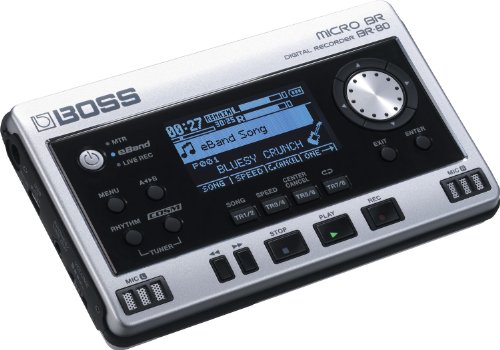
Best Portable Practice Recorder – Roland BR-80
The Roland BR-80 combines multitrack recording with practice-focused features in a portable format. Among multitrack recorders for musicians, it stands out for its three operating modes, built-in stereo microphones, backing patterns, and phrase-training tools.
Best For: Musicians who want recording, play-along practice, and portable stereo capture in one device.
Pros:
- Offers MTR, eBand, and Live Recorder modes.
- Provides 64 V-Tracks and eight simultaneous playback tracks.
- Built-in stereo condenser microphones enable instant recording.
- Includes COSM amps, effects, backing patterns, and USB interface functionality.
Cons:
- SD/SDHC storage is limited to cards up to 32 GB.
- Its single AAA battery requirement and older bundled software may be less convenient for some setups.
The BR-80 is a versatile option for players who value practice features as much as multitrack recording. Its eBand mode and built-in patterns make it useful beyond conventional song tracking.
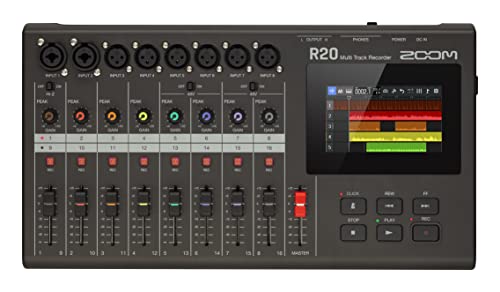
Best Touchscreen Multitrack Recorder – Zoom R20
The Zoom R20 is designed for musicians who want a computer-free workflow from multitrack recorders for musicians. Its touchscreen interface supports recording, editing, and mixing, while six XLR inputs and up to 16 tracks provide room for larger projects.
Best For: Bands, full demos, and hands-on recording and editing without relying on a computer.
Pros:
- Records up to 16 tracks, with up to eight tracks simultaneously.
- Six XLR inputs and combo connectivity support multiple sources.
- Touch controls simplify arranging and editing audio directly on the unit.
- Includes EQ, compression, 150 rhythm patterns, and an onboard synth with 18 sounds.
Cons:
- At 4.3 pounds, it is less portable than compact handheld recorders.
- Its maximum sample rate is 44.1 kHz.
The R20 is a strong middle ground between a traditional recorder and a DAW-style setup. It is particularly appealing for musicians who want multiple inputs and visual editing while keeping the recording process self-contained.
Best Mixer-Style Multitrack Recorder – Tascam Model 12
The Tascam Model 12 is an all-in-one mixer, recorder, USB interface, and DAW controller for musicians who need a more studio-oriented setup. It offers 12 channels, 12-in/10-out USB connectivity, onboard MIDI, and hands-on control for connected recording workflows.
Best For: Home studios, rehearsals, and musicians who want mixer controls alongside multitrack computer recording.
Pros:
- Combines a 12-track digital recorder, mixer, USB interface, and DAW controller.
- Provides 12-in/10-out USB connectivity for DAW integration.
- Each input module includes a one-knob compressor and three-band EQ.
- Offers click output with tap tempo, onboard MIDI, and dual headphone outputs.
Cons:
- Its corded design and 13.3-pound weight make it less suitable for mobile recording.
- The mixer-style footprint requires more setup space than compact recorders.
The Model 12 is best suited to musicians who want physical mixer controls and broad computer connectivity rather than a pocket-sized recorder. It makes a practical centerpiece for a fixed rehearsal or home-studio rig.
Best Touchscreen Workflow – Zoom R12
The Zoom R12 is a flexible choice among multitrack recorders for musicians who want hands-on, computer-free recording. Its touchscreen, onboard editing tools, effects, drum loops, and built-in synths make it useful for developing complete song ideas on the go.
Best For: Musicians who want portable, touchscreen-based multitrack recording with built-in songwriting tools.
Pros:
- Records up to eight tracks and supports DAW-style editing without a computer.
- Includes 150 drum loops, 18 FM synth instruments, MIDI support, and onboard effects.
- Offers two XLR/TRS inputs, 48V phantom power, and Hi-Z guitar or bass input.
- Works as a stereo USB-C interface and DAW control surface.
Cons:
- Battery life is rated at up to five hours, so extended sessions may require replacement batteries.
- Its two physical inputs may be limiting for larger simultaneous recording setups.
The R12 stands out for musicians who value portability and creative features over a large input count. It is especially well suited to songwriting, demos, and mobile production.
Best Simple Songwriting Recorder – TASCAM DP-008EX
The TASCAM DP-008EX is a straightforward option among multitrack recorders for musicians who want an eight-track pocketstudio for songwriting. Built-in stereo microphones, WAV recording, battery operation, and an included 2GB SD card support portable idea capture.
Best For: Songwriters seeking a compact, battery-operated recorder with built-in microphones.
Pros:
- Provides eight-track digital multitrack recording in a compact format.
- Built-in stereo microphones allow quick recording without an external microphone.
- Runs on four AA batteries and includes a 2GB SD card and USB cable.
- Records in WAV format and includes a headphone output.
Cons:
- The supplied notes do not specify onboard effects, drum loops, or touchscreen editing.
- Its listed two-inch screen is smaller than the display on touchscreen-oriented recorders.
The DP-008EX focuses on essential recording rather than an extensive feature set. Its built-in microphones and battery operation make it a practical grab-and-record tool for song ideas.
Best for Band Monitoring – Zoom LiveTrak L-8
The Zoom LiveTrak L-8 combines a mixer and recorder for musicians who need multitrack recording in rehearsal, live, or podcast settings. It can capture up to 12 tracks at 24-bit/96kHz, while multiple headphone outputs and custom monitor mixes help performers hear what they need.
Best For: Bands, live sessions, and podcasters who need flexible mixing and individual headphone mixes.
Pros:
- Records up to 12 tracks simultaneously at 24-bit/96kHz to an SD card.
- Provides six preamps with up to +54dB of gain, 3-band EQ, and effects on every channel.
- Offers four headphone outputs and three independent monitor mixes.
- Can record to an SD card and computer simultaneously over USB.
Cons:
- Its mixer-style design is less focused on touchscreen or computer-free waveform editing.
- At 1,500g, it is heavier than the compact pocketstudio-style option in this roundup.
The L-8 is the strongest fit here for group recording and monitoring. Its channel count, multiple headphone outputs, and simultaneous SD-card and computer recording support collaborative sessions.
Best All-in-One Pick – TASCAM DP-03SD 8-Track Portastudio
The TASCAM DP-03SD is a practical choice among multitrack recorders for musicians who want a familiar Portastudio workflow with modern digital recording. It records up to eight tracks, accepts microphones and instruments, and includes built-in tools for shaping finished songs.
Best For: Home recording, songwriting, and musicians who want an intuitive standalone recorder with onboard microphones and mastering features.
Pros:
- Eight-track recording with two-channel simultaneous input.
- XLR input supports condenser microphones, while TRS inputs accommodate guitar and keyboard connections.
- Built-in stereo condenser microphones, tuner, metronome, editing functions, and mastering effects.
- Simple, cassette-style operation with WAV recording and included SD storage.
Cons:
- At 5.3 pounds, it is less portable than the pocket-sized DP-006.
- Its 2-channel simultaneous input may limit larger live recording setups.
Choose the DP-03SD if you value straightforward hands-on operation and want to complete polished recordings without relying on a computer. Its dedicated controls and built-in production tools make it a versatile standalone option.
Best for Expanded Recording – Zoom R8 Multitrack Recorder
The Zoom R8 is a strong fit for musicians comparing multitrack recorders for musicians who need more simultaneous recording capacity. It combines an eight-track recorder with 16-track playback, built-in stereo microphones, and USB connectivity for a flexible tabletop setup.
Best For: Musicians recording multiple sources at once who also want a tabletop recorder, USB audio interface, pad sampler, and rhythm machine.
Pros:
- Records up to eight tracks simultaneously and provides 16-track playback.
- Two XLR combo inputs and built-in stereo condenser microphones support varied recording setups.
- Records 16- or 24-bit, 44.1 kHz linear PCM WAV audio.
- Supports SDHC cards up to 32GB and connects through USB.
Cons:
- Maximum sample rate is 44.1 kHz.
- The supplied notes do not specify onboard mastering or editing features.
The R8 stands out when simultaneous input and flexible playback matter more than a minimal pocket format. Its combination of recording, interface, sampler, and rhythm functions gives it a broad role in a musician’s setup.
Best Portable Pick – TASCAM DP-006 Pocketstudio
The TASCAM DP-006 is a compact option for musicians seeking multitrack recorders for musicians that can travel easily. It offers six-track recording, two-track simultaneous recording, built-in microphones, and battery operation for capturing song ideas away from a studio.
Best For: Songwriters and mobile musicians who want a lightweight, battery-operated recorder for quick demos and portable multitrack work.
Pros:
- Compact 1.8-pound design with four included AA batteries.
- Supports up to six tracks and six-track simultaneous playback.
- Built-in stereo pair of omni-directional condenser microphones.
- Records CD-quality 16-bit/44.1 kHz WAV audio with a dedicated stereo master track.
Cons:
- Allows only two tracks to be recorded simultaneously.
- Its 2.5 mm headphone jack may require an adapter for standard headphones.
- It has fewer tracks and inputs than the DP-03SD and Zoom R8.
The DP-006 prioritizes portability and simplicity over high input capacity. It is especially appealing for sketching arrangements, recording acoustic ideas, and building demos wherever inspiration strikes.
How We Picked the Best Multitrack Recorders for Musicians
We compared these recorders by looking at recording capacity, input flexibility, portability, monitoring, onboard tools, storage, power options, and computer connectivity. We also considered whether each model is better suited to quick demos, serious songwriting, live recording, podcast production, or a more complete home-studio workflow.
Because musicians work in different ways, there is no single best format. A compact pocket recorder may be ideal for capturing ideas, while a larger tabletop unit can provide more inputs, hands-on controls, and easier overdubbing for a full band.
Quick Comparison
- Most portable: Pocketstudio-style models with built-in microphones and battery operation are convenient for songwriting anywhere.
- Best for larger sessions: Units with six or more XLR inputs are better for recording multiple microphones or a band at once.
- Best for hands-on control: Tabletop recorders and mixer-recorders provide physical faders, knobs, and dedicated monitoring controls.
- Best for computer integration: Models with USB audio interface functionality can connect recording hardware to a DAW.
- Best for quick demos: Compact recorders with effects, drum patterns, or built-in microphones reduce setup time.
Key Buying Factors for Multitrack Recorders for Musicians
Track and Input Capacity
Track count determines how many parts you can record, layer, or retain during a project, while input count determines how many sources you can capture simultaneously. Solo musicians may need only one or two inputs, but bands and live setups benefit from four, six, or more microphone and instrument inputs.
Portability and Power
Battery-powered models are useful for rehearsals, travel, field recording, and songwriting away from a desk. Larger units generally offer more controls and connectivity but are better suited to a dedicated studio, stage, or tabletop position.
Built-In Tools
Built-in microphones, effects, drum loops, metronomes, and bouncing functions can speed up composition and reduce the need for extra equipment. Check whether the included tools match your style rather than paying for features you will rarely use.
Computer and Storage Support
If you plan to edit or mix on a computer, look for USB interface support and a workflow compatible with your preferred DAW. Also check the required memory card or storage media, file-transfer process, and whether the recorder supports the formats you need.
Who Should Buy Which Multitrack Recorders for Musicians?
Songwriters and traveling musicians should prioritize compact battery-powered models with built-in microphones, simple overdubbing, and fast startup. Solo producers may prefer a recorder with effects, drum loops, and enough tracks for layered guitar, vocals, keyboards, and percussion.
Bands and live performers should focus on simultaneous input count, monitoring, and mixer controls. A mixer-recorder can be especially useful when you want live mixing alongside multitrack capture. Home-studio users may benefit most from a tabletop recorder that combines physical controls, broad connectivity, and USB integration.
Before buying, decide whether your priority is portability, input count, tactile control, or computer-based production. Matching the recorder to your actual recording routine will matter more than choosing the model with the largest headline track count.