
Reliable monitoring helps vocalists stay on pitch, hear timing cues, and perform confidently without chasing volume or fighting feedback. The right setup depends on your stage size, band mix, mixer, and whether you prefer floor wedges or in-ear monitoring.
These 10 options cover compact powered monitors, higher-output wedges, passive speakers, and a rechargeable IEM amplifier for different live-performance needs and budgets.
Best 10 Stage Monitors for Vocalists Picks for 2026
Compact Vocal Monitor
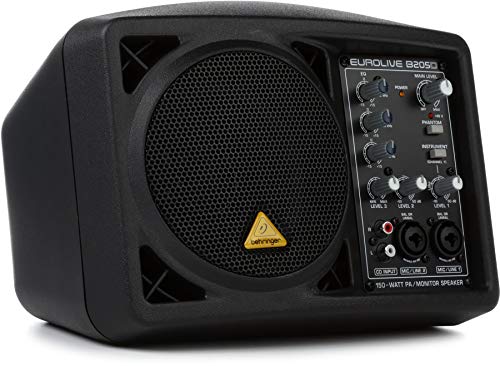
- 150-watt active full-range speaker
- Three-channel mixer with three-band EQ
- Phantom-powered mic inputs and instrument input
Best For: Vocalists needing a portable monitor with built-in mixing
Traditional Floor Wedge

- 10-inch two-way passive monitor
- Titanium compression horn driver
- 300-watt peak power handling
Best For: Live setups already using a separate amplifier
Feedback-Controlled Wedge

- 250-watt bi-amped powered monitor
- 12-inch woofer with 3-inch tweeter
- Adjustable feedback filter and limiter
Best For: Live vocal monitoring where feedback control is important
High-Output Coaxial Monitor

- 800-watt Class-D active monitor
- 10-inch driver with 1-inch tweeter
- XLR link output and FOH/Monitor selector
Best For: Live vocalists needing high output and flexible signal routing
Best Powered Wedge

- Powered 10-inch wedge with 300W amplifier
- XLR in/out plus 1/4-inch and 1/8-inch inputs
- Onboard three-band EQ and road-ready enclosure
Best For: Vocalists wanting a compact powered floor monitor
Best Personal In-Ear Option

- Up to 16 hours from the rechargeable battery
- Mono/stereo switch supports varied mixer outputs
- Locking combo input and lightweight belt-clip design
Best For: Vocalists using headphones or earbuds for personal monitoring
Best Large-Wedge Coverage

- Active 300W monitor with a 12-inch woofer
- Adjustable feedback filter for vocal setups
- Integrated limiter and sound processor for protection
Best For: Vocalists needing a larger powered floor wedge
High-Output Vocal Wedge
15-Inch Seismic Audio Floor Monitor
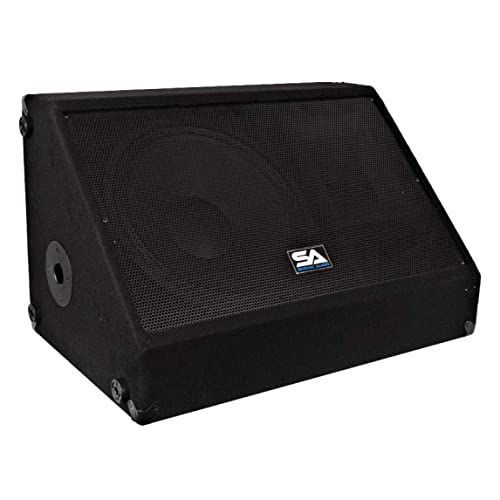
- 350W RMS, 700W peak handling
- Titanium horn with 45 Hz–20 kHz response
- Rugged carpeted cabinet with pole mount
Best For: Vocalists needing a powerful full-size passive wedge
Matched Pair Value
Rockville RSM12P 12-Inch Monitor Set

- Two passive 12-inch wedge monitors
- 250W RMS per cabinet with titanium horn
- Speakon and 1/4-inch input/thru connections
Best For: Bands and vocal teams needing two consistent stage wedges
Compact Stage Choice
Sound Town METIS-10M 10-Inch Monitor

- 10-inch woofer with 1-inch compression tweeter
- 150W RMS and 300W peak handling
- Compact cabinet with recessed side handle
Best For: Small-stage vocalists prioritizing portability and easy setup
Compact Vocal Monitor – Behringer Eurolive B205D
For singers who need a compact, flexible option among stage monitors for vocalists, the Behringer Eurolive B205D combines a 150-watt active speaker with a built-in three-channel mixer. Its full-range neodymium driver and lightweight 7.05-pound design suit vocal, keyboard, rehearsal, and small monitoring applications.
Best For: Vocalists, keyboard players, home studios, and compact monitoring setups.
Pros:
- 150-watt active design with a lightweight, compact cabinet
- Three-channel mixer with three-band EQ
- Two microphone preamps with phantom power plus an instrument-ready input
- Full-range 5.25-inch neodymium driver
Cons:
- Smaller driver and lower output than larger floor-wedge monitors
- Single-speaker system
The B205D is especially practical when portability and input flexibility matter more than maximum stage volume. Its integrated mixer can simplify a vocalist’s setup, while the small cabinet is easy to position or transport.
Traditional Floor Wedge – Seismic Audio SA-10MTSingle
Seismic Audio - SA-10MTSingle - 10" Floor / Stage Monitor Wedge Style with Titanium Horn
Check Price On AmazonThe Seismic Audio SA-10MTSingle is a conventional floor wedge for stage monitors for vocalists who prefer a dedicated, stage-ready enclosure. It uses a 10-inch woofer and titanium compression horn in a two-way design, with 150 watts RMS and 300 watts peak power handling.
Best For: Vocalists and performers who want a straightforward wired floor monitor for live stages.
Pros:
- 10-inch two-way speaker with titanium horn driver
- 150 watts RMS and 300 watts peak power handling
- 40-ounce woofer magnet and 2-inch voice coil
- Floor-wedge format with XLR and 1/4-inch/Speakon connectivity
Cons:
- Passive speaker design requires a separate amplifier
- Heavier than compact powered monitors at 22 pounds
- Not water resistant
This monitor is a sensible choice for a conventional passive stage system. Its 10-inch woofer provides a larger platform than compact personal monitors, but buyers must include suitable amplification in the overall setup.
Feedback-Controlled Wedge – Behringer EUROLIVE F1220D
The Behringer EUROLIVE F1220D is a larger powered wedge for stage monitors for vocalists who want more cabinet and driver size. Its bi-amped design combines a 12-inch woofer with a 3-inch tweeter, while the adjustable feedback filter and integrated limiter add control for live use.
Best For: Vocalists and bands needing a powered 12-inch monitor with feedback-management features.
Pros:
- 250-watt bi-amped powered monitor system
- 12-inch woofer and 3-inch tweeter for a broad frequency range
- Adjustable feedback filter and integrated limiter
- Multiple connection options, including XLR, 1/4-inch, RCA, and Speakon
Cons:
- Heavier and larger than compact vocal monitors at 23.6 pounds
- Not water resistant
- Single monitor system
The F1220D offers a fuller wedge-style setup than small personal monitors and adds useful protection and feedback controls. It is a strong fit for performers who need a powered monitor with more low-frequency support without moving to a separate amplifier.
High-Output Coaxial Monitor – Samson RSXM10A
The Samson RSXM10A is a high-output powered option among stage monitors for vocalists, using an 800-watt Class-D amplifier with a 10-inch low-frequency driver and 1-inch tweeter. Its coaxial design, XLR-1/4-inch combo input, link output, and FOH/Monitor selector support flexible live-stage placement.
Best For: Vocalists, bands, DJs, and sound engineers seeking a powerful active monitor for live performance.
Pros:
- 800 watts of output from a lightweight Class-D active design
- 10-inch driver with 1-inch tweeter in a compact coaxial cabinet
- XLR-1/4-inch combo input and XLR link output
- FOH/Monitor selector and 1 3/8-inch pole-mount receptacle
Cons:
- Heavier than compact personal monitors at 30 pounds
- Not water resistant
- Single monitor system
The RSXM10A stands out for its stated output and routing flexibility. The coaxial layout is well suited to stage monitoring, while the link output and selector switch make it adaptable to different live sound configurations.
Best Powered Wedge – Sound Town METIS-10MPW
For singers who prefer a traditional floor wedge, the Sound Town METIS-10MPW is one of the practical stage monitors for vocalists. Its powered 10-inch design combines a low-frequency woofer, titanium compression driver, and onboard tone controls for straightforward monitoring at rehearsals, churches, bars, and small venues.
Best For: Vocalists needing a compact, powered wedge with flexible wired inputs and quick EQ adjustment.
Pros:
- Integrated 300W amplifier provides dependable output without a separate power amp.
- 10-inch woofer and 1-inch titanium compression driver support focused live monitoring.
- XLR input and output allow source connection and daisy chaining, while 1/4-inch and 1/8-inch inputs add flexibility.
- Built-in bass, mid, and treble controls make quick room-specific adjustments easy.
Cons:
- The carpet-covered enclosure is not water resistant.
- Its wired, floor-standing wedge format may be less convenient than a personal in-ear system.
The METIS-10MPW is a sensible choice when you want an all-in-one vocal monitor that sits on the floor and connects directly to common audio sources. Its recessed handle, metal grille, and reinforced corners also suit regular transport between performances.
Best Personal In-Ear Option – LEKATO P30 IEM Amplifier
The LEKATO P30 takes a personal-monitoring approach for stage performers who want to hear through headphones or earbuds rather than a floor speaker. Among stage monitors for vocalists, it stands out for its rechargeable battery, switchable mono/stereo operation, and locking combo input designed for secure movement onstage.
Best For: Vocalists who prefer lightweight, headphone-based monitoring with extended battery life.
Pros:
- Built-in 1000mAh battery offers up to 16 hours of continuous use per charge.
- Switchable stereo and mono modes accommodate stereo headphone outputs or mono mixer sends.
- Locking XLR/1/4-inch combo input helps prevent accidental cable disconnects.
- Compact 0.4-pound design includes a reinforced belt clip and 3.5mm headphone output.
Cons:
- It requires headphones or earbuds, so it does not provide room-filling stage sound.
- It is battery powered rather than a standalone speaker monitor.
For singers who value mobility and a less cluttered stage, the P30 is a portable alternative to a wedge. Its mono/stereo switch and locking input make it adaptable, while the long stated battery life supports extended rehearsals or performances.
Best Large-Wedge Coverage – Behringer EUROLIVE F1320D
The Behringer EUROLIVE F1320D is a powered 12-inch monitor speaker built for live and playback applications. For vocalists comparing stage monitors for vocalists, its larger woofer, 300W output, integrated limiter, and adjustable feedback filter offer a useful combination for performers who need a substantial floor-wedge presence.
Best For: Vocalists performing in live settings who want a larger active wedge with feedback control.
Pros:
- 12-inch woofer and 1-inch compression driver support broad, dynamic monitoring.
- 300W Class-D amplification delivers high power while keeping the active design relatively lightweight for its output.
- Adjustable feedback filter helps manage potential microphone feedback.
- Integrated limiter and sound processor provide system control and speaker protection.
Cons:
- At 33.1 pounds, it is less portable than smaller monitor options.
- The enclosure is not water resistant.
- Its larger footprint may be excessive for very small stages or rehearsal spaces.
The F1320D makes the most sense when monitoring coverage and onboard protection matter more than minimum size. Its feedback filter is especially useful for vocal setups, while the 12-inch format gives it a more substantial stage-monitor profile than compact wedges.
High-Output Vocal Wedge – 15-Inch Seismic Audio Floor Monitor
For vocalists who need substantial stage volume, this Seismic Audio 15-inch monitor combines a 350-watt RMS rating with a titanium horn and 45 Hz–20 kHz frequency response. Its floor-wedge design suits live performances, rehearsals, DJ events, and public-address setups.
Best For: Vocalists and bands needing a powerful, full-size passive monitor for larger stages or louder mixes.
Pros:
- 15-inch woofer with 350 watts RMS and 700 watts peak handling
- Titanium horn tweeter and 101 dB sensitivity support clear, projecting sound
- Rubber feet, steel grille, metal handles, and carpeted cabinet provide practical stage durability
- Two 1/4-inch inputs and pole mounting add setup flexibility
Cons:
- At about 40 pounds, it is less convenient to transport than smaller monitors
- Passive operation requires a compatible amplifier or powered mixer
- It is not water resistant
This is a strong choice when vocal monitoring power matters more than compact portability. Confirm that your amplifier can drive its 8-ohm load and that you have adequate transport space.
Matched Pair Value – Rockville RSM12P 12-Inch Monitor Set
This matched pair of Rockville RSM12P monitors gives vocalists a practical two-wedge setup for lead vocals, keys, or drum cues. Each 12-inch cabinet handles 250 watts RMS and includes Speakon and 1/4-inch connections for flexible stage cabling.
Best For: Bands, worship teams, DJs, and vocalists who need two consistent passive monitors for rehearsals, clubs, or small events.
Pros:
- Two monitors are included, simplifying matched left-and-right or multi-performer monitoring
- 12-inch woofer and 1-inch titanium compression horn cover 45 Hz–20 kHz
- Speakon and 1/4-inch input/thru connectors support daisy-chaining
- Rubber feet, recessed handles, steel grilles, and aviation-grade carpet suit frequent setup
Cons:
- Passive design requires an external amplifier or powered mixer
- The two-speaker package is less compact to store and transport than a single monitor
- It is not waterproof or water resistant
The RSM12P package is especially useful when several performers need dependable vocal monitoring from one purchase. Its 8-ohm impedance and connection options make it straightforward to integrate with common pro-audio amplification.
Compact Stage Choice – Sound Town METIS-10M 10-Inch Monitor
The Sound Town METIS-10M is a compact passive monitor for vocalists who want a manageable cabinet without giving up a dedicated compression driver. Its 10-inch woofer, 1-inch tweeter, and 150-watt RMS rating fit live music, bar, church, and portable sound systems.
Best For: Vocalists and small bands seeking a compact, easy-to-carry wedge for modest venues and portable setups.
Pros:
- Compact 10-inch format is easier to position and transport than larger wedges
- 150 watts RMS and 300 watts peak power handling support typical small-stage monitoring
- Parallel 1/4-inch jacks allow straightforward daisy-chaining
- Carpet finish, metal grille, reinforced corners, and recessed side handle add practical durability
Cons:
- Lower power and smaller woofer provide less low-end headroom than the larger monitors listed here
- Passive operation requires compatible amplification
- It is not waterproof or water resistant
This model makes sense when portability and footprint are priorities. For louder stages or bass-heavy monitor mixes, a larger 12- or 15-inch option may provide more headroom.
How We Picked These Stage Monitors for Vocalists
We focused on the factors that most affect a singer’s live experience: vocal clarity, usable output, feedback control, portability, connection requirements, and overall system value. The selection includes powered and passive wedges so you can match the monitor to your existing mixer or PA. It also includes an in-ear monitor amplifier for performers who need personal monitoring instead of a traditional floor speaker.
Power ratings are not directly comparable across every product because manufacturers may use different measurement standards. Treat wattage as a general category indicator, then consider speaker size, cabinet design, sensitivity, and real-world application.
Quick Comparison
| Monitor type | Best suited to | Main advantage | What to verify |
|---|---|---|---|
| Compact powered wedge | Small stages, soloists, speeches | Simple setup with built-in amplification | Inputs, output level, and low-frequency headroom |
| 10- or 12-inch powered wedge | Bands, churches, rehearsal rooms | Balanced vocal projection and convenience | Feedback controls, weight, and mixer compatibility |
| 15-inch monitor | Larger stages and fuller mixes | More low-end support and output potential | Portability and whether bass may mask vocals |
| Passive wedge | Users with an external amplifier or powered mixer | Flexible integration and often lower upfront cost | Required amplifier power, impedance, and cabling |
| IEM amplifier | Vocalists using in-ear monitors | Personal, isolated monitoring without floor spill | Signal routing, earphones, and wireless needs |
Key Buying Factors for Stage Monitors for Vocalists
Powered or Passive Design
Powered monitors have amplification built in, making them convenient for direct connection to a mixer or line-level source. Passive models require a suitable amplifier or powered mixer, but they can fit neatly into an existing PA system. Check impedance and recommended amplifier power before buying a passive speaker.
Vocal Clarity and Speaker Size
A 10- or 12-inch monitor is often a practical starting point for vocalists because it can provide clear mids without becoming difficult to transport. Larger 15-inch cabinets may offer more low-end authority, but they can be heavier and may require careful EQ so guitars, keyboards, and bass do not overwhelm the vocal range.
Feedback Control and Placement
Look for feedback filters, usable equalization, or other anti-feedback features, especially if you sing close to the monitor. Place the wedge in the microphone’s rejection zone, keep it aimed toward your ears, and avoid pointing the microphone directly at its speaker. Good placement is as important as raw power.
Connections and Setup
Confirm whether the monitor accepts XLR, TRS, or other inputs and whether it provides a link or output for additional speakers. For passive models, account for speaker cable requirements. For IEM systems, verify connector locking, mono or stereo operation, battery life, and compatibility with your earphones or wireless pack.
Who Should Buy Which Stage Monitors for Vocalists?
Choose a Compact Powered Monitor for Small Setups
Solo singers, acoustic duos, presenters, and performers in small venues should prioritize portability and straightforward operation. A compact powered wedge can provide enough vocal reference without taking up much stage space.
Choose a 10- or 12-Inch Powered Wedge for Bands
Band vocalists and church performers will generally benefit from a powered 10- or 12-inch monitor with adequate headroom and feedback management. This is the most versatile category for rehearsals, regular gigs, and medium-sized stages.
Choose a Larger Wedge for Demanding Mixes
If you need more output or a fuller monitor mix, a 12- or 15-inch cabinet may be appropriate. Make sure the venue, amplifier, and transport setup can accommodate its size, and use EQ to preserve vocal intelligibility.
Choose Passive Monitors for an Existing PA
Passive wedges make sense when you already own a compatible power amplifier or powered mixer. They can also be useful when several matching monitors must share one amplification system, but system matching is essential.
Choose an IEM Amplifier for Isolation
Vocalists who need consistent volume, reduced stage spill, or a quieter stage should consider the IEM option. In-ear monitoring requires more attention to fit, signal routing, and safe listening levels, but it can deliver a more controlled performance environment.