
If you want a dual dash cam that combines front and rear recording with app-based convenience, the Dash 4K+1080P Dual Dash Cam is built for that exact job.
This review looks at where it is strong, where it is limited, and whether it is the right fit for your car.
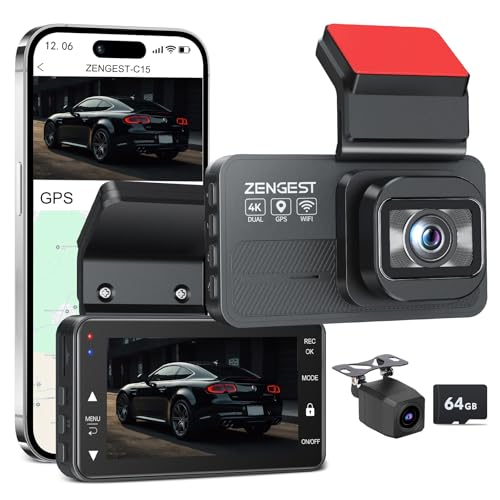
Dash 4K+1080P Dual Dash Cam Review Summary
The Dash 4K+1080P Dual Dash Cam makes sense for drivers who want a broad feature set in one package: high-resolution front recording, rear coverage, GPS logging, Wi-Fi app control, and included storage.
Its appeal is practical rather than flashy.
It is aimed at buyers who want evidence-focused driving protection and do not want to piece together accessories one by one.
The strongest case for this product is its balance of capture coverage and convenience.
The front camera records in 4K, the rear camera records in 1080P, and the package includes a 64GB card.
That means it is ready to use sooner than a barebones model that requires separate memory card shopping.
Add the 170° front and 150° rear viewing angles, and it is clearly designed to reduce blind spots and capture more context in a collision.
It is also a feature-heavy option for buyers who value alerts and data alongside footage.
GPS can record speed, location, and route in the app, the G-sensor locks important clips after a sudden impact, and ADAS warnings are included for lane deviation and forward-collision awareness.
That combination makes it better suited to cautious commuters and long-distance drivers than to people who only want the simplest possible camera.
Review Scorecard
| Category | Score | Rationale |
|---|---|---|
| Video capture | 9/10 | 4K front and 1080P rear recording gives strong coverage for reading road detail and documenting incidents. |
| Coverage | 9/10 | 170° front and 150° rear angles help reduce blind spots from both directions. |
| Convenience | 8/10 | 64GB card included plus Wi-Fi app control reduces setup friction. |
| Safety features | 8/10 | GPS, G-sensor protection, parking mode, and ADAS add useful driving context. |
| Night performance | 8/10 | Night vision, large F2.0 aperture, six-layer lens, and WDR are all oriented toward low-light clarity. |
| Value for feature set | 8/10 | The list of included functions is broad, which should appeal to buyers who want one purchase to cover the essentials. |
Key Features and Specifications of Dash 4K+1080P Dual Dash Cam
This model is built around a two-camera setup.
The front camera records at 4K UHD, while the rear camera records at 1080P FHD.
That is a meaningful advantage for drivers who want detail in the front view without giving up rear coverage.
The listing also calls out 170° front and 150° rear angles, which suggests a wider field of view than simple single-lane cameras.
Several features are aimed at preserving usable footage.
The camera supports loop recording, so when storage fills up it overwrites older, unneeded video.
The G-sensor protects video after a collision, locking the relevant clip so it is not lost during normal overwriting.
A 64GB microSD card is included, which is useful because it lowers the number of separate purchases a buyer needs to make before installation.
Low-light performance is another focus.
The listing mentions night vision, an F2.0 aperture, a 6-layer optical lens, and WDR.
Taken together, those are the kinds of components buyers usually look for when they expect to drive at night, in rain, or in mixed lighting.
The point is not to promise magic in darkness, but to improve the odds that critical details remain visible when conditions are not ideal.
The GPS and Wi-Fi/app features broaden the product beyond basic recording.
GPS can log speed, location, and the vehicle’s track, but the listing notes that GPS information is shown in the phone app rather than on the camera screen itself.
That is a small but important detail, because it tells buyers where to expect the data.
App control also makes it easier to review footage without repeatedly removing the card.
The ADAS support is another differentiator.
According to the listing, the system can alert you when lane deviation occurs or when a forward collision is about to happen.
That makes this less of a passive recorder and more of a driver-assistance-oriented dash cam, though buyers should still think of it as a warning layer rather than a substitute for attention.
Pros and Cons of Dash 4K+1080P Dual Dash Cam
Pros
- 4K front recording gives the main camera strong detail potential.
- 1080P rear coverage adds useful evidence from behind the vehicle.
- The included 64GB card reduces setup hassle.
- GPS, Wi-Fi app control, and vehicle-track logging add practical convenience.
- Night vision, WDR, and the F2.0 aperture are all welcome for low-light driving.
- ADAS and G-sensor features make it more complete than a basic recorder.
Cons
- The feature set is broad enough that buyers may need time to learn the system.
- GPS data is app-based rather than shown on the camera itself.
- ADAS alerts are helpful, but some buyers may prefer a simpler camera without extra warnings.
- The product is feature-heavy, so the installation and menu experience matter more than they would on a minimal model.
Who Should Buy Dash 4K+1080P Dual Dash Cam?
This is a good fit for drivers who want front-and-rear evidence capture without building a dash cam kit piece by piece.
If you care about incident documentation, lane and collision context, and app-based review of footage, the Dash 4K+1080P Dual Dash Cam lines up well with those needs.
It is especially relevant for commuters, rideshare drivers, highway drivers, and anyone who parks in busy areas.
The included parking mode and collision protection features matter more when the car is left unattended for long stretches.
Buyers who routinely drive after dark should also find the low-light-focused hardware reassuring.
It is less compelling for someone who wants the most basic camera possible.
If your priority is just a simple loop recorder with no app layer, no GPS tracking, and no assistance features, this may be more than you need.
The value here comes from breadth, not minimalism.
Dual-Camera Coverage and Driving Protection
Front Detail Matters Most
The front 4K camera is the headline feature for a reason.
When a dash cam is used as evidence, the forward-facing view usually matters most, and higher resolution generally helps with reading signs, road markings, and vehicle context.
For buyers, that makes the front camera the strongest part of the package.
Rear Coverage Is Not an Afterthought
The 1080P rear camera is important because many accidents involve impacts from behind or complex traffic interactions that are easier to understand with a rear view.
The rear unit is not trying to match the front camera’s resolution; instead, it adds balance and context.
That is the right tradeoff for a dual-camera system.
Night and Low-Light Use
Night vision, WDR, a large aperture, and a six-layer lens all point toward improved performance when lighting is inconsistent.
That matters because many incidents happen in exactly those conditions: dusk, rain, parking lots, and unlit streets.
Buyers looking for a daytime-only camera should not overvalue these features, but most drivers will benefit from them.
Alerts and Evidence Retention
The G-sensor and ADAS features serve different jobs.
The G-sensor is about protecting footage after an impact, while ADAS is about warning the driver before a lane or collision issue becomes serious.
Together they make the camera feel more protective.
The main limitation is that neither feature replaces attentive driving, so buyers should view them as support tools.
Alternatives to Dash 4K+1080P Dual Dash Cam
If you want comparable options, look at established dual dash cam lines such as Viofo dual dash cams, Redtiger dash cams, Vantrue dual dash cams, and 70mai dash cams.
These are the kinds of Amazon-available brands buyers usually compare when they want front and rear coverage with app support or parking features.
The right alternative depends on what you value most.
Viofo is often searched by buyers who want a strong reputation for video-focused models.
Vantrue is a common comparison point for people who want more premium feature sets.
Redtiger and 70mai are often considered when buyers want a broad mix of convenience, app integration, and value-oriented bundles.
If you are shopping strictly on features, compare the camera resolution, rear-camera support, included card, parking mode, and app workflow rather than looking only at the brand name.
A good alternative should match your actual use case, not just the biggest spec sheet.
Is Dash 4K+1080P Dual Dash Cam Worth It?
Yes, for the right buyer.
If you want a dual dash cam with high-resolution front recording, usable rear coverage, GPS logging, app access, included storage, and protection features like loop recording and a G-sensor, this is a sensible pick.
It is worth considering most strongly if you want one package that covers everyday driving, parking protection, and evidence capture without making you assemble extras separately.
If you prefer a stripped-down device with fewer settings and fewer connected features, you may be happier with a simpler model.
For feature-conscious buyers, though, this looks like a practical, well-rounded dash cam rather than a gimmick-heavy one.