
Four-channel scopes give you a clearer view of engine, ignition, sensor, and communication signals at the same time, making advanced diagnostics faster and more accurate.
In this roundup, we focused on practical options for shops and serious DIY users who want dependable capture quality, useful accessories, and the right balance of portability, bandwidth, and software support.
Best 10 Four Channel Automotive Oscilloscopes Picks for 2026
Portable Android Scope
Micsig SATO1004 4-Channel Tablet Scope

- Android-based interface with physical buttons
- 4 channels, 100MHz bandwidth, 1GSa/s sampling
- 32GB storage plus remote app control support
Best For: portable diagnostics and tablet-style workflow
Diagnostic Scope Module
TOPDON Phoenix 4-Channel Scope

- 50M memory depth with zoomed waveform views
- One-tap storage plus recording and playback
- Works only with compatible Phoenix tools
Best For: existing Phoenix diagnostic tool owners
Large Touchscreen Scope
Micsig ATO1004A 4-Channel Tablet Oscilloscope

- 10.1-inch touchscreen with 100MHz, 4-channel design
- 110Mpts storage depth and multiple I/O ports
- Battery-powered with up to 5 hours runtime
Best For: buyers who want a large display and portable power
Bench Mixed-Signal Scope

- 4 channels with 70MHz bandwidth and 8 GSa/s
- 100 Mpts memory depth, expandable to 200 Mpts
- 16 digital channels supported with optional probe
Best For: professional bench use and mixed-signal analysis
Portable 4-Channel Tablet Scope
- 10.1-inch HD touchscreen with touch-first control
- 32GB storage and 110 Mpts depth for saved captures
- Supports ignition, CAN/LIN/FlexRay, and pressure tests
Best For: portable touchscreen diagnostics with broad automotive coverage
Scan-Tool Add-On Scope Box

- 4-channel, 100MHz module for supported X-431 tools
- Recording, playback, zoom, auto-calibration, and FFT support
- Includes multiple leads, clamps, probes, and pickups
Best For: X-431 owners who want a scope add-on for automotive diagnostics
Compact Android Scope
- Android-based 4-channel scope with physical controls
- 130,000 waveforms/sec capture helps catch transients
- Wi-Fi remote monitoring and 32GB onboard storage
Best For: compact wireless diagnostics with fast waveform capture
Elite Connected Diagnostic Pick
Autel MaxiScope MP608 4-Channel
- 12-bit resolution with ±1% measurement accuracy
- AI-assisted math channels and probe setup
- Works with Autel tablets and Windows PCs
Best For: Autel users who want a connected 4-channel scope
High-Bandwidth PC Scope Choice

- 4 channels, 1GSa/s sampling, 250MHz bandwidth
- USB plug-and-play with no extra power supply
- 20+ measurements plus PASS/FAIL and replay
Best For: PC-based users who need a fast 4-channel scope
Portable Android Diagnostic Pick

- Android-only split design with USB-C connection
- 50Mpts memory and 200MHz bandwidth
- 7500mAh battery rated for up to 24 hours
Best For: Android-based technicians needing a portable 4-channel scope
Portable Android Scope – Micsig SATO1004 4-Channel Tablet Scope
If you want a four channel automotive oscilloscope that feels more like a modern diagnostic tablet, the Micsig SATO1004 is built around speed, touch control, and mobile-style workflow. It combines a 100MHz, 4-channel design with Android-based software, so it suits technicians who want quick waveform access, remote viewing, and broad vehicle testing support in one handheld unit.
Best For: Techs who want a portable four-channel scope with tablet-style control and remote monitoring.
Pros:
- Android operating system with a physical button control panel for faster operation
- Supports automotive tests including ignition, sensors, actuators, networks, charging, starter, CAN, LIN, FlexRay, and pressure tests
- Remote operation is possible through a smartphone app in a stable network environment
- Includes 32GB internal storage for waveforms, screenshots, and recorded videos
Cons:
- Remote use depends on a stable Wi-Fi/network connection
- Handheld format may not suit users who prefer a bench-style scope
The SATO1004 is a strong fit if you value workflow efficiency and need a flexible four channel automotive oscilloscope for broad diagnostic coverage. Its mix of touch control, storage, and connectivity makes it especially practical for mobile diagnostics and fast review of captured data.
Diagnostic Scope Module – TOPDON Phoenix 4-Channel Scope
The TOPDON Phoenix Scope is a four channel automotive oscilloscope designed for technicians already using the Phoenix diagnostic ecosystem. It focuses on faster signal capture, deep memory, and analysis tools, making it a good choice when you want a scope module that fits into an existing workflow rather than a standalone handheld unit.
Best For: Phoenix tool users who need a capable 4-channel scope module with strong analysis features.
Pros:
- 50M memory depth with zoom views for both global and detailed waveform inspection
- One-tap waveform storage and waveform recording/playback for easier fault analysis
- Advanced math functions and FFT analysis for deeper signal diagnostics
- Includes 23 automatic measurements and efficient cursor operation
Cons:
- Works exclusively with supported Phoenix Max/Smart/Elite/Lite models
- Not compatible with Phoenix Nano or XLink
This scope is best viewed as a specialized add-on for compatible TOPDON diagnostic tools. If you already work inside that platform, the fast storage, recording, and measurement features make it a practical upgrade for automotive signal analysis.
Large Touchscreen Scope – Micsig ATO1004A 4-Channel Tablet Oscilloscope
For buyers comparing four channel automotive oscilloscopes, the Micsig ATO1004A stands out for its large 10.1-inch touchscreen and practical storage and battery specs. It is aimed at technicians who want a broad automotive test set in a tablet-style format with easy connectivity and enough battery life for extended use.
Best For: Technicians who want a large-screen 4-channel automotive scope with long battery life.
Pros:
- 10.1-inch touchscreen with 1280 x 800 resolution and 11×10 grid
- Up to 110Mpts storage depth for waveforms, pictures, and videos
- 7.4V 7500mAh battery supports up to 5 hours of continuous work
- Supports automotive tests including ignition, sensors, actuators, networks, charging, starter, CAN, LIN, FlexRay, and pressure tests
Cons:
- Battery runtime varies by model and power consumption
- Specifications may be more than needed for users who only need basic scope functions
The ATO1004A is a practical pick when screen size, storage depth, and battery-powered mobility matter. It offers a balanced feature set for diagnostic work without forcing you into a smaller or less flexible display experience.
Bench Mixed-Signal Scope – Rigol MSO5074 4-Channel 70MHz
The Rigol MSO5074 is a four channel automotive oscilloscope with a more traditional bench-style design and mixed-signal capability. With 70MHz bandwidth, high sample rate, and included digital channels, it suits users who want a professional scope for electrical and logic work rather than a tablet-focused automotive diagnostic platform.
Best For: Professional users who want a bench oscilloscope with 4 analog channels and mixed-signal support.
Pros:
- Four channels with 70MHz bandwidth and up to 8 GSa/s sample rate
- 100 Mpts memory depth, with optional expansion up to 200 Mpts
- Includes 16 digital channels for mixed-signal work with an optional probe
- High waveform capture rate over 500,000 wfm/s
Cons:
- 16 digital channels require the optional PLA2216 logic probe
- Heavier bench scope form factor at 11.68 pounds
If your priority is lab-style signal visibility and mixed-signal capability, the MSO5074 delivers a more conventional professional scope experience. It is less automotive-specific than the tablet models here, but it offers strong performance for users who need detailed waveform capture and logic analysis.
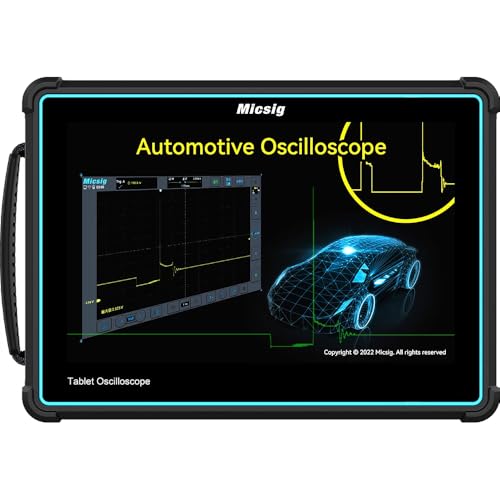
Portable 4-Channel Tablet Scope – Micsig ATO1004 10.1-Inch
If you want a four channel automotive oscilloscope that feels more like a modern tablet than a bench tool, the Micsig ATO1004 is built for fast hands-on diagnostics. Its 10.1-inch touchscreen, 100MHz bandwidth, and 1GSa/s sampling rate give you a practical balance of display size and measurement capability for ignition, sensor, actuator, and network testing.
Best For: Technicians who want a portable touchscreen scope with broad automotive test coverage and large on-device storage.
Pros:
- 10.1-inch HD touchscreen with 11×7 grid support for clear waveform viewing and touch control
- 32GB storage with 110 Mpts depth, plus screenshots, video capture, and segmented recording
- Supports ignition, sensors, actuators, CAN, LIN, FlexRay, K, charging/starter, and pressure tests
- USB, LAN, HDMI, Wi-Fi, and Type-C ports for flexible setup and expansion
Cons:
- Battery life is listed at up to 5 hours, depending on usage and model
- At 8.1 pounds, it is portable but not ultra-light
- Bandwidth is 100MHz, which may be more than enough for many jobs but not a specialty high-speed lab scope
Overall, the ATO1004 is a well-rounded choice if you value a large touchscreen, strong storage depth, and wide automotive test support in a tablet-style format. The universal BNC interface also helps keep probe compatibility simple and lowers accessory hassle.
Scan-Tool Add-On Scope Box – Launch X-431 O2-2
The Launch X-431 O2-2 is a four channel automotive oscilloscope designed as an add-on module for compatible X-431 scan tools. With 100MHz bandwidth, 4-channel support, and a BNC input design, it is aimed at technicians who want to extend a scan tool into a more capable electrical test platform for circuits, sensors, actuators, and ignition checks.
Best For: X-431 users who want a scope module that integrates directly with their scan tool workflow.
Pros:
- 4 channels and 100MHz bandwidth for multi-signal automotive testing
- Works with supported LAUNCH X-431 scan tools through the O2-2 application
- Includes waveform recording/playback, zoom, auto-calibration, and FFT math functions
- Package includes leads, clamps, probes, and other test accessories
Cons:
- Designed for compatible X-431 devices, so it is not a standalone universal scope
- Uses 8-bit vertical resolution and 10M buffer memory for 4 channels
- Battery-powered portable design is useful, but the module format may not suit users seeking a tablet-style interface
For shops already built around LAUNCH diagnostics, the O2-2 makes a strong case as a focused expansion module. Its mix of automated measurement features, recording tools, and included accessories should help it slot into everyday automotive troubleshooting.
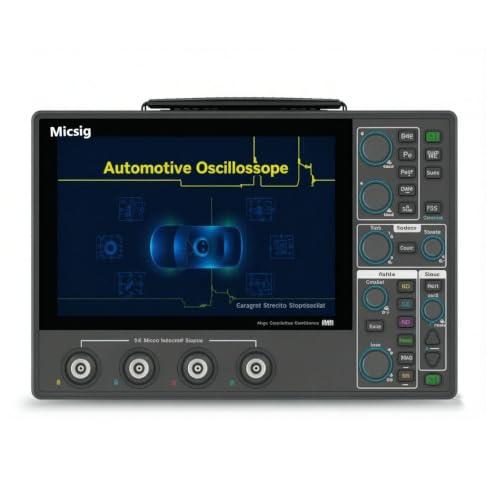
Compact Android Scope – Micsig SATO1004 8-Inch
The Micsig SATO1004 is a four channel automotive oscilloscope built for quick-response diagnostics in a compact tablet form. It runs Android, adds a physical control panel, and raises waveform capture speed to 130,000 waveforms per second, making it a practical pick when you want faster signal viewing for ignition, sensor, actuator, and network work.
Best For: Technicians who want a compact Android-based scope with remote viewing and fast waveform capture.
Pros:
- Android OS with a physical control panel for intuitive operation
- 130,000 waveforms per second capture rate for spotting transient anomalies
- Remote monitoring via smartphone app over Wi-Fi
- 32GB internal storage for waveform data, screenshots, and recorded videos
Cons:
- 8-inch display is smaller than the brand’s larger tablet option
- Battery capacity and runtime are not specified in the provided notes
- Like other modern Micsig units, it relies on the universal BNC interface for probe compatibility
If you prefer a lighter, more compact diagnostic scope with wireless visibility, the SATO1004 is a smart alternative to larger tablet models. Its combination of Android software, remote access, and fast capture speed makes it well suited to busy automotive troubleshooting.
Elite Connected Diagnostic Pick – Autel MaxiScope MP608 4-Channel
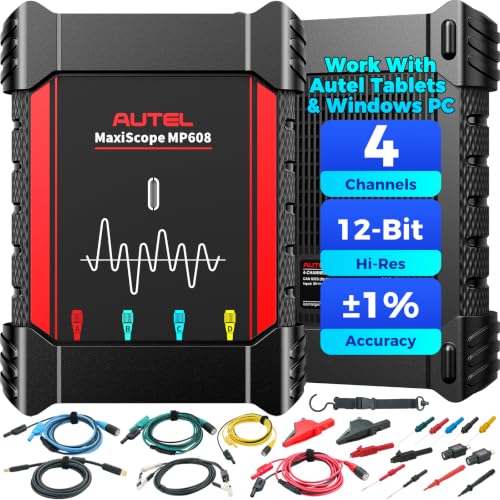
For buyers comparing four channel automotive oscilloscopes, the Autel MaxiScope MP608 is built around guided diagnostics, tablet mobility, and PC-level analysis. It pairs 4-channel capture with 12-bit vertical resolution, ±1% measurement accuracy, and trigger actions for intermittent fault capture, while the software adds AI-generated math channels, probe parameters, and a built-in automotive case library.
Best For: Technicians already using Autel tablets or Windows PCs who want a connected 4-channel scope with workflow and case-library support.
Pros:
- 4-channel oscilloscope with ±1% measurement accuracy and 12-bit vertical resolution
- Trigger actions help catch intermittent faults more reliably
- AI-generated math channel formulas and probe parameters simplify setup
- Supports oscilloscope, spectrum, and XY modes with simultaneous multi-view display
Cons:
- Designed for compatibility with specific Autel tablets and Windows 10/11 PCs, not broad standalone use
- Depends on the connected workflow features for the full experience
This is the strongest fit if you want an automotive oscilloscope that blends measurement tools with guided software and device integration. The included probes, clips, and PC/tablet support make it a practical choice for diagnostic work that goes beyond basic waveform viewing.
High-Bandwidth PC Scope Choice – Hantek 6254BE 250MHz
The Hantek 6254BE is aimed at users who want a fast, laptop-friendly option among four channel automotive oscilloscopes. It offers 4 channels, 1GSa/s real-time sampling, 250MHz bandwidth, and a broad 2mV-10V/div input range, plus USB 2.0 plug-and-play operation for portable work on supported Windows systems.
Best For: Technicians and mobile users who want a high-bandwidth 4-channel scope with PC-based operation.
Pros:
- 4 channels with 1GSa/s real-time sampling and 250MHz bandwidth
- USB 2.0 plug-and-play design with no extra power supply needed
- More than 20 automatic measurement functions and PASS/FAIL check
- Supports waveform record, replay, cursor tracking, and trigger functions
Cons:
- Requires a compatible computer or tablet for operation
- Portable use depends on the host device and USB connection
This model makes sense if bandwidth and PC convenience matter more than a dedicated automotive tablet platform. Its measurement and trigger features give it a capable toolset for diagnostic work, especially for users who prefer a computer-based setup.
Portable Android Diagnostic Pick – Micsig VTO2004 4-Channel
The Micsig VTO2004 is a split-type option for users shopping four channel automotive oscilloscopes and willing to work inside Android. It delivers 4 analogue channels, 1GSa/s sampling, 200MHz bandwidth, and 50Mpts memory depth, while the built-in 7500mAh battery is designed to support up to 24 hours of field testing.
Best For: Android users who want a portable 4-channel automotive oscilloscope with deep memory and long battery life.
Pros:
- 4 analogue channels with 1GSa/s real-time sampling and 200MHz bandwidth
- 50Mpts memory depth with zoom for longer signal capture
- Built-in 7500mAh battery supports up to 24 hours of field testing
- USB-C connection works with Android phones and tablets that support OTG
Cons:
- Android only; not compatible with iOS, Windows, or Mac systems
- Requires a separate Android device for power and display
If your workflow is built around Android, this unit offers a strong mix of portability, storage depth, and channel count. The compatibility limits are important, but for the right device ecosystem it can be a very practical field diagnostic scope.
How We Picked These Four Channel Automotive Oscilloscopes
We looked for tools that make real-world vehicle diagnosis easier, not just scopes with impressive specs on paper. Priority went to channel count, bandwidth, sampling rate, memory depth, trigger features, and how well each unit fits automotive workflows such as injector, crank/cam, ignition, and CAN/LIN testing.
We also considered portability, screen size, battery use, included probes and leads, software compatibility, and whether the scope is practical for mobile techs, workshop bays, or PC-based bench use.
Quick Comparison: What Separates the Best Options
Some Four Channel Automotive Oscilloscopes are built as tablet-style handheld tools for field diagnostics, while others are better suited to bench work with a laptop or shop PC. Lower-bandwidth models are often enough for routine sensor and actuators checks, while higher-bandwidth units are better when you need more detail on fast switching events and advanced signal analysis.
If you want speed and convenience, a portable touchscreen model is usually the easiest to use. If you want deeper analysis and more expansion potential, a mixed-signal or PC-connected platform may be the better long-term choice.
Key Buying Factors for Four Channel Automotive Oscilloscopes
Bandwidth and Sampling Rate
For basic automotive work, moderate bandwidth can be sufficient. For sharper waveform detail on ignition, PWM, and high-speed communication signals, choose a model with higher bandwidth and a strong sampling rate so you do not miss transient events.
Memory Depth and Triggering
More memory helps preserve long captures, which matters when faults appear intermittently. Useful trigger controls also help isolate a misfire, dropout, or sensor glitch without sorting through unnecessary data.
Portability and Display
Tablet-style and handheld scopes are ideal when you move around the vehicle. Larger displays can improve readability, but they may trade off compactness. Choose the format that matches your working environment.
Accessories and Software
Good probes, back probes, leads, and adapters can save time and improve signal quality. For PC-based options, check driver support, software stability, and whether the interface feels intuitive enough for your skill level.
Who Should Buy Which Four Channel Automotive Oscilloscopes?
Mobile technicians and fast-moving repair shops usually benefit most from portable Four Channel Automotive Oscilloscopes with rugged cases and integrated displays. Diagnostic specialists who need deeper analysis may prefer higher-bandwidth bench or tablet systems with more memory and better software.
DIY users should look for a model with a straightforward interface, solid automotive presets, and enough capability to handle common engine and electrical tests without paying for features they will not use.