
Compact synthesizers make it easier to explore sound design without giving up valuable desk space. The right model can serve as a portable sketchpad, a performance instrument, or a serious addition to a larger studio setup.
This roundup compares 10 compact options across analog, digital, hybrid, sampling, and unconventional designs, with attention to portability, controls, sound-shaping potential, and ease of use.
Best 10 Compact Synthesizers Picks for 2026
Experimental Powerhouse
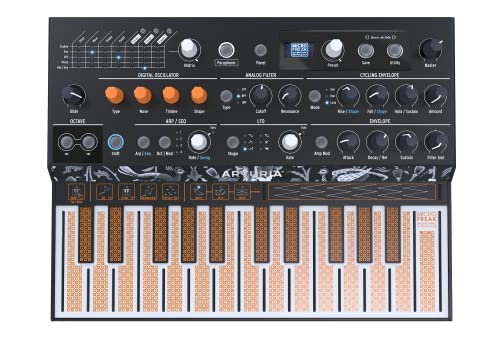
- Hybrid digital oscillators and analog filter
- 25-key touch keyboard with poly-aftertouch
- CV, USB, and MIDI connectivity
Best For: Advanced experimental sound designers
Portable Performance Pick

- SH-101-inspired basses and leads
- Wave manipulation and onboard sequencing
- One-pound compact design
Best For: Portable jamming and approachable synthesis
Playable Hybrid Choice

- 37-key, six-voice polyphonic design
- Hybrid digital-and-analog sound profile
- Includes MiniFreak VST counterpart
Best For: Beginners wanting more keys and polyphony
Sample-Making Pocket Tool

- Built-in mic for immediate sample capture
- Chopping, step sampling, and resampling
- Granular controls and computer software
Best For: Portable sampling and experimental sound design
Premium Analog Powerhouse

- Two wavefolding VCOs plus a sub-oscillator
- 32 full-size keys with velocity and aftertouch
- 64-step sequencer, CV, MIDI, and USB-C
Best For: Expressive analog bass, leads, and live performance
Classic Digital Sound in a Small Box

- JD-800 modeling with 108 original waveforms
- Polyphonic two-part sequencer with motion recording
- Layering, multitimbrality, and detailed onboard effects
Best For: Retro digital patches and compact tabletop sequencing
Pocket Retro Pick

- Pocket-sized, battery-powered design
- Stylus-controlled three-octave touch surface
- Built-in speaker, headphone output, and auxiliary connection
Best For: Beginners and portable retro sound experiments
Best Portable FM Pick
M-VAVE Wireless FM Synthesizer

- Six-operator FM engine with 32 algorithms
- Battery-powered with built-in speaker
- Presets, effects, arpeggiator, and sequencer
Best For: Portable FM sound design and MIDI setups
Best Playful Choice

- Touch-sensitive stem controls pitch
- Cheek squeeze adds vibrato
- Headphone, amp, and speaker connectivity
Best For: Casual play, gifts, and musical experimentation
Best for Experimental Textures
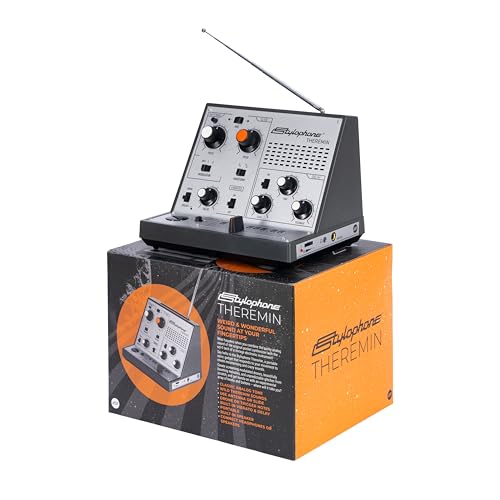
- Theremin antenna and touch-slider control
- Built-in delay and vibrato effects
- Battery-powered with speaker and headphone output
Best For: Drones, ambient textures, and expressive pitch work
Experimental Powerhouse – MicroFreak Hybrid Synthesizer
The Arturia MicroFreak is one of the most feature-packed compact synthesizers for experimental sound design. Its hybrid architecture combines multiple digital oscillator modes with a resonant analog filter, while the touch-sensitive 25-key surface, modulation matrix, and sequencing tools support expressive, evolving performances.
Best For: Advanced users who want unusual timbres, deep modulation, and CV-compatible hardware connectivity in a lightweight instrument.
Pros:
- Offers 17 listed oscillator types spanning physical modeling, wavetable, vocoder, noise, and more.
- 25-key PCB keyboard supports individual pressure or poly-aftertouch detection.
- Includes CV pitch, gate, and pressure outputs plus USB and MIDI connectivity.
- Sequencer includes automation recording, note editing, randomization, and Spice and Dice functions.
Cons:
- The touch-plate keyboard has no moving keys, which may not suit traditional keyboard players.
- Its advanced modulation and sound-design features may be demanding for beginners.
Choose the MicroFreak when experimentation and connectivity matter more than conventional playability. At 2.3 pounds and just 12.2 inches long, it delivers substantial sound-design flexibility in a genuinely portable format.
Portable Performance Pick – Roland S-1 Tweak Synth
The Roland AIRA Compact S-1 Tweak Synth is a practical choice among compact synthesizers for quick, hands-on jams. Inspired by the SH-101, it focuses on punchy basses, expressive leads, wave manipulation, onboard sequencing, and performance-oriented controls in a one-pound format.
Best For: Beginners and experienced creators who want a small, approachable synth for portable beat-making and melodic performance.
Pros:
- Draws inspiration from the Roland SH-101 sound and workflow.
- Combines bass and lead sounds with futuristic wave-manipulation tools.
- Includes onboard sequencing and hands-on performance features.
- Compact product size and one-pound weight support mobile use.
Cons:
- The supplied notes do not specify key count or detailed connection options.
- Its SH-101-inspired focus may be less suitable for users seeking a broad workstation-style instrument.
The S-1 emphasizes immediacy rather than an extensive specification list. It is a strong fit if you want an inviting, portable instrument for shaping basses, leads, and sequences without a steep learning curve.
Playable Hybrid Choice – MiniFreak 37-Key Synthesizer
Arturia MiniFreak 37 Key Polyphonic 6-Voice Hybrid Synthesizer Keyboard (Standard, 37 Key)
Check Price On AmazonThe Arturia MiniFreak is a strong option for shoppers comparing compact synthesizers that still offer a more conventional playing experience. Its 37-key layout and six-voice polyphonic hybrid design are aimed at exploring the space between digital and analog sounds, and the included VST counterpart extends its usefulness with software integration.
Best For: Beginners and players who want a portable hybrid synthesizer with more keys and polyphonic performance than ultra-compact designs.
Pros:
- Provides 37 keys for a more playable setup than smaller compact instruments.
- Six-voice polyphonic architecture supports chord-based performance.
- Hybrid digital-and-analog sound profile encourages broad sound exploration.
- Includes a MiniFreak VST counterpart and a two-year manufacturer warranty.
Cons:
- At 22.76 inches long and 2.94 kilograms, it is less pocketable than micro-sized synths.
- The supplied details list USB connectivity but do not specify CV or MIDI connections.
The MiniFreak makes a sensible middle ground between portability and playability. Select it when 37 keys and polyphony are priorities, while accepting a larger footprint than the smallest compact synthesizers.
Sample-Making Pocket Tool – Roland P-6 Creative Sampler
The Roland AIRA Compact P-6 is a compact sampler for creators who want to capture, reshape, and perform sounds on the move. Its built-in microphone, onboard keyboard, chopping and step-sampling functions, granular controls, and resampling workflow make it a flexible alternative for buyers considering compact synthesizers and sound-design tools.
Best For: Mobile producers and experimental musicians who want hands-on sampling, custom loops, and granular sound manipulation.
Pros:
- Built-in microphone enables quick sample capture without external equipment.
- Chop, step sampling, chromatic playback, and resampling support varied workflows.
- Provides dedicated filters and envelopes for each sample.
- Includes extensive granular parameters and P-6 Sample Tool software for macOS and Windows.
Cons:
- It is primarily a sampler rather than a conventional synthesizer keyboard.
- The supplied notes do not specify battery life or detailed output connections.
- The compact onboard keyboard may be less suitable for extended melodic playing.
The P-6 is especially compelling when sampling is central to your process. Its 7.44-by-3.19-inch body and 10.72-ounce weight make it easy to carry, while the granular engine and resampling tools provide room for deeper sound transformation.
Premium Analog Powerhouse – MOOG Messenger
The MOOG Messenger is a strong choice among compact synthesizers for musicians who want classic analog character in a portable, performance-ready format. Its two wavefolding oscillators, flexible ladder filter, full-size keys, and hands-on controls support detailed bass, lead, and sequence programming.
Best For: Producers and performers seeking a feature-rich monophonic analog synthesizer with full-size keys.
Pros:
- Two variable-shape VCOs, sub-oscillator, sync, and frequency modulation provide broad analog sound design.
- Full-size velocity- and aftertouch-sensitive keys offer expressive control.
- Integrated 64-step sequencer, arpeggiator, 256 presets, and extensive CV/MIDI connectivity.
Cons:
- Its monophonic design is less suited to playing chords.
- At over 27 inches wide and 5.14 kg, it is less portable than the smallest tabletop units.
The Messenger stands out when you want compact-synth convenience without giving up substantial controls, keyboard expression, or deep modulation. It is especially compelling for bass-focused studio work and live performance.
Classic Digital Sound in a Small Box – Roland JD-08
The Roland JD-08 is a practical pick among compact synthesizers for producers who want the character of the JD-800 in a lightweight tabletop module. It combines modeled vintage sound, extensive effects, two-part multitimbrality, and a polyphonic sequencer in a notably small enclosure.
Best For: Producers building layered digital patches, evolving sequences, and retro-inspired arrangements.
Pros:
- Recreates the JD-800 sound and behavior with 108 waveforms and original and new presets.
- Two-part, 64-step, eight-note-per-part polyphonic sequencer includes motion recording and pattern randomization.
- Offers layered tone structures, up to 128 voices depending on patch load, and a detailed multi-effects section.
Cons:
- A compatible K-25M keyboard is sold separately.
- As a tabletop sound module, it does not include an integrated keyboard.
The JD-08 is best for buyers prioritizing rich digital textures and sequencing over traditional keyboard immediacy. Its small footprint and expanded effects make it useful in compact studios and hybrid setups.
Pocket Retro Pick – Stylophone Original
The Stylophone Original is one of the most accessible compact synthesizers for beginners, casual players, and anyone who wants an instantly portable retro instrument. Its touch-sensitive metal surface, stylus control, built-in speaker, and battery operation make it easy to experiment almost anywhere.
Best For: Beginners, gifts, portable musical sketching, and players who enjoy distinctive vintage sounds.
Pros:
- Extremely compact design fits in a coat pocket and runs on three AA batteries.
- Simple stylus-based interface is easy to learn and play.
- Offers three octaves, optional vibrato, a built-in speaker, headphone socket, and auxiliary connectivity.
Cons:
- Its touch-surface interface is less versatile than a conventional keyboard.
- It provides a focused retro sound rather than extensive modern synthesis controls.
The Stylophone is a fun, low-barrier way to explore synthesis and create recognizable vintage tones. Choose it for portability and immediacy, not for deep sequencing or elaborate sound design.
Best Portable FM Pick – M-VAVE Wireless FM Synthesizer
For musicians seeking compact synthesizers with substantial sound-design depth, the M-VAVE combines a six-operator FM engine with battery power, a built-in speaker, and 27 silicone keys. Its presets, effects, arpeggiator, and sequencer make it a flexible option for portable sketching and performance.
Best For: Portable FM synthesis, beginners who want ready-to-play sounds, and creators who need MIDI flexibility.
Pros:
- Six operators and 32 algorithms offer genuine FM sound shaping.
- Battery operation, built-in speaker, and compact 9.6-ounce design support mobile use.
- Includes 128 presets, six effects, arpeggiator, and a 16-step sequencer.
- Supports USB, Bluetooth, and 3.5mm MIDI connections.
Cons:
- The 27-key silicone keyboard may feel less substantial than a conventional keyboard.
- Its extensive FM controls may take time to master beyond the presets.
This is the most feature-rich choice of the three for hands-on synthesis and sequencing. Choose it if you want a compact instrument that can also function as a controller or sound module.
Best Playful Choice – Otamatone Deluxe PAC-MAN
The Otamatone Deluxe PAC-MAN takes a character-driven approach to compact synthesizers. Instead of traditional keys, its touch-sensitive stem controls pitch while cheek pressure adds vibrato, making it an approachable instrument for casual playing, group fun, and musical experimentation.
Best For: Teens, adults, beginners, collectors, and relaxed playing at home or outdoors.
Pros:
- Touch or slide controls make pitch exploration simple and distinctive.
- Three pitch ranges and a longer, wider stem provide an expanded playing range.
- Portable, battery-powered design includes a strap and three AA batteries.
- 3.5mm stereo jack supports headphones, amps, and speakers.
Cons:
- Its unconventional controls are less suited to traditional keyboard technique.
- The 1.6-pound body is less pocketable than smaller handheld instruments.
- It offers a focused novelty-instrument experience rather than deep synthesis controls.
This PAC-MAN edition prioritizes personality and accessibility over conventional synthesis. It is a strong fit when the goal is an entertaining, giftable instrument that encourages spontaneous play.
Best for Experimental Textures – Stylophone Theremin
Among compact synthesizers, the Stylophone Theremin stands out for expressive pitch movement and retro analog character. Its antenna, touch slider, built-in speaker, delay, and vibrato encourage drones, glides, and cinematic textures rather than conventional chord playing.
Best For: Experimental sound design, drones, ambient textures, and performers who want expressive pitch control.
Pros:
- Combines theremin-style antenna control with a precision touch slider.
- Built-in delay and vibrato add depth to sustained and moving sounds.
- Battery-powered body includes a speaker and headphone output for portable use.
- 3.5mm audio output connects to amps, pedals, and recording gear.
Cons:
- Its experimental control scheme is less suited to conventional melodies and keyboard parts.
- The 896-gram weight makes it less lightweight than the smallest pocket instruments.
- Its sound palette is focused on analog-style, distorted, and atmospheric textures.
This is the most specialized option here, rewarding players interested in gesture, pitch slides, and unusual textures. Pick it over a conventional mini synth when expressive experimentation matters more than broad preset coverage.
How We Picked the Best Compact Synthesizers
We evaluated these Compact Synthesizers by looking at the features that matter most in real-world use: synthesis or sampling architecture, hands-on controls, keyboard or touch interface, sequencing, connectivity, portability, power options, and built-in sound capabilities. The selection includes traditional keyboards, tabletop modules, pocket instruments, and playful learning-oriented designs so different buyers can find a suitable fit.
Because compact instruments vary widely, we did not treat size alone as a measure of quality. A small analog synthesizer may suit a performer who wants immediate controls, while a digital or hybrid model may offer more voices, effects, presets, and sequencing in the same footprint.
Quick Comparison
| Best For | What to Prioritize | Typical Advantage |
|---|---|---|
| Beginners | Clear controls and built-in sounds | Shorter learning curve |
| Producers | Sequencing, MIDI, USB, and sound variety | Better studio integration |
| Live performers | Battery power, durable controls, and fast access | Portable performance workflow |
| Sound designers | Flexible modulation and synthesis engines | More original patch creation |
| Casual players | Speaker, portability, and approachable interface | Easy spontaneous use |
Key Buying Factors for Compact Synthesizers
Synthesis Type and Sound Range
Analog instruments often provide immediate, hands-on tone shaping and strong bass or lead sounds. Digital and FM models can deliver broader timbral variety, while hybrid synthesizers combine different sound engines for greater flexibility. Samplers are useful when you want to manipulate recorded material rather than build every sound from oscillators.
Controls and Playability
Check whether the instrument uses full-size keys, mini keys, a touch strip, buttons, pads, or a stylus-like interface. A compact control surface saves space, but it may require more menu navigation or feel less expressive than a conventional keyboard. Consider how comfortably you can access pitch, modulation, envelopes, effects, and sequencing functions.
Connectivity and Workflow
USB, MIDI, audio input, sync, and headphone connections determine how easily a synthesizer fits into your setup. If you plan to record, verify the available audio and MIDI routing. For standalone use, built-in speakers, rechargeable or battery power, and onboard sequencing can be more important than extensive studio connections.
Voice Count, Sequencing, and Effects
Monophonic instruments play one note at a time and are often excellent for basses and leads. Polyphonic models support chords and layered parts. A sequencer, arpeggiator, delay, reverb, or modulation effects can significantly expand what a small instrument can do without additional gear.
Who Should Buy Which Compact Synthesizers?
Choose a traditional compact keyboard if you want a familiar playing experience and direct access to synthesis controls. A hybrid or polyphonic model is generally the better choice for producers who need chords, layered textures, and a wider palette. A tabletop module works well when you already own a MIDI keyboard and want to save space.
For travel, prioritize battery operation, a built-in speaker, sturdy construction, and headphones support. Beginners may prefer an instrument with presets and clearly labeled controls, while experienced sound designers should focus on modulation depth, sequencing flexibility, and hands-on parameter access.
Finally, unconventional pocket instruments can be worthwhile for experimentation, education, or casual play, but they should not be judged by the same standards as studio-focused synthesizers. Match the interface and workflow to how you actually expect to make music, and confirm power, connectivity, and size requirements before buying.