
Adding a subwoofer can extend the low end of a compact monitoring system, but the right pairing depends on room size, crossover control, connectivity, and listening goals. This roundup compares 10 monitor and subwoofer options for home studios, producers, and creators who need more bass without sacrificing clarity.
Some picks are complete monitor-and-subwoofer bundles, while others are individual monitors or subs designed to integrate with compatible gear. Use the guide below to narrow the choices based on your workspace, budget, and preferred setup.
Best 10 Studio Monitors with Subwoofer Output Picks for 2026
Deep-Bass Powerhouse
- 10-inch driver reaches into the 20 Hz region
- Balanced XLR and TRS connectivity
- Selectable XLF club-style tuning
Best For: High-output studio and surround-sound bass extension
Room-Friendly Calibration

- Designed for ADAM T5V and T7V monitors
- Adjustable crossover, phase, and volume
- Footswitch-ready subwoofer bypass
Best For: Flexible low-end integration in ADAM T-Series setups
Compact Monitor Pair

- Stereo pair with 50 watts of amplification
- TRS, RCA, and auxiliary inputs
- Built-in high- and low-frequency tuning
Best For: Compact desktop production and multimedia listening
Controlled Low-End Extension

- 8-inch bass-reflex subwoofer reaches 22 Hz
- 150-watt amplifier
- Adjustable filtering and phase switch
Best For: Recording and live-music monitoring systems
Flexible Bass Expansion

- 8-inch woofer reaches down to 30 Hz
- Adjustable highpass and lowpass filters
- TRS, RCA, aux, and Bluetooth inputs
Best For: Flexible home studio and multimedia setups
Compact Monitoring Pair
Yamaha HS3 Powered Studio Monitor

- Pair of compact 3.5-inch monitors
- XLR/TRS, RCA, and stereo-mini inputs
- Room control and high-trim adjustments
Best For: Small desktop studios and nearfield monitoring
White Finish Subwoofer

- 8-inch woofer with 30 Hz response
- Variable lowpass and switchable 80 Hz highpass
- Bluetooth, TRS, RCA, and pass-through outputs
Best For: White-finish production and multimedia systems
Best Complete 2.1 Bundle
Mackie CR3.5 Monitors with CR8SBT Subwoofer

- Complete monitor, subwoofer, and cable bundle
- Bluetooth, remote, and adjustable crossover
- Multiple inputs with front headphone output
Best For: A ready-to-use desktop or bookshelf 2.1 audio system
Best Heavy-Duty Pick

- 50 watts of Class AB power per pair
- TRS, RCA, and auxiliary connectivity
- Designed to pair with the Eris Sub 8BT
Best For: Desktop studios that may add a subwoofer later
Best Dedicated Subwoofer Upgrade
Mackie CR8SBT 8-Inch Subwoofer

- Designed for Mackie CR Series monitors
- TRS, RCA, and Bluetooth connectivity
- Remote, bypass, and adjustable crossover controls
Best For: CR Series owners seeking more controlled low-end output
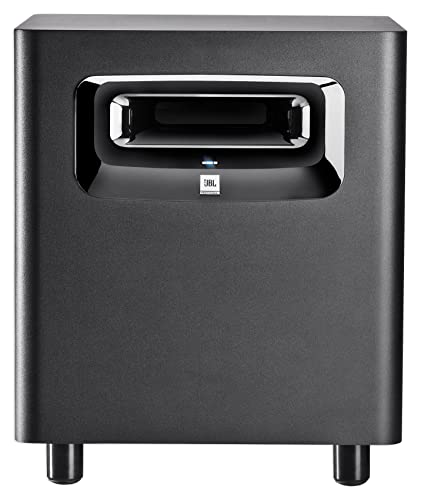
Deep-Bass Powerhouse – JBL LSR310S
The JBL LSR310S is a strong choice for anyone building studio monitors with subwoofer output into a larger nearfield or surround setup. Its 10-inch driver, balanced inputs and outputs, and low-frequency extension into the 20 Hz region make it suited to adding substantial bass to an existing monitor system.
Best For: Producers and studio owners who want deep, high-output bass extension, including dance and surround applications.
Pros:
- 10-inch custom driver reaches into the 20 Hz region and delivers up to 113 dB peak output.
- Balanced XLR and 1/4-inch connections allow integration with professional monitor systems.
- XLF tuning adds a club-style bass voicing for dance production.
- Sensitivity switching supports both -10 dBV and +4 dBu signal sources.
Cons:
- Its large, floor-standing design requires more room than a compact subwoofer.
- The XLF setting may be less appropriate when a neutral response is the priority.
The LSR310S is built for impact and flexibility rather than minimal footprint. It is especially appealing when you need substantial low-end headroom and straightforward balanced connectivity.
Room-Friendly Calibration – ADAM Audio T10S
The ADAM Audio T10S is a practical subwoofer for studio monitors with subwoofer output, particularly when you want adjustable integration rather than simply more bass. It is designed to complement ADAM’s T5V and T7V monitors and includes controls for crossover, phase, and level matching.
Best For: T-Series monitor owners who need flexible low-end extension and quick mix checking with or without the subwoofer.
Pros:
- Engineered specifically to complement the ADAM T5V and T7V monitors.
- Adjustable crossover, phase rotation, and dedicated volume controls support room calibration.
- Downward-facing woofer allows more placement flexibility.
- Footswitch-ready bypass connection makes subwoofer comparison quick.
Cons:
- Its strongest system-matching advantage is with ADAM’s T-Series monitors.
- Using the calibration controls effectively requires time spent matching the subwoofer to the room and monitors.
The T10S focuses on controlled integration and workflow convenience. Its bypass feature is particularly useful when checking whether added bass is improving a mix or merely changing its presentation.
Compact Monitor Pair – PreSonus Eris 3.5
The PreSonus Eris 3.5 is a compact stereo pair for desks and small listening spaces, making it a useful starting point for studio monitors with subwoofer output elsewhere in the system. It combines 3.5-inch woven-composite woofers, 50 watts of amplification, and multiple wired inputs for production, gaming, and everyday listening.
Best For: Desktop users who want a compact stereo monitor pair with flexible connections and basic acoustic adjustment.
Pros:
- Sold as a complete stereo pair with 50 watts of built-in amplification.
- Balanced TRS, RCA, and front-panel auxiliary inputs support varied source equipment.
- High- and low-frequency controls help tailor the sound to the room.
- Front headphone output is convenient for private listening.
Cons:
- 3.5-inch woofers provide less low-end scale than a dedicated studio subwoofer.
- The compact cabinet and listed 80 Hz–20 kHz response may leave very deep bass to a separate subwoofer.
The Eris 3.5 is best viewed as an accessible desktop monitoring foundation rather than a full-range bass solution. Its small footprint and connection options make it easy to place in a compact production or multimedia setup.
Controlled Low-End Extension – Yamaha HS8S
The Yamaha HS8S is an 8-inch powered subwoofer for extending the low end of a studio monitoring system. With a 22 Hz–150 Hz frequency response, 150-watt amplifier, and adjustable low-cut and high-cut controls, it gives you several ways to integrate bass extension with your existing monitors.
Best For: Recording and live-music setups that need a powerful, adjustable subwoofer with dedicated filtering controls.
Pros:
- 8-inch bass-reflex design reaches down to 22 Hz.
- 150-watt amplifier provides substantial power for low-frequency playback.
- Low-cut switch, 80–120 Hz low-cut control, and 80–120 Hz high-cut control support system matching.
- Phase switch helps adjust the subwoofer’s relationship with the main monitors.
Cons:
- The floor-standing cabinet is relatively large and weighs 33.6 pounds.
- Its feature set is oriented toward a dedicated wired studio setup rather than portability.
The HS8S is a capable option when you want deep extension and hands-on crossover adjustment. Its filtering and phase controls make it easier to shape the subwoofer’s role around the main monitors and room.
Flexible Bass Expansion – PreSonus Eris Sub 8BT
The PreSonus Eris Sub 8BT is a practical add-on for a setup built around studio monitors with subwoofer output. Its 8-inch front-firing woofer reaches down to 30 Hz, while adjustable highpass and lowpass filters help integrate the subwoofer with your main monitors.
Best For: Music producers, hi-fi listeners, and multimedia users who want wired or Bluetooth connectivity and room-tuning controls.
Pros:
- 100 watts of power and frequency response down to 30 Hz.
- Highpass and lowpass crossover controls support smoother monitor integration.
- Offers balanced TRS, RCA, front-panel aux, and Bluetooth 5.0 connectivity.
- Includes room-tuning controls and a front headphone output with built-in amplifier.
Cons:
- Its plastic-and-metal construction may feel less premium than a fully wood-built enclosure.
- Bluetooth range is listed at up to 10 meters, which may not suit every room layout.
With flexible inputs, crossover adjustment, and a compact 8-inch design, the Eris Sub 8BT is a versatile choice when you want to extend the low end without giving up control over monitor blending.
Compact Monitoring Pair – Yamaha HS3 Powered Studio Monitor
The Yamaha HS3 is a compact pair for buyers seeking studio monitors with subwoofer output in a small workspace. Its 3.5-inch woofers, 0.75-inch dome tweeters, and wired XLR/TRS, RCA, and stereo-mini connections make it suited to nearfield monitoring and future subwoofer expansion.
Best For: Desktop music production and studio recording where space, straightforward wired connectivity, and a compact pair of monitors matter.
Pros:
- Sold as a pair with a 3.5-inch woofer and 0.75-inch dome tweeter.
- Includes room control and high-trim response controls.
- Provides XLR/TRS combo, RCA, and stereo-mini inputs.
- Includes speaker cable, stereo-mini-to-RCA cable, and anti-slip pads.
Cons:
- The 70 Hz to 22 kHz frequency response leaves less deep-bass extension than a dedicated subwoofer.
- There is no wireless connectivity.
- The listed output power is 26 watts and above, limiting headroom compared with larger monitors.
The HS3 is a space-conscious starting point for a monitor-and-subwoofer system. Its compact drivers and useful response controls suit desktop work, while the wired inputs can fit a conventional studio signal chain.
White Finish Subwoofer – PreSonus Eris Sub 8 BT White
PreSonus Eris Sub 8 BT White 8-inch Front-Firing Studio Subwoofer with Bluetooth Wireless Technology
Check Price On AmazonThe white PreSonus Eris Sub 8 BT adds controlled low-frequency extension to systems using studio monitors with subwoofer output. It combines an 8-inch front-firing woofer, 100 watts of power, Bluetooth, and pass-through outputs with crossover controls for matching satellite speakers.
Best For: Music production, listening, or multimedia setups that need a white-finish subwoofer with Bluetooth and adjustable monitor integration.
Pros:
- 8-inch glass-composite woofer delivers response down to 30 Hz.
- Variable lowpass filter and switchable 80 Hz highpass filter aid crossover setup.
- Includes stereo 1/4-inch TRS and RCA inputs and pass-through outputs.
- Bluetooth wireless input and built-in tuning controls add placement flexibility.
Cons:
- The white finish may not match darker monitor or studio furniture setups.
- Bluetooth is useful for input, but a wired connection may still be preferred for critical monitoring.
This version offers the same practical low-end and integration features in a white enclosure. It is a strong fit when appearance matters alongside 30 Hz extension, wired pass-through connectivity, and simple crossover adjustment.
Best Complete 2.1 Bundle – Mackie CR3.5 Monitors with CR8SBT Subwoofer
If you want studio monitors with subwoofer output without assembling a system piece by piece, this Mackie bundle provides a compact 2.1 setup. It pairs CR3.5 monitors with an 8-inch CR8SBT subwoofer, plus a 10-foot RCA cable for connecting the components.
Best For: Buyers who want an all-in-one desktop or bookshelf system for music, gaming, movies, and casual listening.
Pros:
- Includes the CR3.5 monitor pair, CR8SBT subwoofer, and RCA cable.
- CR3.5 monitors offer TRS, RCA, and 3.5mm inputs, along with a front headphone output.
- CR8SBT adds Bluetooth, adjustable crossover control from 40Hz to 180Hz, and a desktop remote.
Cons:
- The 3.5-inch monitors are compact, so the subwoofer handles the system’s deeper bass.
- This bundle may include more equipment than buyers seeking a simple monitor-only setup need.
Its main advantage is convenience: the speakers, subwoofer, control options, and connecting cable are packaged together. Tone controls and desktop or bookshelf modes also make it easier to adapt the monitors to different placements.
Best Heavy-Duty Pick – PreSonus Eris E4.5
The PreSonus Eris E4.5 is a practical choice if you want studio monitors with subwoofer output potential while starting with a monitor pair. Its 4.5-inch woven-composite woofers, room-tuning controls, and broad connection options suit production, listening, and multimedia use.
Best For: Home studios and desktop listeners who want compact monitors that can later be paired with the Eris Sub 8BT.
Pros:
- Delivers 50 watts of Class AB amplification, rated at 25 watts per side.
- Includes balanced TRS, RCA, and front-panel 1/8-inch auxiliary inputs.
- High- and low-frequency controls help tailor the sound to the room and speaker placement.
- Front headphone output and integrated amplifier make private listening convenient.
Cons:
- The listed product is a monitor pair, not a bundled subwoofer system.
- Buyers wanting added low-end extension must add a compatible Eris Sub 8BT separately.
The Eris E4.5 balances a small footprint with useful studio-focused controls and connectivity. It is a flexible starting point for a 2.1 setup, but the subwoofer upgrade is an additional purchase rather than part of this package.
Best Dedicated Subwoofer Upgrade – Mackie CR8SBT 8-Inch Subwoofer
The Mackie CR8SBT is a dedicated 8-inch subwoofer for expanding compatible CR monitors into a fuller system. It connects through TRS or RCA, includes Bluetooth input, and provides crossover and desktop remote controls for managing the added bass.
Best For: CR Series owners who want stronger low-frequency output without replacing their existing desktop monitors.
Pros:
- Purpose-built for CR Series monitors with TRS or RCA connections.
- 8-inch driver and up to 200 watts of maximum output add substantial bass support.
- Adjustable crossover helps blend the subwoofer with the monitors.
- Desktop remote provides convenient volume control and subwoofer bypass.
Cons:
- It is a subwoofer only, so compatible monitors are required.
- Its 32.4-pound weight and large enclosure may require careful desktop or floor placement.
- Bluetooth input does not replace the wired monitor connection in a typical CR monitor setup.
For listeners who already have compatible Mackie monitors, the CR8SBT is a focused way to extend the system’s low end. Its adjustable crossover and remote make integration more convenient than using a subwoofer with fewer controls.
How We Picked These Studio Monitors with Subwoofer Output
We selected products based on their usefulness in a real-world nearfield monitoring setup, including low-frequency extension, monitor compatibility, connection options, physical footprint, and ease of integration. The list includes compact powered monitors, dedicated studio subwoofers, and bundles that provide a more complete path to fuller bass.
Because these products are not all the same type, check the specifications carefully before buying. A subwoofer-only option requires compatible left and right monitors, while a monitor pair may need a separately purchased sub. Bluetooth can be convenient for casual playback, but wired connections are generally preferable for critical monitoring.
Quick Comparison
- Best for established studio systems: JBL Professional LSR310S or ADAM Audio T10S.
- Best for compact desks: PreSonus Eris 3.5 or Yamaha HS3.
- Best for flexible home listening: PreSonus Eris Sub 8BT or the white Eris Sub 8 BT.
- Best all-in-one value: The Mackie CR3.5 and CR8SBT bundle.
- Best for matching compatible monitors: Yamaha HS8 Subwoofer or Mackie CR8SBT.
Key Buying Factors for Studio Monitors with Subwoofer Output
Room Size and Bass Management
A larger subwoofer is not automatically better. In a small room, excessive low-end energy can create uneven bass and make mixes harder to judge. Look for adjustable crossover and level controls so the sub can blend smoothly with the monitors. Placement also matters: avoid pushing the sub tightly into a corner unless you have checked the resulting bass response.
Inputs, Outputs, and Compatibility
Confirm that the subwoofer accepts your audio interface or monitor controller and provides the outputs needed for your speakers. Balanced inputs and outputs, such as XLR or TRS, can help reduce noise in studio installations. Also check whether your monitors have enough low-frequency control to integrate with a subwoofer.
Driver Size and Frequency Range
Compact 3.5- or 4.5-inch monitors save desk space but usually benefit more from a sub than larger nearfield speakers. An 8- or 10-inch sub can provide stronger extension, though it requires careful calibration. Compare the advertised frequency ranges, crossover controls, and maximum output rather than judging only by driver size.
Wireless Features and Everyday Convenience
Bluetooth and remote controls are useful for casual playback, streaming, or switching sources. For mixing and production, use the most direct wired signal path available and treat wireless features as an added convenience rather than a substitute for balanced studio connections.
Who Should Buy Which Studio Monitors with Subwoofer Output?
Choose a compact monitor pair such as the Eris 3.5, Eris E4.5, or Yamaha HS3 if you are building a small desktop setup and want simple, space-conscious monitoring. Add a compatible subwoofer later if your room and workflow require deeper bass.
Choose the JBL, ADAM, Yamaha, or Mackie subwoofer options if you already own suitable monitors and want to expand the system. The Mackie bundle is a practical starting point for buyers who need both monitors and a subwoofer in one purchase. For flexible home use, the Bluetooth-equipped PreSonus subs add convenient wireless playback alongside their wired studio connections.