
The best audio interface can make vocals, instruments, and spoken-word recordings sound cleaner while giving your computer the inputs and monitoring tools your setup needs.
These 10 models cover affordable beginner options, compact two-channel interfaces, and more flexible choices for growing home studios. Use the guide below to match features, connectivity, and workflow to the way you record.
Best 10 Audio Interface Picks for 2026
Classic Tone Choice
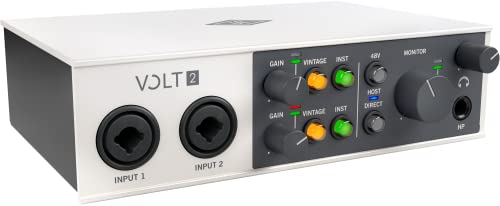
- Vintage mode emulates classic 610 preamp character
- 24-bit/192 kHz recording and MIDI connectivity
- Supports Mac, Windows, iPad, and iPhone
Best For: Musicians and creators seeking vintage-inspired tone and flexible recording options
Portable Value Pick

- USB-C bus power enables a one-cable setup
- Two combo inputs with Hi-Z and 48V phantom power
- 24-bit/192 kHz recording with direct monitoring
Best For: Laptop and mobile creators building a simple two-channel recording setup
Easy Recording Upgrade
Focusrite Scarlett 2i2 4th Gen

- Auto Gain and Clip Safe simplify recording levels
- 120 dB dynamic range and 24-bit/192 kHz support
- Includes major recording software and plug-ins
Best For: Beginners and home producers wanting guided controls and a complete software bundle
Monitoring-Focused Pick

- 2-in/2-out USB-C interface with two preamps
- 24-bit/192 kHz recording support
- Hardware monitoring and macOS, Windows, and iOS compatibility
Best For: Creators who want straightforward high-resolution recording with hardware monitoring
Best Connected Studio Hub
Focusrite Scarlett 4i4 4th Gen

- 4-in/4-out design with MIDI I/O
- 24-bit/192kHz recording and 120dB dynamic range
- Auto Gain, Clip Safe, and Air modes
Best For: Flexible home studios and multi-source recording
Best Rugged 4-Input Value

- Four inputs and four outputs
- Four MIDAS-designed preamps with phantom power
- 24-bit/192kHz audio and MIDI I/O
Best For: Affordable multi-input home recording
Best Compact Starter Interface
Focusrite Scarlett Solo 3rd Gen

- One XLR mic input and one Hi-Z instrument input
- 24-bit/192kHz recording with Air mode
- Compact design with headphone and balanced outputs
Best For: Solo musicians, vocalists, and small desktop studios
Classic Studio Color
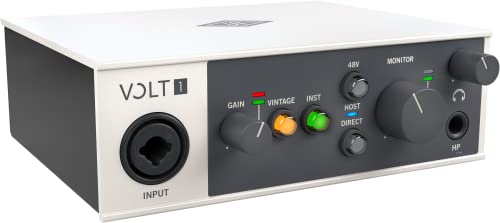
- Vintage mode adds classic 610-style preamp character.
- Records up to 24-bit/192 kHz.
- Supports desktop and compatible Apple mobile setups.
Best For: Solo musicians wanting vintage-style sound and high-resolution recording.
Modern Songwriter Pick
Focusrite Scarlett Solo 4th Gen

- Includes one mic preamp and one Hi-Z input.
- Offers 120 dB dynamic range and 192 kHz recording.
- Includes a broad starter software and plugin bundle.
Best For: Songwriters recording vocals, guitar, or other solo performances.
Flexible Starter Value

- Two combo inputs accept mic, line, or instrument sources.
- Includes phantom power and zero-latency direct monitoring.
- Supports recording, podcasting, and live streaming at 48 kHz.
Best For: Budget-conscious creators needing flexible two-input recording.
Classic Tone Choice – Universal Audio Volt 2
The Universal Audio Volt 2 is a compact 2×2 audio interface for musicians, podcasters, and streamers who want a polished recording setup with a vintage-inspired preamp sound. Its Vintage mode, 24-bit/192 kHz recording, MIDI connectivity, and compatibility with Mac, Windows, iPad, and iPhone make it flexible for studio and mobile work.
Best For: Creators who want classic UA-style preamp character, high-resolution recording, and LUNA or UAD software support.
Pros:
- Vintage mode emulates the sound of UA’s classic 610 preamps.
- Supports up to 24-bit/192 kHz recording with clear converters.
- Works with Mac, Windows, iPad, and iPhone setups.
- Includes MIDI and supports LUNA, UAD plug-ins, and instruments.
Cons:
- Mobile iPhone and Lightning iPad use requires additional Apple adapter hardware.
- An external Volt power supply is required for supported mobile recording setups.
Volt 2 is a strong pick when tonal character matters as much as technical specifications. It offers a straightforward two-channel format while adding useful software and mobile-recording flexibility.
Portable Value Pick – PIYONE Q28 USB-C Interface
The PIYONE Q28 is a portable 2×2 audio interface designed for simple computer and mobile recording. It combines USB-C bus power, two combo inputs, 24-bit/192 kHz fidelity, 48V phantom power, and direct monitoring in a compact setup.
Best For: Laptop and mobile creators who need an affordable, plug-and-play interface for microphones, guitars, and basic two-channel recording.
Pros:
- USB-C connectivity provides data transfer and bus power without a bulky external supply.
- Two combo inputs support microphones, instruments, and Hi-Z guitar connections.
- Offers 24-bit/192 kHz recording and 48V phantom power.
- Direct monitoring and a 3.5mm headphone output support low-latency tracking.
Cons:
- The supplied details list Windows support, so users of other operating systems should verify compatibility.
- Its feature set is focused on two-channel recording rather than larger studio setups.
Q28 emphasizes convenience and portability. It is a practical choice for home recording or mobile workflows where USB-C power, simple controls, and flexible inputs are priorities.
Easy Recording Upgrade – Focusrite Scarlett 2i2 4th Gen
The Focusrite Scarlett 2i2 4th Gen is a versatile 2-channel audio interface for recording microphones and instruments. It pairs 24-bit/192 kHz conversion and a 120 dB dynamic range with Auto Gain, Clip Safe, Air modes, and a substantial software bundle.
Best For: Beginners and home recordists who want guided level-setting features, quality preamps, and a ready-to-use music-production package.
Pros:
- Auto Gain helps set suitable recording levels for microphones and guitars.
- Clip Safe helps prevent clipping during takes.
- Air modes add presence and harmonic drive to vocals and guitars.
- Includes Pro Tools Intro+, Ableton Live Lite, Cubase LE, and Hitmaker Expansion.
Cons:
- It is limited to two input channels.
- The supplied USB-A to USB-C cable may require an adapter for some host devices.
Scarlett 2i2 4th Gen is especially appealing for users who want recording assistance without sacrificing core studio features. Its software bundle also gives new producers a useful starting point.
Monitoring-Focused Pick – MOTU M2
The MOTU M2 is a compact 2-in/2-out USB-C audio interface with two preamps, hardware monitoring, and support for 24-bit/192 kHz recording. It is designed for computer and iOS workflows and includes more than 6GB of free content.
Best For: Musicians and creators who prioritize hardware monitoring and high-resolution two-channel recording.
Pros:
- Provides two preamps in a 2-in/2-out configuration.
- Supports 24-bit/192 kHz recording.
- Includes hardware monitoring for tracking.
- Compatible with macOS, Windows, and iOS according to the supplied notes.
Cons:
- The supplied details do not specify included DAW software beyond MOTU drivers.
- Two inputs and two outputs may be limiting for larger recording sessions.
M2 keeps the focus on core recording performance and monitoring rather than a long list of extra features. It is a sensible fit for a streamlined, two-channel studio or mobile setup.
Best Connected Studio Hub – Focusrite Scarlett 4i4 4th Gen
The Focusrite Scarlett 4i4 4th Gen is a versatile audio interface for home studios that need to connect microphones, instruments, synths, drum machines, and MIDI hardware. Its 4-in/4-out layout, 192kHz support, and updated recording features make it a practical choice for more involved setups.
Best For: Musicians and producers building a flexible home studio with multiple inputs and outputs.
Pros:
- Includes two mic preamps, two Hi-Z inputs, four line inputs, four line outputs, and MIDI I/O.
- Offers 24-bit/192kHz recording and a stated 120dB dynamic range.
- Auto Gain and Clip Safe help set levels and reduce clipping during recording.
- Includes Air modes and a substantial software bundle.
Cons:
- Its broader feature set may be more than a simple vocal-and-guitar setup requires.
- The interface is larger and heavier than the Scarlett Solo.
Choose this audio interface if you expect your setup to grow or regularly record several sources. Air mode, Auto Gain, and Clip Safe add useful convenience without replacing the need for sensible gain staging.
Best Rugged 4-Input Value – Behringer U-PHORIA UMC404HD
The Behringer U-PHORIA UMC404HD is a 4×4 USB audio interface designed for recording multiple microphones and instruments. It combines 24-bit/192kHz audio, four MIDAS-designed mic preamps, MIDI I/O, and a metal chassis for a straightforward studio setup.
Best For: Budget-conscious recording setups that need four inputs and MIDI connectivity.
Pros:
- Provides four inputs and four outputs with ultra-low-latency operation.
- Includes four mic preamps with +48V phantom power.
- Supports 24-bit/192kHz audio and MIDI I/O.
- Its impact-resistant metal chassis is described as “built-like-a-tank.”
Cons:
- The supplied notes list Windows compatibility as the operating-system detail.
- The product information does not mention convenience features such as automatic gain control.
This audio interface suits users who prioritize input count, MIDI, and durable construction over newer workflow extras. It is compatible with popular recording software including Pro Tools, Ableton Live, and Cubase.
Best Compact Starter Interface – Focusrite Scarlett Solo 3rd Gen
The Focusrite Scarlett Solo 3rd Gen is a compact two-channel audio interface for recording a microphone and an instrument. It supports 24-bit/192kHz audio, includes an Air mode, and offers dedicated inputs for XLR microphone and Hi-Z instrument connections.
Best For: Solo musicians, vocalists, podcasters, and compact desktop recording setups.
Pros:
- Compact design with one XLR mic preamp and one Hi-Z instrument input.
- Records at up to 24-bit/192kHz with high-performance converters.
- Air mode adds clarity to acoustic instruments, while Gain Halos help monitor levels.
- Includes balanced outputs, headphone monitoring, recording software, and a three-year warranty noted in the product description.
Cons:
- With two channels, it is less suitable for recording several sources at once.
- It offers fewer outputs and no listed MIDI I/O compared with the Scarlett 4i4.
For a first audio interface, the Scarlett Solo keeps the signal path simple and the footprint small. It is a strong fit when your typical session involves one microphone, one guitar or bass, and headphones or studio monitors.
Classic Studio Color – Universal Audio Volt 1
The Universal Audio Volt 1 is a compact audio interface for solo recording setups that want a more classic preamp character. Its Vintage mode, 24-bit/192 kHz support, and compatibility with computers and Apple mobile devices make it flexible for vocals, guitar, and portable production.
Best For: Solo musicians and creators seeking vintage-style preamp coloration with high-resolution recording.
Pros:
- Vintage mode is designed to emulate the sound of UA’s classic 610 preamps.
- Supports recording quality up to 24-bit/192 kHz.
- Works with macOS, Windows, iPad, and iPhone setups.
- Includes access to LUNA and supported UAD software tools.
Cons:
- Its two-channel configuration is aimed at relatively small recording setups.
- Mobile Apple recording requires an external Volt power supply and, in some cases, a Lightning to USB Camera Adapter.
Choose the Volt 1 if preamp character and high-resolution capture matter more to you than a larger input count. It is a particularly appealing audio interface for focused, one- or two-source recording.
Modern Songwriter Pick – Focusrite Scarlett Solo 4th Gen
The Focusrite Scarlett Solo 4th Gen is a straightforward audio interface for recording one microphone and one instrument. It combines 24-bit/192 kHz operation, a 120 dB dynamic range, USB-C connectivity, and an Air mode intended to add presence and harmonic drive to vocals and guitars.
Best For: Songwriters and solo producers recording vocals, guitar, or other single-source performances.
Pros:
- Provides a 1 XLR mic preamp and a separate Hi-Z instrument input.
- Offers up to 120 dB dynamic range and 24-bit/192 kHz recording.
- Air mode can add presence and harmonic character to vocals and guitars.
- Includes Pro Tools Intro+, Ableton Live Lite, Cubase LE, and Hitmaker Expansion.
Cons:
- The single mic input limits simultaneous multi-microphone recording.
- Its two-channel layout is best suited to solo or small-scale sessions.
The Scarlett Solo is a strong fit when you need an easy way to record a vocal and instrument without paying for unused inputs. Its software bundle also gives new producers a useful starting point.
Flexible Starter Value – M-AUDIO M-Track Duo
The M-AUDIO M-Track Duo is a practical audio interface for home recording, podcasting, and live streaming. Its two combo inputs accept microphones, line sources, or instruments, while phantom power, direct monitoring, and included MPC Beats software cover essential beginner workflows.
Best For: Budget-conscious creators who need flexible inputs for recording, streaming, podcasting, or basic music production.
Pros:
- Two combo XLR/line/instrument inputs support varied source types.
- Phantom power accommodates compatible condenser microphones.
- USB/Direct monitoring switch enables zero-latency monitoring.
- Includes MPC Beats and supports Mac, PC, iOS, and Android devices.
Cons:
- Its maximum sample rate is 48 kHz, below the 192 kHz capability of some alternatives.
- The interface uses USB Type-B connectivity rather than USB-C.
- It is designed for basic two-channel recording rather than larger sessions.
The M-Track Duo makes sense when input flexibility and monitoring features are priorities. It is a capable entry-level audio interface for creators who do not need high-resolution rates beyond 48 kHz.
How We Picked the Best Audio Interfaces
We focused on interfaces that offer dependable recording essentials: quality microphone preamps, useful input and output configurations, low-latency monitoring, broad computer compatibility, and straightforward setup. We also considered the needs of different users, from solo musicians and podcasters to producers who need multiple simultaneous inputs.
Models with USB-C connections, 24-bit/192kHz support, MIDI, onboard processing, or expandable I/O received extra consideration where those features add practical value. Price and simplicity matter too, so this list includes both entry-level choices and models suited to more demanding workflows.
Quick Comparison
| Best For | Recommended Type | What to Look For |
|---|---|---|
| Solo vocals or guitar | 1–2 input interface | Quality preamp, direct monitoring, instrument input |
| Two-person recording | 2-in/2-out interface | Two combo inputs and independent gain control |
| Small band or multi-mic setup | 4-input interface | Multiple preamps, balanced outputs, MIDI if needed |
| Portable recording | Compact USB-powered model | Bus power, durable build, compatible device support |
Key Buying Factors for an Audio Interface
Inputs and Outputs
Choose based on how many sources you record at once, not just how many instruments you own. One input works for a solo setup, while two inputs allow stereo recording or two performers. Four or more inputs are better for drum miking, band rehearsals, and podcasts with several microphones.
Sound Quality and Preamps
Look for clean gain, sufficient input range, and support for at least 24-bit recording. High sample-rate support can be useful, but microphone quality, room acoustics, placement, and performance usually make a larger difference than the maximum published rate.
Monitoring and Connectivity
Direct monitoring helps reduce distracting latency while recording. Check for a dedicated headphone control, balanced monitor outputs, and the connection your computer uses. USB-powered models are convenient, while MIDI ports matter if you use hardware keyboards, drum machines, or controllers.
Software and Compatibility
Confirm that the interface works with your operating system and preferred digital audio workstation. Bundled software can be helpful for beginners, but stable drivers and a simple control layout are more important for long-term use.
Who Should Buy Which Audio Interface?
Choose a one-input model if you mainly record solo vocals, guitar, voiceovers, or a single instrument. Choose a two-input model for stereo sources, interviews, two performers, or a flexible starter studio. Choose a four-input model if you record several microphones, need external hardware, or expect your setup to grow.
Beginners should prioritize easy controls, reliable monitoring, and bundled software rather than advanced specifications. Experienced producers may prefer better metering, MIDI, more outputs, or additional inputs. Before buying, count your simultaneous sources, check your computer ports, and leave some capacity for future projects.