
Choosing among the best audio mixers for film production depends on your crew size, channel count, recording workflow, and whether you need a portable field unit or a full digital console.
This roundup compares 10 options for production sound, post-production, live recording, and hybrid workflows, including compact Sound Devices recorders and feature-rich Allen & Heath mixers.
Best 10 Audio Mixers for Film Production Picks for 2026
Best Portable Field Mixer

- Three low-noise Kashmir preamps
- 32-bit float and USB-C interface
- Built-in LTC timecode generator
Best For: Location sound and compact bag rigs
Best Wireless Stage-Style Mixer

- 16 mic or line inputs
- Dual-band Wi-Fi and Bluetooth
- 24x24 USB and SD recording
Best For: Larger sets and remotely controlled mixing
Best All-in-One Production Console

- Four XLR inputs and studio preamps
- APHEX processing and SMART pads
- Standalone multitrack recording
Best For: Dialogue, interviews, and compact studio work
Best High-Channel Production Mixer

- 38 inputs and 24 XLR/TRS combi inputs
- 96kHz processing with low latency
- 32x32 USB-C and SLink expansion
Best For: Large productions and complex routing
Best Compact Field Mixer

- Four Kashmir preamps with adjustable limiters
- 32-bit float recording up to 192 kHz
- Compact 0.6 kg design with timecode
Best For: Mobile filmmakers and location sound crews
Best Large-Format Digital Mixer
Allen & Heath Qu-5 Digital Mixer

- 38 inputs and 24 outputs for complex routing
- 96 kHz processing with low latency
- USB-C multitrack recording and remote apps
Best For: Large productions and installed audio systems
Best High-Input Field Recorder

- Eight Kashmir preamps for multi-mic recording
- 32-bit float support up to 192 kHz
- Portable mixer with BNC timecode I/O
Best For: Location sound mixers on multi-microphone shoots
Premium Dante Hub

- 38 inputs and 24 outputs with 96kHz processing
- Built-in 16x16 Dante and 128x128 SLink expansion
- USB-C, SD multitrack recording, effects, and motorized control
Best For: Large film and AV systems needing Dante connectivity
Established Workhorse

- 24 channels with 24 AnalogiQ preamps
- 25 motorized 100mm faders with recall
- Qu-Pad wireless iPad control and integrated iLive FX
Best For: Compact productions wanting physical faders and iPad control
High-Capacity Control Surface
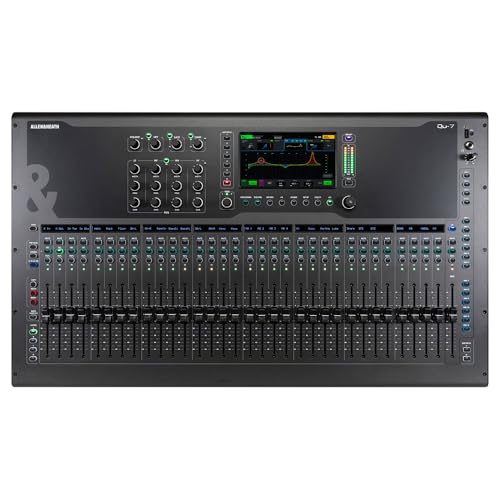
- Up to 38 inputs with 96kHz processing
- 33 motorized faders and configurable mixing layers
- SLink, AES3, USB-C, SD recording, and optional Dante
Best For: Large productions needing extensive hands-on control
Best Portable Field Mixer – Sound Devices MixPre-3 II
For filmmakers seeking audio mixers for film production in a compact field setup, the Sound Devices MixPre-3 II combines three low-noise microphone preamps, a built-in 3 x 2 mixer, multichannel recording, and timecode features in a lightweight 1.1-pound unit.
Best For: Location sound, bag rigs, mobile recording, and computer-based production.
Pros:
- Three ultra-low-noise Kashmir microphone preamps with adjustable limiters.
- 32-bit float recording and a 5-in, 2-out USB-C audio interface.
- Internal LTC timecode generator with multiple timecode options.
- Compact, durable design suitable for field use.
Cons:
- Six-channel configuration is less suitable for larger productions.
- Battery-powered operation may require extra batteries for extended shoots.
The MixPre-3 II is a focused choice when portability, clean preamps, and timecode matter more than extensive routing or input capacity.
Best Wireless Stage-Style Mixer – Allen & Heath CQ-20B
The Allen & Heath CQ-20B is a strong option for audio mixers for film production when a project needs many physical inputs, wireless control, and flexible recording. It provides 16 mic or line inputs, stereo line inputs, Wi-Fi, Bluetooth, USB, and SD recording in a stage-box format.
Best For: Larger sets, studio environments, live production, and remotely controlled mixing.
Pros:
- Offers 16 mic or line inputs, including eight combi inputs.
- Built-in dual-band Wi-Fi supports wireless mixer control.
- Includes Bluetooth input and a 24×24 USB interface.
- Supports SD card recording and playback.
Cons:
- Its 4.4 kg stage-box format is less convenient for mobile location work.
- Requires a more involved setup than a compact field recorder.
The CQ-20B makes sense for productions that prioritize input count and networked control over a small, battery-powered footprint.
Best All-in-One Production Console – RØDECaster Pro II
For creators who want audio mixers for film production with built-in processing and standalone recording, the RØDECaster Pro II combines four XLR inputs, headphone outputs, effects, sound pads, and multitrack recording without requiring a separate computer mixer.
Best For: Interviews, dialogue-focused productions, streaming, podcast-style shoots, and compact studio work.
Pros:
- Four studio preamps support microphone, line, and instrument inputs.
- APHEX processing presets simplify voice-focused production.
- Records multitrack to a computer, microSD card, or USB drive.
- Eight customizable SMART pads support music and sound-effect triggering.
Cons:
- Its feature set is geared more toward spoken-word production than large film crews.
- Nine-channel capacity is limited compared with larger digital mixers.
The RØDECaster Pro II is particularly practical for small crews that value fast setup, onboard voice processing, and standalone operation.
Best High-Channel Production Mixer – Allen & Heath Qu-6
The Allen & Heath Qu-6 is designed for demanding audio mixers for film production workflows that need substantial input capacity, routing, and expansion. Its 38-input platform, 96kHz processing, 25 motorized faders, multichannel USB-C interface, and recording options suit complex production environments.
Best For: Large productions, fixed studio or AV installations, complex routing, and multichannel recording.
Pros:
- Provides 38 inputs, 24 XLR/TRS combi inputs, 12 mixes, and four matrix outputs.
- 96kHz XCVI FPGA processing is designed for low-latency performance.
- Includes 128×128 SLink expansion, USB-C 32×32 audio, and optional Dante on Qu-6D models.
- Offers six multi-FX engines, SD recording, and extensive hands-on controls.
Cons:
- Corded operation and its extensive control surface make it less portable.
- Its capacity and feature set may exceed the needs of small crews.
The Qu-6 is the most capable option here for productions that need professional routing, expansion, hands-on mixing, and high-channel-count recording.
Best Compact Field Mixer – Sound Devices MixPre-6 II
The Sound Devices MixPre-6 II is a compact choice for audio mixers for film production when portability and flexible recording quality matter. Its four Kashmir preamps, built-in 6 x 2 mixer, and 32-bit float recording support suit field, on-set, and computer-based workflows.
Best For: Mobile filmmakers, location sound work, and compact bag rigs.
Pros:
- Four ultra-low-noise Kashmir microphone preamps with adjustable limiters.
- Records from 16-bit to 32-bit float and up to 192 kHz.
- Includes LTC timecode, HDMI triggering, and an 8-in, 4-out USB-C interface.
- Lightweight 0.6 kg design is practical for portable production.
Cons:
- Its six-channel mixer is less expansive than larger production consoles.
- Offers fewer microphone preamps than the MixPre-10 II.
Choose the MixPre-6 II when you need high-quality capture and timecode features in a small, durable recorder/mixer. It is especially well suited to productions where a full-size console would be impractical.
Best Large-Format Digital Mixer – Allen & Heath Qu-5 Digital Mixer
The Allen & Heath Qu-5 is a powerful option among audio mixers for film production when a project needs extensive routing, multiple outputs, and centralized control. Its 38-input architecture, 96 kHz processing, multitrack USB-C interface, and remote apps support demanding production environments.
Best For: Larger productions, studio facilities, live sound, and installed audio systems.
Pros:
- Supports up to 38 inputs, 12 configurable mixes, and four matrix outputs.
- Provides 96 kHz XCVI FPGA processing with ultra-low latency.
- Offers 16 XLR/TRS inputs, 12 XLR outputs, AES3, and SLink expansion.
- Includes USB-C 32×32 audio, SD card capture, effects, and remote control apps.
Cons:
- At 27.4 pounds, it is less portable than compact field mixers.
- Its corded-electric design is less suited to battery-powered location work.
The Qu-5 is the strongest fit here for complex setups that need substantial I/O and hands-on control. Its size and power requirements favor permanent or vehicle-based production environments over lightweight field bags.
Best High-Input Field Recorder – Sound Devices MixPre-10 II
The Sound Devices MixPre-10 II is designed for audio mixers for film production that need more microphone inputs without moving to a full-size console. Eight Kashmir preamps, a 10 x 4 mixer, 32-bit float recording, and flexible timecode connections make it a capable portable on-set recorder.
Best For: Location sound mixers handling multi-microphone film and video shoots.
Pros:
- Eight ultra-low-noise Kashmir preamps with adjustable limiters.
- Supports 16-bit to 32-bit float recording and sample rates up to 192 kHz.
- Provides a 12-in, 4-out USB-C interface and built-in 10 x 4 mixer.
- Includes BNC or Aux timecode I/O plus HDMI triggering.
Cons:
- Its 0.9 kg weight is higher than the MixPre-6 II.
- Battery-powered operation may require attention to runtime during extended shoots.
For productions that need eight microphone preamps in a portable package, the MixPre-10 II offers a practical balance of capacity and mobility. Its timecode and USB features also help it transition between location recording and computer-based workflows.
Premium Dante Hub – Qu-5D Digital Mixer
The Allen & Heath Qu-5D is a high-capacity option among audio mixers for film production, combining 38 inputs, 24 outputs, 96kHz processing, and built-in Dante networking. Its touchscreen, motorized faders, multitrack recording, and remote-control apps support complex production workflows.
Best For: Film and AV teams that need extensive I/O, Dante integration, and hands-on digital mixing control.
Pros:
- 96kHz XCVI FPGA processing provides low-latency professional audio performance.
- Built-in 16×16 Dante networking and 128×128 SLink support provide flexible system connectivity.
- Includes USB-C 32×32 interfacing, SD card multitrack recording, and six multi-FX engines.
- Offers 17 motorized faders, a 7-inch touchscreen, customizable layers, and remote apps.
Cons:
- Its 28.1-pound chassis may be less convenient for highly mobile setups.
- The extensive feature set may be more than needed for small productions.
Choose the Qu-5D when networking and expansion are priorities. It is especially compelling for larger film, studio, or AV environments that can use Dante, multitrack recording, and multiple control options.
Established Workhorse – QU-24 Digital Mixer
The Allen & Heath QU-24 is a straightforward digital choice among audio mixers for film production, with 24 channels, 24 AnalogiQ preamps, integrated iLive FX, and motorized 100mm faders. Wireless iPad control through the Qu-Pad app adds flexibility during setup and operation.
Best For: Productions seeking a conventional 24-channel digital mixer with physical fader control and iPad-based operation.
Pros:
- Provides 24 channels and 24 AnalogiQ preamps for multi-source mixing.
- Twenty-five motorized 100mm faders support mix recall and hands-on adjustments.
- Qu-Pad app support enables wireless access to the mix from an iPad.
- Integrated iLive FX add onboard processing capabilities.
Cons:
- It has fewer channels and expansion details than the newer 38-input models in this roundup.
- The supplied notes do not specify 96kHz processing or Dante networking.
The QU-24 makes sense for teams that value familiar physical controls and a manageable channel count. Its motorized faders and Qu-Pad support can simplify repeatable setups without requiring the larger footprint of the newer high-capacity models.
High-Capacity Control Surface – Qu-7 Digital Mixer
The Allen & Heath Qu-7 is designed for demanding audio mixers for film production, offering up to 38 inputs, 24 outputs, 96kHz processing, 33 motorized faders, and extensive expansion options. USB-C interfacing, SD recording, and onboard effects support recording and production workflows.
Best For: Larger film, touring, and production environments that need many inputs, abundant fader control, and expandable digital I/O.
Pros:
- Supports up to 38 inputs, 24 outputs, 12 configurable mixes, and four matrix outputs.
- Offers 33 motorized faders, a 7-inch touchscreen, customizable layers, and eight SoftKeys.
- Includes 128×128 SLink, AES3 output, USB-C 32×32 audio, and optional Dante on Qu-7D models.
- Provides six multi-FX engines, USB-A recording/playback, multichannel USB audio, and SD recording.
Cons:
- Dante networking is optional and applies to Qu-7D models, not the listed Qu-7.
- The high channel and control capacity may be excessive for small crews or simple sessions.
The Qu-7 is a strong fit when direct access to many channels matters. Its 33 faders and broad recording and expansion features make it a practical centerpiece for complex productions, while the standard model leaves Dante as an optional upgrade path.
How We Picked the Best Audio Mixers for Film Production
We focused on the features that have the greatest effect on real-world production workflows: input and output capacity, recording reliability, portability, routing flexibility, monitoring, connectivity, and ease of operation. The selection includes portable multitrack recorders, compact digital mixers, and larger consoles so different crews can match the equipment to the scale of a project.
We also considered practical details such as 32-bit float recording on the MixPre models, wireless control, USB audio functionality, Dante networking, channel expansion, and the ability to integrate microphones, cameras, computers, and external recorders.
Quick Comparison
| Best For | Recommended Type | Why It Stands Out |
|---|---|---|
| Solo production sound | Sound Devices MixPre-3 II | Small, portable, and designed for high-quality field recording |
| Small crews with more inputs | Sound Devices MixPre-6 II | Additional channels without moving to a full-size console |
| Larger mobile recording setups | Sound Devices MixPre-10 II | High input capacity in a portable recorder format |
| Compact wireless digital mixing | Allen & Heath CQ-20B | Remote control with Wi-Fi and Bluetooth connectivity |
| Podcasting and studio production | RØDE RØDECaster Pro II | Integrated production controls and streamlined routing |
| Venue, stage, or complex production systems | Allen & Heath Qu and QU models | Extensive I/O, digital processing, and console-style control |
Key Buying Factors for Audio Mixers for Film Production
Portability and Power
Field mixers must fit into a sound bag or compact cart and operate reliably away from AC power. A portable recorder is usually the better choice for location dialogue, documentary work, and small crews. Larger digital mixers are more suitable when weight, setup time, and power requirements are manageable.
Inputs, Outputs, and Routing
Count the microphones and wireless receivers you use now, then allow room for additional channels. Also check outputs for camera feeds, monitors, IFB systems, backup recorders, and headphones. Flexible routing matters when you need isolated tracks alongside a mixed production feed.
Recording and Connectivity
32-bit float recording can provide useful headroom for unpredictable location levels, while USB connectivity supports editing, streaming, and computer-based recording. Dante-equipped models are worth considering for networked audio systems and installations.
Control and Monitoring
Look for clear metering, dependable headphone monitoring, fast gain adjustment, and accessible mute or solo controls. Remote control is valuable when the mixer is positioned away from the performance area, but physical controls may be preferable during fast-moving shoots.
Who Should Buy Which Audio Mixers for Film Production?
Choose a MixPre Model for Location Sound
The MixPre-3 II suits minimal crews, while the MixPre-6 II provides more flexibility for multiple wireless systems and microphones. Choose the MixPre-10 II when a larger production needs many isolated tracks without carrying a conventional console.
Choose the CQ-20B or RØDECaster Pro II for Compact Workflows
The CQ-20B is a strong fit for portable digital mixing with wireless control. The RØDECaster Pro II is better suited to creators combining dialogue, music, podcasting, streaming, and computer-based production.
Choose an Allen & Heath Qu or QU Console for Larger Systems
These mixers make more sense for studios, stages, venues, and productions requiring extensive I/O, detailed digital processing, or network integration. Select among them based on channel requirements, Dante support, physical layout, and available space.