
The best power amplifiers deliver clean, reliable output while matching your speakers, venue, and system layout. The right model can improve headroom and consistency without adding unnecessary complexity.
This roundup compares 10 stereo, bridged, and multichannel amplifiers for DJs, PA systems, stages, installations, and reference listening. Use the guide below to narrow your choices by power, impedance, channels, and operating needs.
Best 10 Power Amplifiers Picks for 2026
High-Output Choice

- Up to 4,000 watts in bridged mode
- ATR technology for punch and clarity
- Switchable limiters and monitoring LEDs
Best For: High-power DJ, band, and live-sound systems
Portable Live-Sound Pick
Peavey IPR2 3000 Lightweight Power Amp

- Lightweight 10.8-pound design
- Two independent channels
- Combi inputs and Speakon outputs
Best For: Mobile DJs, bands, and portable rigs
Flexible Rack-Mount Option
Rockville D12 2-Channel Class D Amp

- 1,400W RMS at 4 ohms
- Stereo, parallel, and bridged modes
- LCD monitoring and selectable crossover
Best For: DJ, live-event, and mixed speaker systems
Compact Stereo Pick
Behringer KM750 Stereo Power Amplifier

- 750-watt two-channel output
- ATR technology included
- Compact 18.98-inch chassis length
Best For: Moderate-power stereo amplification
Best 4-Channel Efficiency

- Four channels in a compact 1U rack chassis
- 720W RMS per channel at 4 ohms
- Built-in protection and signal-management controls
Best For: Conference installations and multi-channel PA systems
Best Traditional PA Workhorse

- 300W continuous per channel at 4 ohms
- 600W bridged output at 8 ohms
- Forced-air cooling with flexible I/O
Best For: Two-channel DJ, PA, and stage systems
Best High-Power Clarity

- 2000W maximum output from two channels
- ATR Technology for punchy bass response
- Rack-mountable with XLR and 1/4-inch inputs
Best For: DJs, performers, and high-output passive-speaker systems
Quiet Reference Power

- 2 x 400 watts into 4 ohms
- 800 watts bridged into 8 ohms
- Fanless convection cooling
Best For: Studios, HiFi systems, and quiet monitoring environments
Touring DJ Workhorse
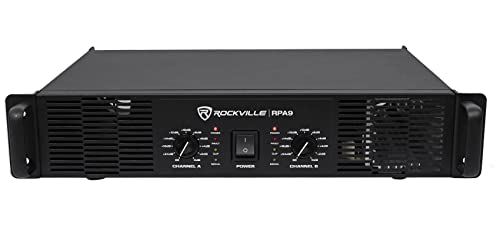
- 3000W peak and 800W RMS
- XLR, 1/4-inch, and RCA inputs
- Stereo and bridged operating modes
Best For: DJs, live events, and mobile sound systems
High-Output System Driver

- Up to 3000W RMS bridged
- Built-in crossover and limiter
- LCD volume and temperature display
Best For: Large venues, subwoofers, and touring sound reinforcement
High-Output Choice – Behringer EUROPOWER EP4000
The Behringer EUROPOWER EP4000 is a high-output option among power amplifiers, designed for setups that need substantial stereo or bridged power. Its ATR technology, switchable limiters, gain controls, and front-panel monitoring LEDs support practical live-sound operation.
Best For: DJs, bands, and sound systems needing high power into low-impedance loads.
Pros:
- Provides 2 x 2,000 watts into 2 ohms and 4,000 watts in bridged mode.
- ATR technology is designed for punch and clarity.
- Switchable limiters help provide overload protection.
- Gain controls and Power, Signal, and Clip LEDs support precise monitoring.
Cons:
- At 38.4 pounds, it is substantially heavier than the lightweight alternatives.
- Its 3.54-inch rack height and nearly 19-inch width require appropriate installation space.
The EP4000 is a strong fit when maximum output is the priority. Choose it if your system can accommodate its heavier chassis and corded-electric operation.
Portable Live-Sound Pick – Peavey IPR2 3000 Lightweight Power Amp
The Peavey IPR2 3000 is a lightweight two-channel choice for power amplifiers, pairing Class D topology with flexible connections for mobile sound systems. Its independent crossovers and DDT protection features make it practical for DJs, bands, and portable rigs.
Best For: Mobile DJs, bands, and users who want a powerful two-channel amplifier that is easier to transport.
Pros:
- Two-channel design supports independent operation.
- Light 10.8-pound weight is convenient for portable setups.
- Combi XLR/1/4-inch inputs and Speakon outputs support common live-sound connections.
- Includes fourth-order Linkwitz-Riley crossovers and DDT technology.
Cons:
- The supplied notes do not specify separate power figures by impedance or operating mode.
- Its 21-inch listed dimension may require careful rack or case planning.
The IPR2 3000 stands out for portability and connection flexibility. It is a sensible option when dependable two-channel operation matters more than choosing the heaviest amplifier chassis.
Flexible Rack-Mount Option – Rockville D12 2-Channel Class D Amp
The Rockville D12 combines high claimed output with practical controls, making it a versatile entry among power amplifiers for DJ, live-event, and home audio systems. Stereo, parallel, and bridged modes, plus a selectable crossover and LCD monitoring, help it adapt to different speaker arrangements.
Best For: Users powering passive speakers, subwoofers, or mixed systems who want flexible routing and monitoring.
Pros:
- Delivers 1,400 watts RMS at 4 ohms and 700 watts RMS at 8 ohms.
- Supports stereo, parallel, and bridged modes.
- LCD displays per-channel volume in dB and operating temperature.
- Selectable bypass, 80Hz, and 160Hz crossover settings add system flexibility.
Cons:
- The 5,000-watt figure is specified as peak output, so RMS ratings are the more useful comparison.
- Its 1.5U rack chassis may not match every existing rack configuration.
The D12 is appealing for systems that benefit from crossover control and multiple operating modes. Its lightweight 9.7-pound chassis and quiet cooling fans also support portable or rack-mounted use.
Compact Stereo Pick – Behringer KM750 Stereo Power Amplifier
The Behringer KM750 is a straightforward two-channel option among power amplifiers for systems that need up to 750 watts of output. Its ATR technology and stainless-steel construction provide a practical feature set for stereo amplification in a relatively compact chassis.
Best For: Stereo systems and setups needing a moderate-output two-channel amplifier.
Pros:
- Two-channel design supports stereo operation.
- 750-watt output suits moderate-power amplification needs.
- ATR technology is included for transient response.
- Its 18.98-by-12.48-by-3.46-inch dimensions are relatively compact.
Cons:
- Its 18.7-pound weight is heavier than the Peavey and Rockville alternatives.
- The supplied notes do not list input, output, limiter, or crossover details.
The KM750 is best suited to buyers who want a simple stereo power amplifier without the higher output claims of the EP4000 or D12. Verify your speaker requirements before choosing it for a larger system.
Best 4-Channel Efficiency – Sound Town NIX-D4800
Sound Town Class-D 4-Channel PA/DJ Power Amplifier, 4 x 720W RMS at 4-ohm, 1U Rack Space (NIX-D4800)
Check Price On AmazonThe Sound Town NIX-D4800 is one of the more flexible power amplifiers for installations that need four channels in a compact 1U chassis. Its Class-D design combines efficient operation with rated output of 480W RMS per channel at 8 ohms or 720W RMS at 4 ohms.
Best For: Conference sound installations, PA systems, and rack setups that need four-channel output in limited space.
Pros:
- Four-channel design provides flexible system expansion.
- Class-D construction offers a lightweight, power-efficient format.
- Includes overload, overheat, short-circuit, limiter, and start-delay protection.
- Stereo/parallel and input-sensitivity switches support varied signal setups.
Cons:
- Its feature set may be more than needed for a simple two-channel system.
- The supplied notes do not specify detailed per-channel output beyond the listed impedance ratings.
Choose this model when channel count and rack efficiency matter as much as output. The 1U metal chassis and built-in protection make it especially practical for permanent or demanding installations.
Best Traditional PA Workhorse – Crown XLi800
Crown XLi800 Two-channel, 600-Watt Bridged 8Ω Power Amplifier. Professional DJ, PA, Stage Amp. Black
Check Price On AmazonThe Crown XLi800 is a straightforward two-channel choice among power amplifiers for DJs, PA systems, and stage use. It delivers 300W continuously per channel at 4 ohms, with up to 600W bridged at 8 ohms, and uses forced-air cooling for sustained operation.
Best For: DJs, live performers, and PA users who want a conventional two-channel amplifier with flexible I/O.
Pros:
- Two-channel configuration suits common stereo PA setups.
- Provides 300W continuous output per channel at 4 ohms.
- Can deliver up to 600W when bridged at 8 ohms.
- Forced-air cooling and flexible I/O support practical stage use.
Cons:
- It has fewer channels than the four-channel Sound Town model.
- The supplied specifications do not list onboard limiting or other advanced protection features.
The XLi800 is a sensible fit for users who prefer a familiar two-channel layout and clear power ratings. Select it when bridged operation or a standard stereo configuration is more useful than maximum channel density.
Best High-Power Clarity – MUSYSIC SYS-2000
The MUSYSIC SYS-2000 targets listeners and performers who want substantial output from a rack-mount two-channel power amplifier. It is rated at 2000W maximum output and adds ATR Technology, XLR and 1/4-inch inputs, a 10Hz–50kHz frequency response, and less than 0.1% THD according to the supplied specifications.
Best For: DJs, live performers, passive-speaker systems, and rack-based home or professional audio setups.
Pros:
- High 2000W maximum output supports demanding PA applications.
- ATR Technology is designed for fast, punchy bass transients.
- Offers XLR and 1/4-inch inputs for professional connectivity.
- Rack-mountable 2U chassis includes thermal protection.
Cons:
- Its two-channel design is less suitable when many speaker zones are required.
- The high output capability may be unnecessary for smaller listening spaces.
The SYS-2000 stands out for buyers prioritizing output headroom, rack integration, and connection flexibility. Its listed frequency response and low-THD specification also make it appealing when clean reproduction is a central buying criterion.
Quiet Reference Power – Behringer A800
The Behringer A800 is a practical choice among power amplifiers for recording studios, post-production, live sound, and HiFi systems. It combines a two-channel design with flexible output and convection cooling for quiet operation.
Best For: Studios, post-production rooms, HiFi setups, and applications requiring quiet, stable amplification.
Pros:
- Provides 2 x 400 watts into 4 ohms or 800 watts into 8 ohms in bridged mono mode.
- Ultra-low impedance design can drive a wide range of passive speakers.
- Convection cooling operates without fan noise.
- Level meters and clip indicators support accurate performance monitoring.
Cons:
- Its 800-watt output may be less suitable for the largest venue systems.
- Surface-mount construction may require a different installation approach than a rackmount amplifier.
The A800 stands out when quiet operation and monitoring are priorities. Its bridged mono capability adds flexibility, while the convection-cooled design suits environments where fan noise is undesirable.
Touring DJ Workhorse – Rockville RPA9
The Rockville RPA9 is a versatile option among power amplifiers for DJs, live events, and professional audio setups. Its rackmount chassis, multiple input and output types, and stereo or bridged modes make it adaptable to different sound systems.
Best For: DJs, mobile entertainers, live venues, and users needing flexible connections in a rackmount format.
Pros:
- Delivers 3000 watts peak and 800 watts RMS.
- Accepts XLR, 1/4-inch, and RCA inputs.
- Provides speakON and banana outputs for compatible speakers and equipment.
- Dual fans, heat sinks, front controls, and LED indicators support extended use and monitoring.
Cons:
- Fan cooling may be less suitable for noise-sensitive studio environments.
- The supplied notes do not specify separate RMS output figures for different impedance loads.
With its 2U rackmount design and built-in crossover, the RPA9 is geared toward practical live-sound deployment. Stereo and bridged operation provide useful system flexibility for DJs and event setups.
High-Output System Driver – Rockville RPA16
The Rockville RPA16 is a high-output choice among power amplifiers for concerts, large venues, DJ events, and sound reinforcement. It offers substantial per-channel power, bridge mode, built-in crossover options, and detailed front-panel monitoring.
Best For: Large venues, subwoofers, touring systems, rental applications, and demanding low-frequency setups.
Pros:
- Produces 2 x 1000 watts RMS at 8 ohms, 2 x 1500 watts RMS at 4 ohms, or 3000 watts RMS bridged at 8 ohms.
- Bridge mode is suited to subwoofers and bass bins.
- Includes crossover settings, limiter protection, and stereo, parallel, and bridged modes.
- LCD monitoring shows volume and temperature, while XLR line outputs support system expansion.
Cons:
- Its 40.8-pound weight makes it less convenient for lightweight mobile rigs.
- The 2U rackmount chassis and high output may be more than small systems require.
The RPA16 is designed for users who need considerable output and configuration control. Its bridgeable architecture and crossover features make it especially useful when driving subs or building a larger rack-based sound system.
How We Picked These Power Amplifiers
We selected models across common live-sound, DJ, PA, installation, and home-audio use cases rather than focusing on one amplifier class or price range. The lineup includes lightweight designs, rack-mount units, reference-style amplifiers, and multichannel options.
Our comparison emphasizes published power ratings, channel configuration, bridge capability, rack compatibility, portability, cooling approach, and practical system flexibility. Because amplifier specifications can vary by impedance and operating mode, treat wattage as a starting point and confirm the manufacturer’s full specifications before buying.
Quick Comparison
| Best For | What to Prioritize | Recommended Type |
|---|---|---|
| Mobile DJs | Portability, cooling, flexible inputs | Lightweight two-channel amplifier |
| Small PA systems | Reliable stereo output and speaker matching | Moderate-power rack-mount model |
| Large passive speakers | Headroom and suitable impedance support | High-output professional amplifier |
| Multi-zone or multi-speaker setups | Independent channel control | Four-channel amplifier |
| Home or reference audio | Low noise and clean operation | Reference-class stereo amplifier |
Key Buying Factors for Power Amplifiers
Output Power and Speaker Impedance
Choose an amplifier whose continuous output suits the speakers at their rated impedance, commonly 4 or 8 ohms. More wattage is not automatically better: excessive power can damage drivers, while too little power may encourage clipping. Leave sensible headroom for musical peaks and avoid relying only on maximum or peak ratings.
Channels and Bridging
Two-channel amplifiers are versatile for stereo PA systems, while four-channel designs can run multiple speaker pairs or zones. Bridging combines channels for higher output, but it usually changes the minimum supported impedance and may reduce flexibility. Confirm the speaker load and connection requirements before using bridge mode.
Size, Weight, and Cooling
Class-D models are often attractive for mobile rigs because they reduce weight, though design quality matters more than the class label alone. Rack depth, ventilation, fan noise, and front-to-back airflow are important for permanent racks and crowded equipment cases. Never block cooling vents.
Connections and Protection
Check whether the amplifier accepts the balanced or unbalanced inputs in your system and whether its speaker outputs match your cables. Protection against overheating, overload, short circuits, and DC faults is especially valuable for touring or unattended installations.
Who Should Buy Which Power Amplifiers?
Choose a lightweight two-channel model if you transport equipment regularly or need straightforward power for a mobile DJ or compact PA. Choose a higher-output stereo amplifier for demanding passive speakers, larger rooms, or systems that need additional headroom.
Choose a four-channel amplifier when you need to power several speaker pairs or separate zones from one rack unit. Choose a reference-oriented model for home or studio listening where low noise, predictable operation, and clean stereo reproduction matter more than maximum touring output.
Before purchasing, compare the amplifier’s continuous ratings with your speakers’ impedance and recommended power range, then verify connector types, rack dimensions, ventilation, and warranty coverage. A correctly matched amplifier will usually outperform a more powerful unit used outside its intended load.