
The best car amplifiers with DSP combine amplification and digital sound processing to deliver cleaner power, better speaker control, and more precise tuning. They can help correct factory-system limitations while making an aftermarket audio system easier to customize.
This roundup includes six-channel amplifiers, compact four-channel models, and standalone DSP processors for different installation goals. Compare channel count, output, connectivity, tuning tools, and system compatibility before choosing.
Best 10 Car Amplifiers with Dsp Picks for 2026
Best for Flexible OEM Integration
AudioControl D-6.1200 DSP Amplifier

- Configurable 3-, 4-, 5-, or 6-channel design
- Up to 1,200W with extensive input options
- 30-band graphic and 10-band parametric EQ per output
Best For: Custom OEM upgrades and complex multi-speaker systems
Best All-in-One Connectivity

- Four-channel amplifier with built-in DSP
- Bluetooth, USB, optical, RCA, and wired inputs
- App control plus FM radio and auxiliary processed output
Best For: Flexible, mixed-source systems with wireless streaming
Best Standalone DSP Processor
Taramps PRO 2.4S DSP Equalizer

- 15-band EQ with delay, limiter, and crossover controls
- RCA and high-level inputs support OEM integration
- Compact processor for active speaker setups
Best For: Systems needing dedicated DSP before separate amplifiers
Most Comprehensive Tuning
Taramps Pro 2.4 BT DSP Crossover
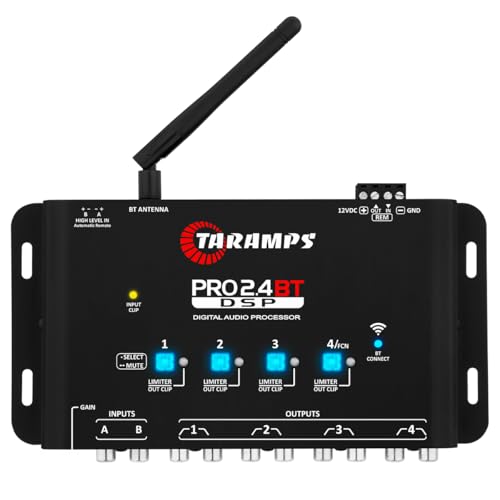
- Wireless app tuning with Bluetooth 5.4 BLE
- 15-band EQ plus crossover, delay, and limiter controls
- High-level and RCA inputs with four outputs
Best For: Enthusiasts who want detailed DSP control in a multi-amplifier system
Best Amplifier Power Option
AUDISHAKO MHD130.4D 4-Channel Amp

- 130W x 4 RMS at 4 ohms and 260W x 4 at 2 ohms
- Bridgeable to 520W x 2 RMS at 4 ohms
- HP, LP, and FULL modes with 50–250Hz crossover
Best For: Aftermarket systems pairing a four-channel amplifier with a separate DSP
Best Streaming DSP

- Built-in Bluetooth music streaming from a smartphone
- Separate Bluetooth connection for DSP app tuning
- Compact unit with RCA and high-level inputs
Best For: Compact systems needing streaming and wireless signal control
Most Flexible High-Power Option

- Six-channel Class D design with flexible configurations
- Up to 1,200W maximum output with bridged options
- Built-in Linkwitz-Riley crossovers and smart protection
Best For: Custom multi-channel systems needing power and routing flexibility
Best Standalone Tuning Processor

- Four independent outputs with two selectable input sources
- 15-band graphic EQ plus parametric equalization
- LCD controls, presets, and sequencer trigger support
Best For: Detailed tuning of multi-channel car audio systems
Best Compact Power Value

- Mini four-channel Class D amplifier for 12V vehicles
- RCA and high-level inputs with bridgeable operation
- Adjustable HPF/LPF and compact under-seat-friendly chassis
Best For: Space-limited speaker and subwoofer upgrades
Best for Flexible OEM Integration – AudioControl D-6.1200 DSP Amplifier
The AudioControl D-6.1200 is a powerful choice for car amplifiers with DSP when you need extensive factory-stereo integration and flexible channel assignment. Its six channels, high-level inputs, balanced RCA inputs, and app-based tuning support complex systems.
Best For: Custom OEM upgrades and multi-speaker systems that need high output and detailed DSP control.
Pros:
- Configurable as a 6-, 5-, 4-, or 3-channel amplifier.
- Offers up to 1,200 watts, with bridged output options.
- Includes 30-band graphic EQ and 10-band parametric EQ per output channel.
- Supports high-level and balanced RCA inputs, AccuBASS, and selectable crossovers.
Cons:
- Its extensive tuning features may be more than a simple system requires.
- It is larger and heavier than compact four-channel options.
The D-6.1200 stands out when you want one amplifier to handle serious system expansion, factory-signal correction, and precise sound shaping. It is best suited to installations where flexible routing and professional-level tuning matter.
Best All-in-One Connectivity – Stetsom HL DSPlayer 400×4
The Stetsom HL DSPlayer 400×4 combines a four-channel amplifier with DSP, Bluetooth, FM radio, and several audio inputs. For shoppers comparing car amplifiers with DSP, its app control and built-in media features make it a versatile all-in-one option.
Best For: Installations that prioritize wireless streaming, multiple source options, and convenient mobile tuning.
Pros:
- Includes RCA, wired, optical, USB, and Bluetooth audio inputs.
- Mobile app provides control over EQ, level, phase, delay, and crossovers.
- Built-in FM radio adds another listening option.
- Provides a processed output for an auxiliary amplifier.
Cons:
- The smartphone is not included.
- Its 400-watt rating may be less suitable for very high-power systems.
This model is appealing if you want DSP functionality without assembling a separate processor and amplifier setup. Its broad connectivity is especially useful for mixed-source systems, while the app keeps tuning adjustments accessible.
Best Standalone DSP Processor – Taramps PRO 2.4S DSP Equalizer
The Taramps PRO 2.4S is a compact four-channel DSP equalizer and digital crossover rather than a powered amplifier. Among car amplifiers with DSP, it is a useful companion for systems that already have amplification but need more precise routing, filtering, and signal management.
Best For: OEM upgrades and active speaker systems that need a dedicated DSP processor before the amplifiers.
Pros:
- Provides 15-band graphic EQ, parametric EQ, delay alignment, and a limiter.
- Accepts both RCA and high-level inputs for factory or aftermarket stereos.
- Offers HPF and LPF filters, multiple crossover slopes, and routing options.
- Includes anti-pop protection and clip indicators.
Cons:
- It does not provide speaker power on its own.
- It requires separate amplifiers and additional system setup.
The PRO 2.4S makes sense when DSP control is the priority and you already have, or plan to add, external amplification. Its compact enclosure and OEM-friendly inputs simplify integration while its filters and alignment tools support detailed tuning.
Best for Automatic Tuning – Kicker KEY 4-Channel DSP Amplifier
The Kicker 47KEY2004 KEY is a compact four-channel amplifier designed to improve factory-stereo sound with automatic tuning. For shoppers seeking car amplifiers with DSP, its built-in microphone and internal processing offer a faster alternative to lengthy manual calibration.
Best For: Factory-stereo upgrades that need clearer door-speaker performance and simpler setup.
Pros:
- Uses an included automatic tuning process with a microphone.
- Provides 40-band equalization for tonal improvement.
- Its 24 dB crossover helps tailor output to the connected speakers.
- Compact design is intended for easier installation.
Cons:
- Its 4 x 50-watt output is intended for moderate-power systems.
- Automatic tuning may offer less hands-on flexibility than a fully manual DSP platform.
The KEY is a practical choice for improving a factory system without committing to a complex tuning workflow. Its automatic calibration focuses on clearer, more realistic sound and makes it particularly approachable for straightforward door-speaker upgrades.
Most Comprehensive Tuning – Taramps Pro 2.4 BT DSP Crossover
The Taramps Pro 2.4 BT is a dedicated DSP processor for car audio systems that need extensive control rather than built-in amplification. It works with factory or aftermarket sources and lets you tune settings wirelessly from a phone or tablet, making it a strong option among car amplifiers with DSP when paired with external amplifiers.
Best For: Enthusiasts building daily-driver, trunk, trio, or larger multi-amplifier systems.
Pros:
- Bluetooth 5.4 BLE app control with real-time tuning and preset sharing.
- 15-band graphic EQ, parametric EQ, crossover filters, delay, phase, and limiter controls.
- High-level and RCA inputs, including up to 9V RMS RCA input, support flexible integration.
Cons:
- It is a signal processor, so a separate amplifier is required to power speakers.
- The broad tuning feature set may take time to configure properly.
Choose this model when detailed system calibration and flexible source integration matter more than an all-in-one amplifier design. Its four outputs and app-based controls are especially useful for systems with multiple amplification channels.
Best Amplifier Power Option – AUDISHAKO MHD130.4D 4-Channel Amp
The AUDISHAKO MHD130.4D is a four-channel Class D amplifier designed to power front and rear speakers or compatible bridged configurations. It does not include an onboard DSP, but its RCA inputs make it a practical power stage to use with a separate DSP in a car audio system.
Best For: Aftermarket systems needing four-channel speaker power with flexible crossover modes.
Pros:
- Provides 130W x 4 RMS at 4 ohms or 260W x 4 RMS at 2 ohms.
- Can be bridged for 520W x 2 RMS at 4 ohms.
- HP, LP, and FULL modes with adjustable 50–250Hz crossover range.
- Compact aluminum chassis is sized for under-seat or trunk installation.
Cons:
- DSP functionality requires a separate processor.
- Its RCA inputs are intended for compatible aftermarket head units, DSPs, or line output converters.
This is a sensible match for shoppers assembling a modular setup with car amplifiers and DSP components separately. Its four channels and bridge capability provide room for front-and-rear speakers or compatible higher-output configurations.
Best Streaming DSP – Taramps PRO 2.4BT + Audio DSP
The Taramps PRO 2.4BT + Audio DSP combines wireless music streaming with extensive signal-processing controls in a compact unit. For systems using external car amplifiers with DSP, it can accept factory or aftermarket sources through RCA or high-level inputs while providing app-based tuning from Android or iOS devices.
Best For: Compact installations that need Bluetooth streaming and wireless DSP adjustment.
Pros:
- Streams music directly from a smartphone through built-in Bluetooth Audio.
- Offers a second Bluetooth connection for wireless DSP tuning.
- Includes crossover, 15-band EQ, delay, limiter, routing, and independent output controls.
- Compact design fits into tight installation spaces.
Cons:
- It is an audio processor, not a powered amplifier.
- The notes do not specify supported software update timing.
This model stands out when a system needs both a music source and a tuning interface without relying on a traditional head unit. Its small footprint and dual Bluetooth functionality make it a convenient control center for an externally amplified setup.
Most Flexible High-Power Option – AudioControl EPICSIX
The AudioControl EPICSIX is a strong choice among car amplifiers with DSP-adjacent system flexibility, especially when you need multiple channel configurations. Its six-channel Class D design can support active front-stage, five-channel, six-channel, or bridged setups, while built-in crossovers help direct frequencies to the appropriate speakers.
Best For: Custom systems that need flexible channel routing, substantial power, and a compact amplifier chassis.
Pros:
- Configurable for active 3-way, 5-channel, active 6-channel, or bridged systems
- Provides up to 6 x 200W at 2 ohms or 2 x 400W bridged at 4 ohms
- Includes 12dB/octave Linkwitz-Riley high- and low-pass crossovers
- Low-profile design and smart protection help with installation and reliability
Cons:
- Requires a separately sold 125A fuse
- Line-level inputs are intended for aftermarket radios rather than a stated high-level-input setup
- Its six-channel configuration may be more than a simple factory-system upgrade needs
The EPICSIX stands out when system expansion and wiring flexibility matter more than basic plug-and-play simplicity. It is a capable foundation for a multiway setup, though installation planning and appropriate power wiring are important.
Best Standalone Tuning Processor – PRV AUDIO DSP 2.4X
The PRV AUDIO DSP 2.4X is a dedicated digital crossover and equalizer for drivers who want detailed control over a car audio system. As part of a car amplifiers with DSP setup, it provides two input sources, four independent outputs, graphic and parametric equalization, presets, and a display-based interface for real-time adjustments.
Best For: System builders who want hands-on crossover, equalizer, and source-selection control before the amplifier stage.
Pros:
- Offers four independent output channels with selectable A, B, or A+B sources
- Includes a 15-band graphic equalizer and 12 sound presets
- Provides parametric equalizer control over gain, frequency, and bandwidth
- LCD interface and sequencer connection support practical system management
Cons:
- It is a signal processor, not a powered amplifier
- Detailed tuning may require more setup time than a basic crossover
- The supplied notes do not specify included cables or mounting hardware
The DSP 2.4X makes sense when precise signal shaping is the priority. Pair it with compatible amplifiers for a more adjustable system, but remember to budget for the separate amplification hardware it requires.
Best Compact Power Value – Fosi Audio CA30
The Fosi Audio CA30 is a compact four-channel Class D amplifier for adding power where installation space is limited. It works with RCA or high-level inputs, offers adjustable high- and low-pass filtering, and can be integrated into a car amplifiers with DSP system as a power stage for tuned full-range speakers or subwoofers.
Best For: Compact 12V vehicle installations needing flexible speaker or bridged-subwoofer amplification.
Pros:
- Small chassis fits under seats or in trunks
- Supports four-channel operation or bridged output rated at 400W x 2 at 4 ohms
- RCA and high-level inputs support aftermarket and compatible factory systems
- Adjustable 50Hz-250Hz HPF/LPF, full-pass mode, and protection features add flexibility
Cons:
- The supplied notes describe peak output rather than a clearly stated RMS rating
- Its compact design may not suit systems requiring more than four amplified channels
- Additional DSP hardware is needed for advanced digital tuning
The CA30 is appealing for modest, space-conscious upgrades and mixed speaker configurations. Its input flexibility and bridge mode make it versatile, while a separate DSP can provide the more precise tuning associated with advanced systems.
How We Picked the Best Car Amplifiers with Dsp
We focused on models that combine meaningful signal processing with practical amplification or system-control features. The selection covers four- and six-channel designs, compact Class D units, Bluetooth and app-based tuning, factory-system integration, and standalone DSP crossovers. We also considered rated power, input flexibility, crossover controls, equalization options, installation size, and whether each product suits a complete system or a targeted upgrade.
Because amplifier specifications are not always measured under identical conditions, compare RMS output at the same impedance rather than relying on peak-wattage claims. A DSP amplifier should also provide enough adjustment range for your speakers, subwoofer, and vehicle acoustics.
Quick Comparison
| Best For | What to Look For |
|---|---|
| Factory-system upgrade | High-level inputs, signal summing, and flexible output processing |
| Front and rear speakers | A four-channel amplifier with independent crossover and EQ control |
| Multi-speaker or active systems | Six channels or more and detailed routing options |
| App-based tuning | Bluetooth or USB connectivity with a reliable configuration app |
| Limited installation space | Compact Class D construction and accessible wiring connections |
Key Buying Factors for Car Amplifiers with Dsp
Power and Channel Layout
Match RMS power to the continuous rating of your speakers. Four channels work well for front and rear speakers, while six channels can support more complex active setups or additional processed outputs. If you need a dedicated subwoofer channel, verify whether the amplifier includes one or whether an external amp is required.
DSP Controls and Tuning
Useful DSP features include parametric or graphic EQ, time alignment, adjustable high- and low-pass filters, phase control, signal routing, and gain adjustment. App control can simplify setup, but a model with deeper manual controls may be preferable for advanced installations.
Inputs, Outputs, and Compatibility
High-level inputs are important when retaining a factory radio, while RCA inputs suit aftermarket head units. Check input voltage range, processed outputs, remote-turn-on behavior, and compatibility with factory active systems. Confirm the wiring and integration requirements before installation.
Installation and Reliability
Measure the available mounting space and plan for ventilation. Class D amplifiers are generally efficient and compact, but every amplifier still needs suitable power wiring, grounding, fusing, and impedance matching. Professional installation is advisable when integrating with a complex factory system.
Who Should Buy Which Car Amplifiers with Dsp?
Choose a compact four-channel DSP amplifier if you want a straightforward speaker upgrade in a small vehicle. A six-channel model is better for active front-stage systems, multiple speaker zones, or installations that need several processed outputs. If you already own a capable amplifier, a standalone DSP crossover or equalizer can add tuning flexibility without replacing the power stage.
Bluetooth and app-equipped models are convenient for enthusiasts who expect to adjust sound from a phone. Buyers replacing a factory radio should prioritize high-level input support and integration features. Finally, compare total system requirements—not just amplifier wattage—to ensure the selected unit has enough channels, processing, and installation support for the finished audio system.