
Adding one of the best four-channel car amplifiers can give your vehicle cleaner power, stronger dynamics, and more control than a factory head unit alone.
These 10 models cover compact Class D designs, traditional Class AB amps, bridgeable configurations, and higher-output options for speakers and full-range systems.
Best 10 Four Channel Car Amplifiers Picks for 2026
Reliable Everyday Upgrade

- 360-watt, 4-channel Class A/B design
- Variable crossover and 6dB bass boost
- Speaker-level input supports factory stereos
Best For: Factory-stereo upgrades and daily door-speaker systems
Compact Alpine Performance

- 55W RMS x 4 at 4 ohms
- Works in 4-, 3-, or 2-channel setups
- Compact 11 x 11 x 5-inch footprint
Best For: Compact systems needing moderate, flexible four-channel power
Flexible Class D Power

- 400W RMS with 4 x 100W at 2 ohms
- Bridgeable to 2 x 200W at 4 ohms
- High-level and RCA inputs with built-in crossover
Best For: Flexible vehicle and custom audio installations
High-Output Cobalt Build

- 100W RMS x 4 at 2 ohms
- Adjustable high/low-pass filters and bass boost
- MOSFET supply with two-way protection
Best For: Higher-output 2- or 4-ohm speaker systems with RCA sources
Compact Multichannel Pick
- 400W four-channel Class D design
- Two bridged channels and RCA input
- Compact aluminum housing
Best For: Space-conscious four-channel audio installations
Balanced Sound Upgrade

- 60W RMS x 4 at 4 ohms
- 190W RMS x 2 bridged
- High- and low-pass filters
Best For: Flexible front-and-rear speaker systems
High-Output Power Choice
- 125W RMS x 4 at 4 ohms
- 250W RMS x 4 at 2 ohms
- Four-way protection circuitry
Best For: High-power multi-speaker systems
Compact High-Output Pick
- 800W Class D output in a low-profile chassis
- 2- or 4-ohm stable with 91dB+ signal-to-noise ratio
- Adjustable crossovers and smart protection
Best For: Space-conscious aftermarket-head-unit builds
Adjustable Class A/B Value
- 75W RMS x 4 at 4 ohms; 125W x 4 at 2 ohms
- Variable HPF, LPF, gain, and bass EQ controls
- 105dB signal-to-noise ratio with four-way protection
Best For: Tunable full-range speaker upgrades
High-Power Factory-Radio Pick

- 4 x 300W RMS at 2 ohms or 2 x 600W bridged
- High-level inputs and automatic turn-on for OEM stereos
- HPF, LPF, and Full modes for varied system components
Best For: Demanding factory-radio and bridged-power builds
Reliable Everyday Upgrade – Kicker CXA3604
The Kicker CXA3604 is a practical choice among four channel car amplifiers for upgrading factory door speakers or powering a straightforward aftermarket system. Its Class A/B design, adjustable crossover, and bass boost provide useful tuning control without making the installation overly complicated.
Best For: Factory-stereo upgrades and clear, balanced power for everyday door-speaker systems.
Pros:
- Provides 4-channel, 360-watt output with clean everyday power.
- Includes a variable 12dB crossover and up to 6dB of KickEQ bass boost.
- Accepts speaker-level signals from 9 to 40 volts, supporting many factory systems.
- Includes vertical and horizontal mounting hardware.
Cons:
- Class A/B construction may be less compact or efficient than a comparable Class D amp.
- The supplied notes do not specify individual RMS output figures.
Choose this model if smooth highs, tight bass, and flexible installation options matter more than maximum system power. It is a sensible four-channel solution for a daily-driver audio refresh.
Compact Alpine Performance – Alpine S-A32F
The Alpine S-A32F is a compact four-channel car amplifier for listeners who want a recognized-brand solution with straightforward power delivery. It is rated at 55W RMS per channel at 4 ohms and can operate in 4-, 3-, or 2-channel configurations.
Best For: Compact installations needing dependable power for four speakers or a flexible multi-channel layout.
Pros:
- Delivers 55W RMS x 4 at 4 ohms.
- Supports 4-, 3-, and 2-channel operation.
- Offers greater than 98dB signal-to-noise performance at rated 4-ohm power.
- Uses a surface-mount design with a relatively compact 11 x 11 x 5-inch footprint.
Cons:
- Its specified 55W RMS per channel is less powerful than some higher-output options.
- The supplied notes do not list crossover or bass-boost controls.
The S-A32F makes sense when clean, moderate output and configuration flexibility are the priorities. Confirm the available installation space and speaker impedance before choosing it for a larger system.
Flexible Class D Power – Taramps TS 400X4
The Taramps TS 400X4 is one of the more flexible four channel car amplifiers for installations that may use factory or aftermarket stereos. Its Class D design delivers 4 x 100W at 2 ohms, while bridgeable channels and built-in filtering broaden its speaker and system options.
Best For: Cars, motorcycles, boats, ATVs, UTVs, and other compact builds requiring efficient multi-channel power.
Pros:
- Produces 400W RMS total, rated at 4 x 100W at 2 ohms.
- Can bridge channels for 2 x 200W at 4 ohms.
- Accepts both high-level and RCA inputs, with high-level auto turn-on.
- Built-in HPF, LPF, and Full Range modes support varied speaker setups.
Cons:
- The 4 x 100W rating is specified at 2 ohms, so speaker impedance must be matched carefully.
- The supplied notes do not provide physical dimensions.
This is a strong pick when installation flexibility matters as much as output. Its compact Class D format and high-level input support make it especially useful for mixed OEM and aftermarket projects.
High-Output Cobalt Build – ORION CBA2500.4
The ORION CBA2500.4 is a high-output Class A/B option among four channel car amplifiers, with adjustable filtering and bass boost for system tuning. Its listed continuous ratings are 100W RMS x 4 at 2 ohms and 60W RMS x 4 at 4 ohms, making speaker impedance an important part of the installation.
Best For: Systems needing adjustable 2- or 4-ohm speaker power and MOSFET-based Class A/B amplification.
Pros:
- Rated for 100W RMS x 4 at 2 ohms or 60W RMS x 4 at 4 ohms.
- Includes adjustable low-pass and high-pass filters plus bass boost.
- Features a MOSFET power supply and two-way protection circuitry.
- Supports continuous 2- and 4-ohm speaker loads according to the supplied notes.
Cons:
- Its large 16 x 10 x 10-inch dimensions may require substantial mounting space.
- Only low-level RCA input is identified in the supplied notes, which may limit factory-stereo integration.
- The listed 2500W maximum figure is much higher than the specified continuous RMS ratings, so comparisons should focus on RMS output.
The CBA2500.4 is best evaluated by its continuous power ratings and tuning features rather than its headline maximum number. It suits installations with enough room for a larger chassis and a receiver providing RCA outputs.
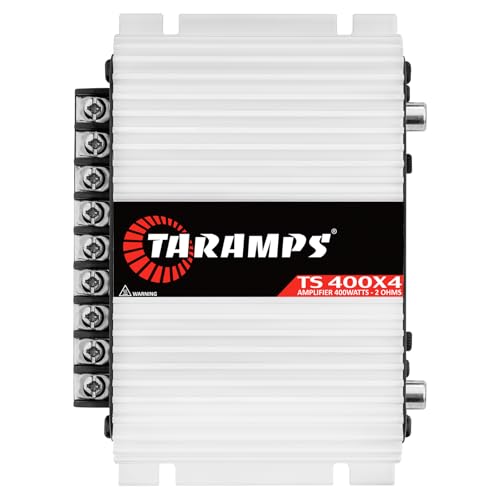
Compact Multichannel Pick – Taramps TS 400×4
For shoppers comparing four channel car amplifiers, the Taramps TS 400×4 is a compact Class D option with four channels, 400 watts of output, RCA input, and two bridged channels. Its small aluminum housing may suit installations where space is limited.
Best For: Compact four-channel systems and installations needing bridging flexibility.
Pros:
- Four-channel design with 400 watts of output power
- Class D construction in a compact aluminum enclosure
- Supports two bridged channels and RCA input
Cons:
- Professional installation is strongly recommended
- Requires a suitable 8–16V DC power supply and can draw up to 33A
The TS 400×4 stands out for its small footprint and flexible channel configuration. Have it installed by a qualified technician to support safe, reliable operation and help protect the amplifier and vehicle system.
Balanced Sound Upgrade – Pioneer GM-A6704
Pioneer GM-A6704 1000W Max Class AB Bridgeable 4-Channel Car Amplifier | High-/Low-Pass Filters
Check Price On AmazonThe Pioneer GM-A6704 is a practical choice among four channel car amplifiers for listeners who want flexible system expansion. Its Class AB design delivers 60 watts RMS x 4 at 4 ohms, or 190 watts RMS x 2 when bridged, with adjustable high- and low-pass filters.
Best For: Front-and-rear speaker systems or setups that may add a subwoofer through bridged channels.
Pros:
- Four-channel Class AB amplifier with 60W RMS x 4 at 4 ohms
- Bridgeable output rated at 190W RMS x 2
- Variable high- and low-pass filters for system tuning
Cons:
- Class AB design is larger than the compact Taramps option
- Maximum power ratings are higher than its listed RMS output
The GM-A6704 offers useful control and a straightforward four-channel layout for balanced speaker coverage. Its filter controls make it easier to tailor the amplifier to different speaker or subwoofer arrangements.
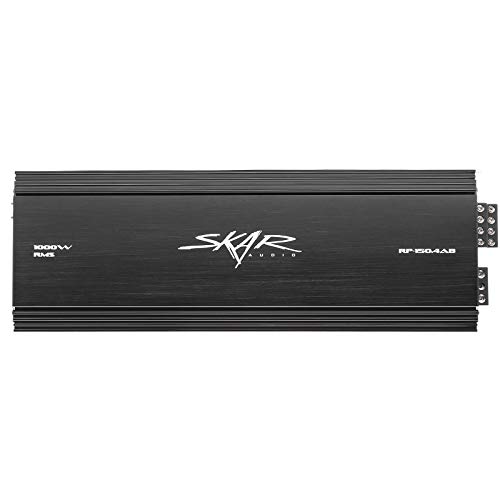
High-Output Power Choice – Skar Audio RP-150.4AB
The Skar Audio RP-150.4AB targets buyers seeking high-output four channel car amplifiers. This Class A/B model is rated at 125 watts RMS x 4 channels at 4 ohms and 250 watts RMS x 4 at 2 ohms, with 4-gauge power and ground terminals.
Best For: Systems that need substantial power for multiple speakers at either 2- or 4-ohm loads.
Pros:
- Up to 250 watts RMS x 4 channels at 2 ohms
- 125 watts RMS x 4 channels at 4 ohms
- Includes four-way protection circuitry and 4-gauge terminals
- 20 Hz–20,000 Hz frequency response and 105 dB signal-to-noise ratio
Cons:
- Its 24.5-inch length may require substantial mounting space
- At 9.8 pounds, it is heavier than the compact alternatives
- Class A/B construction may be less space-efficient for tight installations
The RP-150.4AB is the strongest fit here for buyers prioritizing per-channel RMS output. Confirm available mounting space, speaker impedance, and wiring requirements before installation.
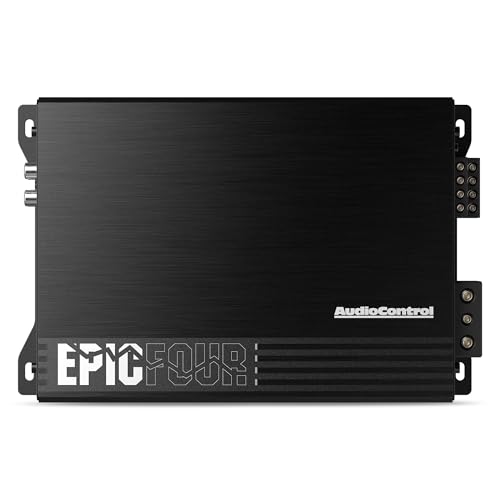
Compact High-Output Pick – AudioControl EPICFOUR
The AudioControl EPICFOUR is a compact four channel car amplifier for installations that need strong output without a large chassis. Its Class D design, line-level inputs, adjustable crossovers, and protection features make it a practical match for aftermarket head units and full-system upgrades.
Best For: Space-conscious builds seeking powerful, clearly controlled output and straightforward aftermarket-head-unit integration.
Pros:
- 800W digital Class D design in a low-profile 6.1 x 9.41 x 2.01-inch chassis.
- Works with 4- or 2-ohm loads and offers a 91dB+ signal-to-noise ratio.
- 12dB/octave Linkwitz-Riley crossovers help direct suitable frequencies to the speakers.
- Includes smart protection for voltage, short-circuit, electrical, and thermal hazards.
Cons:
- Line-level inputs are intended for vehicles with aftermarket head units.
- The recommended 80A fuse is sold separately.
- The EPICENTER Link is useful only if you add the compatible bass-restoration processor.
Choose the EPICFOUR when compact dimensions, high power, and installation safeguards matter most. Its direct-wire terminals and crossover flexibility support a clean, dependable system setup.
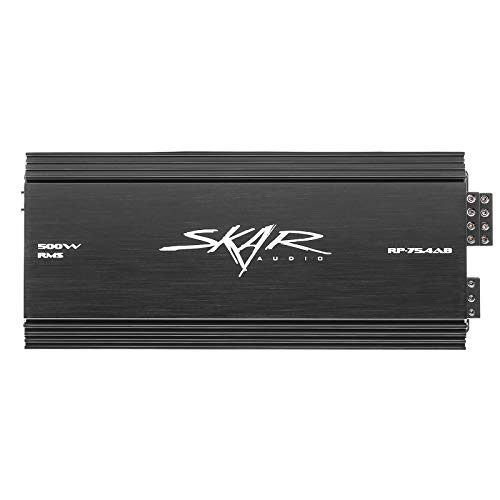
Adjustable Class A/B Value – Skar Audio RP-75.4AB
The Skar Audio RP-75.4AB is a four channel car amplifier built around a traditional Class A/B design. With 75 watts RMS per channel at 4 ohms, adjustable filtering, bass EQ, and a 105dB signal-to-noise ratio, it offers useful tuning control for speaker-focused systems.
Best For: Drivers who want adjustable amplifier controls and balanced four-channel power for full-range speakers.
Pros:
- Delivers 75W RMS x 4 at 4 ohms or 125W RMS x 4 at 2 ohms.
- Variable gain, LPF, HPF, and three-position bass EQ provide flexible system tuning.
- 20Hz–20kHz frequency response supports full-range audio.
- Four-way protection circuitry adds a layer of operational security.
Cons:
- The 19.5 x 7 x 3-inch chassis is larger than some compact Class D alternatives.
- Its listed 500W maximum output is lower than the other high-output options here.
- The supplied notes specify a 2-year limited warranty rather than a lifetime warranty.
The RP-75.4AB is a sensible choice when adjustable controls and Class A/B operation take priority over minimum installation space. Its power ratings suit a broad range of speaker upgrades.
High-Power Factory-Radio Pick – Taramps TS1200X4 1200W
The Taramps TS1200X4 is a high-output four channel car amplifier for demanding speaker and subwoofer systems. It provides 4 x 300W RMS at 2 ohms, supports bridged operation, and accepts both RCA and high-level inputs for direct connection to many factory stereos.
Best For: High-output builds using OEM radios, multiple speaker types, or bridged channels for additional system flexibility.
Pros:
- Produces 1200W RMS total, rated at 4 x 300W at 2 ohms.
- Can deliver 2 x 600W bridged at 4 ohms.
- High-level inputs with automatic turn-on support factory-radio installations.
- HPF, LPF, and Full modes accommodate speakers, subwoofers, tweeters, drivers, and component systems.
Cons:
- Professional installation is recommended.
- The supplied notes do not provide chassis dimensions or a detailed protection-circuit description.
- Its 1-year manufacturer warranty is shorter than the Skar model’s listed coverage.
The TS1200X4 stands out for raw output and factory-radio compatibility. Consider it when your system needs substantial power and flexible input options, provided the installation is planned for its demanding performance level.
How We Picked the Best Four Channel Car Amplifiers
We focused on amplifiers that offer four-channel flexibility, useful power for common car audio systems, and practical installation features. The selected models represent several price and performance levels, including compact digital designs, Class AB options, bridgeable amplifiers, and models intended for higher-output systems.
We also considered RMS power rather than relying only on advertised peak or maximum figures. Input compatibility, impedance support, crossover controls, efficiency, and the ability to run speakers or bridged channels all matter when matching an amplifier to the rest of a vehicle’s audio system.
Quick Comparison
| Best For | What to Look For |
|---|---|
| Factory-system upgrade | Speaker-level inputs, compact size, and modest RMS power |
| Component speakers | Clean power, adjustable crossovers, and suitable impedance |
| Flexible system building | Bridgeable channels and full-range operation |
| High-output setups | Higher RMS ratings, strong wiring, and adequate electrical capacity |
Key Buying Factors for Four-Channel Car Amplifiers
RMS Power and Speaker Matching
Match the amplifier’s RMS output to the speakers’ continuous power rating. More wattage is not automatically better; an amp that is appropriately matched will usually sound cleaner and reduce the risk of speaker damage. Check ratings at the impedance you plan to use, commonly 2 or 4 ohms.
Class D Vs. Class AB
Class D amplifiers are typically smaller, lighter, and more efficient, making them useful in tight installations or systems with limited electrical headroom. Class AB models can be attractive for buyers who prefer conventional analog amplifier designs, but they may produce more heat and require more installation space.
Inputs, Crossovers, and Bridging
RCA inputs are useful with aftermarket receivers, while high-level inputs help connect to a factory radio. Adjustable high-pass and low-pass filters make it easier to integrate speakers. Bridging can increase power for selected channels, but confirm the amplifier’s minimum bridged impedance before wiring it.
Installation and Electrical Demand
Measure the available mounting space and plan for ventilation. Use appropriately sized power and ground cables, a properly rated fuse near the battery, and secure connections. Higher-powered four-channel car amplifiers may require upgraded charging-system components, especially when used at high volume for extended periods.
Who Should Buy Which Four Channel Car Amplifiers?
Choose a compact Class D model if you are upgrading a factory system or need an efficient amplifier under a seat. A Class AB option can suit buyers prioritizing a traditional design and straightforward full-range speaker power. If you want system flexibility, select a bridgeable amplifier with adjustable filtering. For demanding builds, prioritize verified RMS output, stable impedance performance, and sufficient vehicle electrical capacity over inflated maximum-wattage claims.