
Finding the right ramp for a low-clearance car means balancing approach angle, lift height, weight capacity, traction, and storage. The wrong design can scrape a bumper or shift under load.
We compared 10 low-profile car ramp options for home maintenance, focusing on practical fit, stated capacity, portability, and features that make setup safer and easier.
Best 10 Car Ramps for Low Cars Picks for 2026
Best Low-Lift Pick
Black Widow 2.5-Inch Low Car Ramps

- 9.05-degree loading angle
- 2.5-inch lift for basic service
- 10,000-pound total GVW capacity
Best For: Low cars needing modest lift for oil changes
Best High-Capacity Option

- 12,000-pound pair capacity
- 12-inch-wide tread surface
- Rubber feet and non-skid tread
Best For: Mixed vehicle use from cars to trucks
Best Compact Value
MaxxHaul 50516 Low Profile Ramps

- 9.05-degree loading angle
- Compact 2.5-inch lift
- 4,400-pound pair capacity
Best For: Routine maintenance on lighter low-clearance cars
Best Detachable Design
Megan Racing Low Profile Service Ramps
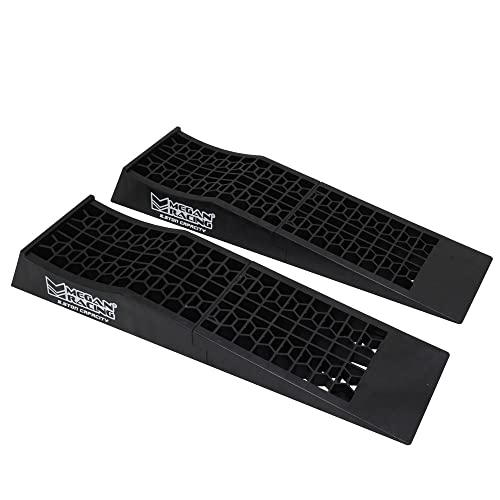
- Detaches into four pieces
- 2.56-inch lift for low cars
- 5,000-pound capacity per side
Best For: Low-profile cars needing easy-to-handle ramps
Best Extendable Option
MaxxHaul 50709 Detachable Car Ramps

- 6,500-pound matched-pair capacity
- 6-1/2-inch maximum lift
- Detachable and extendable sectional design
Best For: Higher-clearance maintenance setups needing adaptable ramp length
Best Lightweight Low-Profile Pick

- 2.6-inch tire-position lift
- 10-inch-wide platform
- Only 5.3 pounds per pair
Best For: Portable maintenance access for low-chassis cars and sports vehicles
Best Four-Piece Set
Magisale Low Profile Plastic Car Ramps

- Four-piece configuration
- 8.3-degree loading angle
- 13,200-pound rated capacity
Best For: Low-clearance garage maintenance and oil-change work
Best Wide-Track Lift
2.6-Inch Low-Profile Car Ramps

- 10-inch-wide track for wider tires
- 2.6-inch lift with a 17-degree slope
- Lightweight PP pair with traction features
Best For: Low-clearance and modified vehicles needing compact maintenance ramps
Best Compact Jack Clearance
2.44-Inch Low-Profile Service Ramps

- 17-degree approach for low-profile cars
- 2.44-inch lift for jack access
- Curved top and mesh drainage channels
Best For: Garage oil changes and basic maintenance on low-chassis cars
Best High-Capacity Pair
VEVOR 2.56-Inch Low-Profile Ramps

- 9-degree incline helps reduce scraping
- Stated 20,000-pound GVW capacity
- Stackable PP ramps with honeycomb traction
Best For: Low-chassis vehicles needing portable, high-capacity maintenance ramps
Best Low-Lift Pick – Black Widow 2.5-Inch Low Car Ramps
For drivers seeking car ramps for low cars, the Black Widow ramps offer a gentle 9.05-degree loading angle and a modest 2.5-inch lift. Their compact plastic design is suited to basic oil changes and underbody access, provided your vehicle’s clearance and weight are within the stated limits.
Best For: Low-clearance vehicles needing a small lift for oil changes and routine underbody service.
Pros:
- Gentle 9.05-degree approach angle accommodates many low vehicles.
- Honeycomb plastic construction helps reduce moisture buildup.
- Supports up to 5,000 pounds per axle, or 10,000 pounds GVW total.
- Compact 27.5-inch length and 2.5-inch lift are practical for light-duty service.
Cons:
- The 2.5-inch lift provides limited working room compared with taller ramps.
- Vehicle clearance and gross weight should be confirmed before use.
- The manufacturer recommends using a spotter to help prevent roll-offs.
This is a straightforward choice when low approach angle and compact storage matter more than maximum lift height. Its capacity is substantial, but the short rise is best suited to routine maintenance rather than extensive repairs.
Best High-Capacity Option – Ironton Poly Car Ramp Set
The Ironton Poly set is a strong option among car ramps for low cars when you also want broad vehicle compatibility. With an 8.5-inch height, 12-inch width, and 12,000-pound pair capacity, these ramps are designed for cars, trucks, SUVs, and vans.
Best For: Buyers who need high-capacity ramps for a range of vehicles, from low-clearance cars to full-size trucks.
Pros:
- 12,000-pound GVW capacity, rated at 6,000 pounds per ramp.
- Wide 12-inch tread accommodates many tire widths.
- Non-skid tread and rubber feet help limit tire and ground movement.
- High-impact poly construction is corrosion-resistant and weighs 20.6 pounds per pair.
Cons:
- At 8.5 inches tall, these ramps provide more lift than some low-profile maintenance ramps.
- The larger dimensions may require more storage space.
- Actual vehicle clearance and weight should still be checked before use.
Choose the Ironton set if capacity, width, and versatility are priorities. Its traction features and gradual dimensions add practical stability, while the higher lift gives more access for undercarriage inspections and service.
Best Compact Value – MaxxHaul 50516 Low Profile Ramps
MaxxHaul 50516 4,400 lb. Capacity Low Profile Car Ramps, 2-Count, Black (Pack of 1)
Check Price On AmazonThe MaxxHaul 50516 keeps the low-profile format simple, with a 9.05-degree loading angle and a 2.5-inch lift. These car ramps for low cars are intended for routine underside access while remaining compact at 27 inches long and 7.75 inches wide.
Best For: Low-clearance vehicles needing a compact pair of ramps for routine maintenance.
Pros:
- 9.05-degree loading angle is designed for low-clearance vehicles.
- Heavy-duty plastic uses honeycomb channels for strength and easier debris removal.
- Compact 27-inch length and 2.5-inch lift suit basic service tasks.
- Pair capacity is rated at 4,400 pounds, or 2,200 pounds per ramp.
Cons:
- The 2.5-inch lift offers limited clearance for larger repairs.
- Lower capacity than the other high-capacity options in this selection.
- The supplied warranty is 90 days.
The MaxxHaul is a practical fit for owners who want a compact, low-entry ramp set for oil changes and similar jobs. Check your vehicle’s weight carefully, since its per-ramp rating is more limited than heavier-duty alternatives.
Best Detachable Design – Megan Racing Low Profile Service Ramps
The Megan Racing service ramps combine a low-profile 2.56-inch lift with a detachable construction that separates the two ramps into four pieces. For shoppers comparing car ramps for low cars, the design offers compact handling while retaining a stated 5,000-pound capacity per side.
Best For: Low-profile cars and users who value detachable components for handling or storage.
Pros:
- Low-profile drive-on design is suited to cars with limited clearance.
- Detaches into four pieces for easier handling or storage.
- Raises vehicles approximately 2.56 inches for jack and service access.
- High-strength plastic composite construction.
Cons:
- The low 2.56-inch lift leaves limited room for extensive work.
- The supplied dimensions are relatively narrow at 7.8 inches wide.
- Vehicle clearance, tire fit, and the stated load rating should be verified before use.
This set stands out primarily for its detachable format and low entry height. It is a sensible match for routine service on low-profile cars when convenient handling is more important than creating substantial working clearance.
Best Extendable Option – MaxxHaul 50709 Detachable Car Ramps
For shoppers comparing car ramps for low cars, the MaxxHaul 50709 stands out for its long, 9.5-degree approach and adaptable sectional design. It provides a maximum 6-1/2-inch lift and supports up to 6,500 pounds per matched pair, but it must be used on a hard, level surface.
Best For: Drivers who want extendable ramps with a higher lift and detachable sections for added clearance beneath a vehicle.
Pros:
- Detachable sections can help free up space beneath the vehicle.
- Sectional extensions can be added separately to increase ramp length.
- Supports up to 3,250 pounds per ramp and 6,500 pounds per pair.
- Built-in handles make transport and storage easier.
Cons:
- Extensions are sold separately.
- At approximately 33 pounds per pair, these are heavier than some compact alternatives.
- Not suitable for uneven, sloped, slippery, or loose surfaces.
The MaxxHaul is a flexible choice when you need more lift than a low-profile service ramp provides. Its capacity and extendable format are useful, though the required surface conditions and heavier build should factor into your setup.
Best Lightweight Low-Profile Pick – NBTS265 Low Chassis Car Ramps
These lightweight car ramps for low cars are designed for low-chassis vehicles, sports cars, and tuners. Their 17-degree slope raises the tire position 2.6 inches, while the 10-inch width and traction-focused surface help accommodate wider tires and provide a stable maintenance platform.
Best For: Low-clearance vehicles needing a portable ramp pair for inspections, repairs, oil changes, or jack-supported maintenance.
Pros:
- Low-profile design is intended for low-chassis vehicles.
- Wide 10-inch platform helps reduce tire overhang on modified vehicles.
- Honeycomb traction surface, drainage channels, and bottom non-slip pads support stability.
- At 5.3 pounds per pair, it is easy to carry and store.
Cons:
- The tire placement lift is limited to 2.6 inches.
- The supplied notes list a 20,000-pound GVW rating, so buyers should verify how it applies to their vehicle and setup.
- The ramp’s 17-degree slope may require careful alignment with especially low front ends.
This pair is appealing when portability and low entry height matter most. It offers modest lift rather than deep underbody clearance, making it better suited to routine service tasks than jobs requiring a taller working height.
Best Four-Piece Set – Magisale Low Profile Plastic Car Ramps
The Magisale set is a practical option for shoppers seeking car ramps for low cars and a four-piece configuration. Its 8.3-degree loading angle and 2.6-inch lift are suited to low-clearance vehicles, while the lightweight PP construction is rated for up to 13,200 pounds.
Best For: Garage maintenance tasks where a four-ramp set, low approach angle, and compact plastic design are useful.
Pros:
- Four-piece set can support flexible vehicle maintenance setups.
- An 8.3-degree incline is designed to ease loading for low-clearance vehicles.
- Honeycomb channels help prevent moisture buildup and simplify cleaning.
- Rated for up to 6 tons, or 13,200 pounds.
Cons:
- The lift height is limited to 2.6 inches.
- Each ramp is 7.9 inches wide, narrower than some low-profile alternatives.
- The supplied notes identify the material as plastic, which may not suit buyers seeking metal ramps.
Magisale’s main advantage is its four-piece format and gentle approach angle. It is a sensible fit for basic garage servicing and oil changes, provided the 2.6-inch lift meets your clearance needs.
Best Wide-Track Lift – 2.6-Inch Low-Profile Car Ramps
For shoppers comparing car ramps for low cars, this pair combines a 2.6-inch lift with a wider 10-inch track. The 17-degree slope is intended to help low-chassis vehicles, sports cars, and tuners clear the approach while leaving room to position a jack underneath.
Best For: Low-clearance vehicles needing a portable ramp for inspections, repairs, or maintenance.
Pros:
- 10-inch width helps accommodate wider tires.
- Honeycomb, drainage, and bottom non-slip features support traction and stability.
- Lightweight at 5.3 pounds per pair and easy to store.
- Rated for a stated 20,000-pound GVW.
Cons:
- The 2.6-inch lift may not provide enough clearance for every task.
- Plastic construction may not suit buyers seeking steel ramps.
- Vehicle clearance and maintenance requirements must be checked before use.
Its wider footprint and low approach make this a practical option for modified or low-slung cars, particularly when you want a compact ramp to use alongside a jack. Confirm that the modest lift meets your specific repair needs.
Best Compact Jack Clearance – 2.44-Inch Low-Profile Service Ramps
These car ramps for low cars use a short 17-inch profile and a 17-degree loading angle to help low-front-end vehicles climb without contacting the bumper. Their 2.44-inch lift is designed to create space for a hydraulic floor jack during oil changes and basic maintenance.
Best For: Low-chassis cars that need modest lift and unrestricted working space for a jack.
Pros:
- Shorter design leaves room for jacks and other tools.
- Wider ramp profile is intended to improve loading stability.
- Curved top and bulged end help limit tire overrun and sliding.
- Mesh channels help shed oil, water, and debris.
Cons:
- The 2.44-inch lift is limited for jobs requiring greater elevation.
- Plastic construction may not appeal to those wanting metal ramps.
- Actual vehicle fit should be confirmed before loading.
This two-ramp set is a sensible choice when the main goal is gaining enough height to place a jack under a lowered car. The compact dimensions and drainage channels favor garage maintenance, but the lift remains relatively modest.
Best High-Capacity Pair – VEVOR 2.56-Inch Low-Profile Ramps
For car ramps for low cars with a higher stated capacity, this VEVOR two-piece set offers a 2.56-inch lift and a 9-degree incline. The low angle is intended to reduce undercarriage scraping, while the curved, honeycomb surface supports tire positioning during garage maintenance.
Best For: Low-chassis vehicles needing portable ramps for oil changes, inspections, or single-wheel access.
Pros:
- Each ramp is rated for 5,000 pounds, with a stated 20,000-pound GVW capacity for the set.
- Low 9-degree incline is suited to low-chassis vehicles and sports cars.
- Impact-resistant PP construction is weather- and corrosion-resistant according to the supplied specifications.
- Stackable, portable design can be stored in a trunk.
Cons:
- The 2.56-inch lift may be insufficient for deeper undercarriage work.
- The listed dimensions are longer and narrower than some compact ramp designs.
- The manufacturer recommends pairing the ramps with a jack or jack stands for stable lifting.
This set stands out for its low approach angle and high stated capacity, making it attractive for heavier vehicles that still need gentle loading. Its lift is best viewed as supplemental access for maintenance rather than a replacement for a complete lifting system.
How We Picked the Best Car Ramps for Low Cars
We focused on ramps designed for low-clearance vehicles and routine garage work such as oil changes, inspections, tire access, and underbody maintenance. Our comparison considered each ramp’s stated weight rating, lift height, approach profile, construction, traction features, and storage requirements.
Capacity claims should be treated as a starting point rather than a substitute for safe loading. Always account for the vehicle’s actual weight, axle loading, ramp placement, surface conditions, and manufacturer instructions. A pair of ramps must be used on a firm, level surface, with the vehicle centered and secured before anyone works underneath it.
Quick Comparison
| What to Compare | Why It Matters |
|---|---|
| Lift height | Determines how much working room you gain beneath the vehicle. |
| Approach angle | Helps prevent contact with a low front bumper, splitter, or undertray. |
| Weight capacity | Must safely exceed the vehicle’s relevant axle and total-load requirements. |
| Ramp material | Plastic is often light and portable; steel may offer a more rigid, heavy-duty feel. |
| Traction and stops | Anti-slip surfaces, wheel chocks, and raised end stops help limit movement. |
| Storage design | Stackable, detachable, or compact ramps are easier to keep in a home garage. |
Key Buying Factors for Car Ramps for Low Cars
Clearance and Approach Angle
Low-profile ramps are not automatically suitable for every lowered vehicle. Check the ramp’s entry height and slope against your car’s front overhang, splitter, and minimum clearance. Longer ramps usually provide a gentler approach, while detachable or extendable designs can make alignment easier.
Capacity and Construction
Look for a stated capacity comfortably above your vehicle’s requirements, not merely a close match. Consider whether the rating is listed per ramp, per axle, or for the pair. Heavy-duty plastic can be convenient for occasional work, while reinforced steel designs may appeal to frequent users who prioritize rigidity.
Grip and Setup
Choose ramps with textured contact surfaces, anti-slip pads, secure wheel stops, or provisions for anchoring when available. Use them only on clean, dry, level flooring. Do not rely on ramps alone if the manufacturer requires additional wheel chocks or jack stands.
Lift Height and Usability
A 2.5-inch lift may be enough for an oil change, while suspension or exhaust work may require more space and a different support method. Confirm that the ramp width accommodates your tires and that the top platform is long enough for stable positioning.
Who Should Buy Which Car Ramps for Low Cars?
- For occasional oil changes: Choose a lightweight, low-profile pair that is easy to position and store.
- For lowered sports cars: Prioritize a long, gentle approach and verify bumper and splitter clearance before purchase.
- For larger vehicles: Select a high-capacity model with a wide tire track and clear, conservative load ratings.
- For frequent garage work: Favor durable construction, dependable traction, and a stable top platform over the lowest price.
- For limited storage: Look for detachable, stackable, or portable ramps that can be kept compact between uses.
Before buying, measure your vehicle’s lowest entry point, tire width, and required working height. The best ramp is the one that clears the car without scraping, supports it with an appropriate safety margin, and fits your garage routine.