
Choosing among the best DJ controllers with XLR outputs can make it easier to connect directly to powered speakers, mixers, and professional sound systems without relying on extra adapters.
This roundup compares 10 options across standalone, portable, motorized, beginner-friendly, and Serato-focused designs, so you can match features and connectivity to the way you actually DJ.
Best 10 Dj Controllers with Xlr Outputs Picks for 2026
Professional Standalone Pick

- Four-channel standalone performance with onboard Stems
- Balanced XLR Main, Booth, and Zone outputs
- 10.1-inch touchscreen and integrated DMX lighting output
Best For: DJs needing advanced laptop-free control and flexible venue I/O
Portable Battery-Powered Pick

- Battery-powered standalone controller with built-in speakers
- Balanced XLR Main outputs and multiple media inputs
- Wi-Fi streaming with a 7-inch touchscreen
Best For: Mobile and small-event DJs prioritizing easy, cable-light setup
Motorized Performance Pick
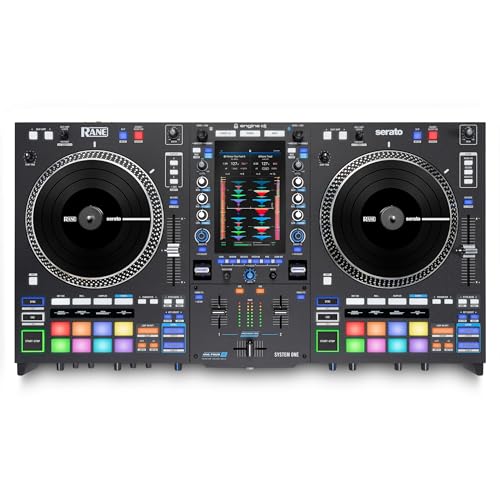
- Motorized 7.2-inch platters for turntable-style control
- XLR Main, RCA Main, and 1/4-inch Booth outputs
- Standalone, Serato DJ Pro, and streaming support
Best For: Scratch and open-format DJs seeking tactile platter performance
Compact Streaming Pick

- Balanced XLR Main outputs in a compact standalone design
- Built-in speakers, Wi-Fi streaming, USB, and SD support
- 7-inch touchscreen with two-deck Engine DJ operation
Best For: Home and mobile DJs wanting accessible standalone streaming
Premium Portable Pick
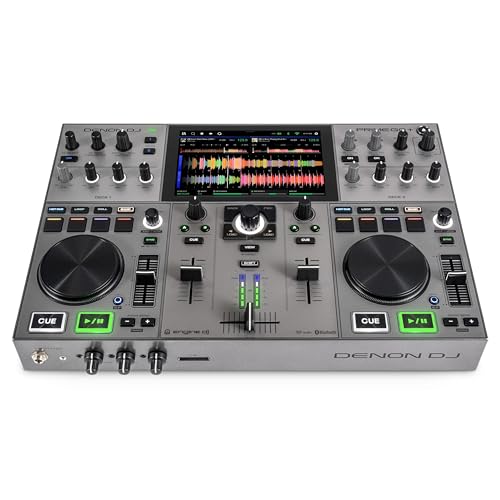
- Balanced XLR main outputs and multiple booth, RCA, and AUX connections
- Battery-powered standalone operation with Engine DJ OS
- Wi-Fi streaming, stems, FX, and lighting-control features
Best For: Mobile and advanced DJs seeking standalone performance and professional PA connectivity
Performance Production Pick

- Balanced XLR outputs for professional PA connections
- Four-deck control with large low-latency platters
- Built-in Roland TR sounds and 16-step sequencing
Best For: Serato DJs who want scratching, four-deck control, and live drum performance features
Compact Standalone Value

- Master XLR and RCA outputs with RCA booth output
- Standalone USB playback plus VirtualDJ control
- Dual screens and touch-sensitive jog wheels in a lightweight chassis
Best For: Portable two-channel setups and DJs seeking USB and VirtualDJ flexibility
Versatile Two-Deck Pick
Hercules DJControl Inpulse 500

- Two-deck Serato and DJUCED control
- Built-in audio interface and input mixer
- Jog wheels, RGB pads, and retractable feet
Best For: Hands-on mixing and scratching at home
Beginner-Friendly All-Rounder
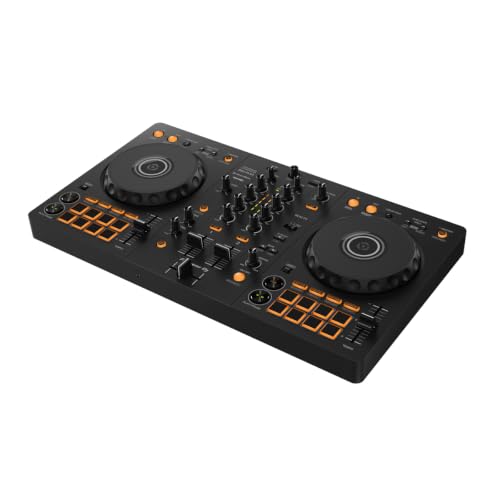
- Simple two-channel learning layout
- Smart Fader eases transitions
- Portable and compatible with multiple platforms
Best For: Beginners, streaming, and mobile practice
Scratch-Focused Budget Pick

- Battle-style layout for scratch practice
- Includes Serato DJ Lite access
- Compact, affordable two-deck design
Best For: Hip-hop, scratching, and open-format beginners
Professional Standalone Pick – Denon DJ PRIME 4 G2
The Denon DJ PRIME 4 G2 is a feature-rich choice for DJs seeking dj controllers with xlr outputs. Its four-channel standalone design, onboard Stems rendering, large touchscreen, and balanced Main, Booth, and Zone outputs make it suited to more demanding performance setups.
Best For: DJs who want laptop-free four-deck performance, advanced Stems tools, and flexible venue connectivity.
Pros:
- Four-channel standalone operation with onboard Stems rendering and Wi-Fi streaming.
- Balanced XLR Main, Booth, and Zone outputs support varied professional setups.
- Large 10.1-inch touchscreen, 8-inch jog wheels, and pressure-sensitive MPCe pads.
- Built-in 3-pin XLR DMX output enables direct lighting control.
Cons:
- Its 21.8-pound weight and larger footprint are less convenient for frequent transport.
- The extensive feature set may be more than casual two-deck users need.
The PRIME 4 G2 stands out when output flexibility and standalone performance depth matter most. It is a strong fit for mobile DJs, events, and venues that can take advantage of its multiple balanced outputs and lighting integration.
Portable Battery-Powered Pick – Numark Mixstream Pro Go
The Numark Mixstream Pro Go is a practical option among dj controllers with xlr outputs when portability is a priority. Its battery-powered design, built-in speakers, Wi-Fi streaming, and balanced XLR Main outputs support flexible performances away from a traditional booth.
Best For: Mobile DJs, performers, and beginners who want standalone mixing with battery operation and built-in sound.
Pros:
- Battery-powered design with built-in speakers for highly portable use.
- Balanced XLR Main outputs plus RCA Main and dedicated headphone connections.
- Wi-Fi streaming, SD media, two USB ports, and Engine DJ standalone operation.
- Supports wireless DJ light control and standalone Stems prepared through Engine DJ Desktop.
Cons:
- It provides two-deck operation rather than the four-channel layout of larger systems.
- The compact 6-inch jog wheels may offer less physical room than pro-sized decks.
Choose the Mixstream Pro Go when easy setup and mobility outweigh the need for extensive mixer routing. Its included battery and speakers make it especially convenient for pop-up sets, practice, and small events.
Motorized Performance Pick – RANE SYSTEM ONE
The RANE SYSTEM ONE brings a turntable-inspired feel to dj controllers with xlr outputs through its motorized 7.2-inch aluminum platters. It combines standalone Engine DJ operation, Serato DJ Pro integration, onboard Stems, and XLR Main connectivity in a substantial all-in-one system.
Best For: Open-format and scratch-oriented DJs who want motorized platters, standalone flexibility, and Serato integration.
Pros:
- Motorized aluminum platters provide a turntable-style performance feel.
- XLR Main, RCA Main, and 1/4-inch Booth outputs support varied audio setups.
- Works with USB, SD, internal storage, streaming services, Serato DJ Pro, and djay PRO.
- Includes standalone Stems, extensive FX, a vertical touchscreen, and a MAG FOUR crossfader.
Cons:
- At 29.4 pounds, it is the heaviest and least travel-friendly option in this group.
- Its advanced motorized and software features may be excessive for straightforward mixing.
The SYSTEM ONE is a specialist choice for DJs who value platter response and scratching as much as standalone convenience. Its broad source support and professional outputs make it adaptable, but its size and weight favor installed or carefully transported setups.
Compact Streaming Pick – Numark Mixstream Pro+
The Numark Mixstream Pro+ is a compact standalone option for shoppers comparing dj controllers with xlr outputs. It offers balanced XLR Main outs, built-in speakers, Wi-Fi streaming, a 7-inch touchscreen, and support for USB and SD media in a relatively lightweight design.
Best For: Home, practice, and mobile DJs wanting simple two-deck standalone mixing with streaming access.
Pros:
- Balanced XLR Main outputs are complemented by RCA Main and dedicated headphone outs.
- Built-in speakers and standalone Engine DJ operation simplify setup.
- Streams from supported services and reads music from USB, SD, and Dropbox.
- Includes wireless lighting control and prepared standalone Stems support.
Cons:
- It is a two-deck controller without the four-channel layout of premium systems.
- Its 6-inch jog wheels provide less surface area for tactile control.
- Unlike the Mixstream Pro Go, this model uses corded power.
The Mixstream Pro+ offers a straightforward balance of connectivity, streaming, and portability. It is a sensible pick for DJs who want XLR output and standalone convenience without moving up to a heavier professional system.
Premium Portable Pick – Denon DJ PRIME GO+
The Denon DJ PRIME GO+ is a strong choice among dj controllers with xlr outputs for DJs who want professional connections without being tied to a laptop. Its battery-powered standalone design, built-in Wi-Fi streaming, and balanced XLR main outputs make it especially flexible for mobile performances.
Best For: Mobile and advanced DJs who need standalone operation, streaming access, and balanced PA connectivity.
Pros:
- Balanced XLR main outputs plus 1/4-inch booth, RCA main, and AUX connections.
- Battery-powered Engine DJ operation supports laptop-free performances.
- Built-in Wi-Fi enables access to more than 100 million tracks across supported streaming services.
- Offers extensive performance tools, including 26 main FX, Touch FX, stems, and lighting control.
Cons:
- Its advanced feature set may be more than a beginner needs.
- Streaming and some software features depend on Wi-Fi or preparation in Engine DJ.
Choose the PRIME GO+ if portability and standalone capability matter as much as output flexibility. It is a particularly capable option for performers moving between home, events, and professional PA systems.
Performance Production Pick – Roland DJ-505
The Roland DJ-505 combines two-channel mixing with four-deck control and balanced XLR outputs, making it one of the more performance-focused dj controllers with xlr outputs. It is designed around Serato DJ Pro and adds Roland TR drum sounds and sequencing for DJs who want to build live rhythmic elements into their sets.
Best For: Serato users, scratch-focused DJs, and performers who want integrated drum-machine and sampler control.
Pros:
- Balanced XLR outputs provide a direct connection to professional PA systems.
- Controls up to four decks from a two-channel layout.
- Large low-latency platters support scratching and precise manipulation.
- Includes Roland TR drum kits, a 16-step sequencer, and Serato DJ Pro software.
Cons:
- The controller is centered on Serato DJ Pro, so it may be less appealing to users of other software.
- Its two-channel mixer layout may feel limited for setups requiring more physical channels.
The DJ-505 stands out when creative performance is a priority. Its XLR connectivity handles professional sound systems, while the TR drum engine and sequencer give conventional DJ sets an added production-oriented dimension.
Compact Standalone Value – Gemini GMX USB DJ Controller
The Gemini GMX is a compact option for shoppers comparing dj controllers with xlr outputs and wanting both computer-based and USB playback. It includes standalone media-player functionality, VirtualDJ LE support, dual screens, touch-sensitive jog wheels, and master XLR and RCA outputs in a lightweight design.
Best For: DJs who want a portable two-channel controller for USB playback, VirtualDJ mixing, and small mobile setups.
Pros:
- Provides master XLR and RCA outputs, plus RCA booth output.
- Supports standalone USB playback or control of DJ software.
- Dual screens display waveforms and track information without relying entirely on a computer screen.
- Lightweight design weighs less than 7 pounds and includes MIDI mapping.
Cons:
- Its two-channel design may not suit DJs who need more mixer channels.
- The supplied notes identify VirtualDJ LE, but do not specify support for newer software versions.
- Its 24-bit audio interface is listed at a 44.1 kHz frequency.
The GMX makes sense for straightforward, portable DJ setups where XLR output and USB flexibility are more important than extensive club-style expansion. Its built-in screens and standalone playback can also simplify setup at smaller events.
Versatile Two-Deck Pick – Hercules DJControl Inpulse 500
The Hercules DJControl Inpulse 500 is a practical option for shoppers comparing DJ controllers with XLR outputs, though the supplied specifications do not confirm an XLR connector. It combines two-deck control, a built-in audio interface, and a hardware input mixer in a sturdy, performance-focused design.
Best For: DJs who want hands-on two-deck control, scratching features, and flexible audio-input mixing.
Pros:
- Two-deck controller compatible with Serato and DJUCED.
- Built-in audio interface and hardware input mixer for audio inputs.
- Large touch-sensitive jog wheels, 16 RGB pads, and dedicated loop controls.
- Retractable feet and a metal backing plate add practical protection and stability.
Cons:
- The supplied details list USB connectivity but do not verify an XLR output.
- At 11.6 pounds, it is less travel-friendly than lighter controllers.
The Inpulse 500 is a feature-rich choice for home setups and developing performers. If XLR connectivity is essential, confirm the rear-panel outputs before buying.
Beginner-Friendly All-Rounder – Pioneer DJ DDJ-FLX4
The Pioneer DJ DDJ-FLX4 is a lightweight two-channel controller for beginners comparing DJ controllers with XLR outputs. Its supplied specifications confirm USB connectivity and a built-in sound card, but they do not identify an XLR output, so venue connections should be checked separately.
Best For: New DJs who want an accessible controller for learning, streaming, and portable setups.
Pros:
- Simple layout designed to support beginners as their skills develop.
- Smart Fader can adjust volume, bass, and BPM during transitions.
- Works with rekordbox, Serato DJ Pro, and djay across PC, Mac, iOS, and Android.
- Supports music streaming services and live-streaming or MC use from one device.
Cons:
- The supplied notes do not confirm an XLR output.
- Its two-channel design may be limiting for more advanced multi-deck workflows.
With its approachable controls, broad device compatibility, and 2.8-kilogram weight, the DDJ-FLX4 is easy to recommend for learning and mobile practice. Verify the output connections if balanced XLR cabling is a firm requirement.
Scratch-Focused Budget Pick – Pioneer DJ DDJ-REV1
The Pioneer DJ DDJ-REV1 is a compact, battle-style controller for shoppers considering DJ controllers with XLR outputs, but its supplied details do not confirm an XLR connection. It focuses on scratch practice, Serato DJ Lite access, and straightforward control from a PC or Mac.
Best For: Beginners learning scratching, battle-style techniques, hip-hop, and open-format mixing.
Pros:
- Battle-style layout mirrors a turntable and battle-mixer setup.
- Tall pitch faders and quick effect controls suit scratch-focused practice.
- Serato DJ Lite is unlocked for immediate plug-in-and-play use.
- Compact 5-pound design is convenient for beginners and smaller spaces.
Cons:
- The supplied specifications do not verify an XLR output.
- Compatibility is limited to PC and Mac in the provided details.
- The two-deck beginner format may not suit larger or more advanced setups.
The DDJ-REV1 makes sense when scratch technique and affordability matter more than extensive connectivity. For PA systems requiring balanced XLR, confirm the available outputs before purchasing.
How We Picked the Best Dj Controllers with Xlr Outputs
We focused on controllers and standalone DJ systems that offer balanced XLR master outputs or a comparable professional connection for cleaner, more reliable integration with powered speakers and venue audio equipment. We also considered software compatibility, deck layout, portability, standalone capability, performance controls, display features, and overall suitability for different experience levels.
Because “professional” does not always mean “best for everyone,” the selection includes full-size performance systems as well as compact controllers for bedrooms, mobile setups, and learning environments. The right choice depends on whether you prioritize onboard music playback, creative control, portability, or simple computer-based mixing.
Quick Comparison
| Best For | Recommended Type | What to Prioritize |
|---|---|---|
| Large standalone setups | Prime 4 G2-style system | Standalone operation, extensive controls, multiple inputs, and strong output connectivity |
| Portable performance | Mixstream Pro Go or Prime Go+ | Battery life, wireless features, compact dimensions, and onboard playback |
| Motorized performance | RANE SYSTEM ONE | Motorized platters, tactile control, and detailed performance workflow |
| Serato users | Roland DJ-505 or Pioneer DJ DDJ-REV1 | Serato integration, pad functions, layout, and available performance effects |
| Beginners | DDJ-FLX4 or DJControl Inpulse 500 | Clear controls, guided learning features, software support, and easy setup |
Key Buying Factors for Dj Controllers with Xlr Outputs
Check the Complete Output Setup
XLR master outputs are valuable because balanced cables help reduce noise over longer runs. Confirm whether the controller also includes booth outputs, RCA outputs, or separate microphone inputs if your setup requires independent monitoring or announcements.
Decide Between Standalone and Computer-Based DJing
Standalone models can play music from USB drives or internal-compatible systems, reducing dependence on a laptop. Traditional controllers may offer better value and software integration, but they require a computer and the right DJ application.
Match the Layout to Your Performance Style
Two-deck layouts are often easier to learn, while four-deck systems provide more room for layering tracks, samples, and stems. Motorized platters, performance pads, stem controls, and onboard effects matter most if you actively use those techniques.
Consider Size, Power, and Transport
Large controllers can provide a more comfortable club-style workflow but take more space and effort to carry. Portable systems are better for compact venues and outdoor use, especially when they include battery operation or wireless connectivity.
Who Should Buy Which Dj Controllers with Xlr Outputs?
Choose a full-size standalone Denon DJ system if you want a central performance hub with minimal computer dependence. Pick a portable Numark or Denon DJ model for mobile sets, travel, or spaces where convenience matters more than maximum deck size. The RANE option suits DJs who specifically want motorized tactile control.
For laptop-based Serato workflows, the Roland and Pioneer DJ controllers offer familiar performance layouts, while the Hercules and entry-level Pioneer models are sensible starting points for new DJs. The Gemini unit is worth considering if you want a straightforward media-player and controller combination at a potentially lower cost. Before buying, verify current software requirements, included cables, firmware support, and the exact output specifications for your speakers.