
A well-chosen patch bay can make a studio or live rack easier to route, troubleshoot, and expand without repeatedly reaching behind your equipment. The best options under $200 range from complete XLR feed-through bays to modular panels and buffered pedalboard solutions.
This roundup compares 10 patch bays and rack components for different setups, including balanced connections, D-series compatibility, channel count, installation style, and everyday flexibility.
Best 10 Patch Bays Under 200 Picks for 2026
Best Rackmount XLR Hub

- 16 reversible XLR ports
- Rugged steel rackmount chassis
- Mounting screws included
Best For: High-capacity XLR routing in studios and live racks
Best Buffered Guitar Patchbay

- Ultra-transparent buffer
- Five TRS in/out connections
- Switchable TS buffer and MIDI thru
Best For: Instrument rigs with 1/4-inch routing and buffering
Best Compact XLR Module

- Three balanced XLR points
- Rolled-steel chassis
- Gold-plated contacts
Best For: Small recording and live-sound XLR setups
Best XLR Rack Pigtails
Sound Professionals XLRM3 Panel Assembly

- 19-inch rack-mount design
- Eight numbered shielded cables
- Male-to-female XLR connectors
Best For: Custom 1U rack panels and XLR installations
Compact Pedalboard Connectivity
Temple Audio 4-Way Jack Patch Module

- Made for Templeboard pedalboards
- Four 1/4-inch jack connections
- Lightweight 4.6-ounce module
Best For: Templeboard pedalboard setups
Flexible Rack Expansion
1U Hinged D-Series 12-Connector Panel

- Fits standard 19-inch racks
- Accepts 12 D-Series connectors
- Hinged for easier cable additions
Best For: Custom rack connector installations
Ready-Made XLR Routing

- Eight-channel XLR signal management
- 1U rack-mount audio format
- Includes screws and user manual
Best For: Studio and live-sound XLR setups
Best Value Rack Panel

- Eight numbered D-series openings
- Heavy-duty cold-rolled steel
- Includes rack mounting hardware
Best For: DIY studios and compact 19-inch rack builds
Best Solderless Option
DIYTECH XLR Pass-Through Cable 2-Pack

- Male-to-female XLR connection
- No soldering required
- Two panel-mount cables included
Best For: Fast XLR panel and patch-bay installations
Best High-Capacity Panel
JINGCHENGMEI 1U Hinged 16-Port Panel
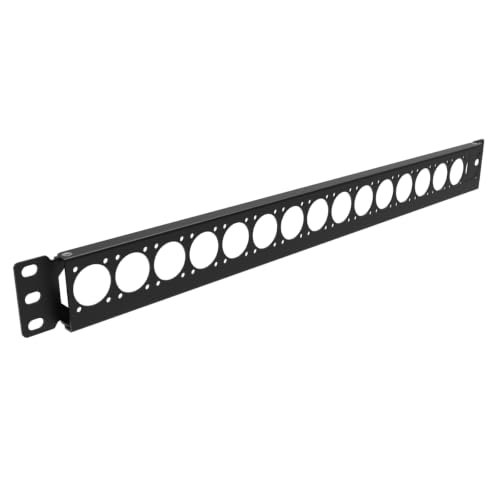
- Sixteen D-series openings
- Hinged access for maintenance
- Sturdy powder-coated steel
Best For: Professional racks needing flexible, high-density connections
Best Rackmount XLR Hub – DIYTECH 16-Port XLR Patchbay
For patch bays under 200, the DIYTECH 16-Port XLR Patchbay is a practical choice when you need a rack-mounted hub for balanced XLR routing. Its reversible connectors and steel chassis suit studios, live rigs, theaters, houses of worship, and broadcast setups.
Best For: Rack-based XLR patching and flexible microphone, mixer, preamp, console, or recorder connections.
Pros:
- Provides 16 XLR ports with reversible male/female configurations.
- Heavy-duty steel construction with a black powder coat is designed for frequent use.
- Includes mounting screws for standard 19-inch rack installation.
- Balanced three-pin wiring is suited to clean signal routing and longer cable runs.
Cons:
- Designed for XLR connections rather than 1/4-inch patching.
- Intended for indoor use according to the listed specifications.
The DIYTECH stands out for systems that need many XLR connections in a compact rack panel. Its reversible design adds installation flexibility without requiring connector rewiring.
Best Buffered Guitar Patchbay – Friedman Buffer Bay 6
Friedman Amplification Buffer Bay 6 Ultra Transparent Buffer & Professional Patch Bay
Check Price On AmazonAmong patch bays under 200, the Friedman Buffer Bay 6 is aimed at pedalboard and instrument setups that benefit from a transparent buffer alongside patching. It combines five identical 1/4-inch TRS input/output connections with a switchable buffered TS connection and MIDI thru.
Best For: Guitar and instrument rigs requiring multiple 1/4-inch connections, transparent buffering, and MIDI thru.
Pros:
- Offers an ultra-transparent, natural, and musical-sounding buffer.
- Includes five identical 1/4-inch TRS inputs and outputs.
- Provides a buffered TS connection that can be switched on or off.
- Includes a seven-pin MIDI thru connection in a compact enclosure.
Cons:
- Its 1/4-inch-focused design is less suitable for XLR-only systems.
- Requires corded electric power.
The Buffer Bay 6 is a specialized option rather than a general studio patch panel. Choose it when transparent buffering and flexible instrument-connection options matter more than a large number of XLR points.
Best Compact XLR Module – Hosa MXL-369 XLR Patchbay
The Hosa MXL-369 is a straightforward pick for patch bays under 200 when a compact, three-point balanced XLR module meets your routing needs. Its rolled-steel chassis and gold-plated contacts are suited to professional recording and live-sound applications.
Best For: Small professional audio setups that need three balanced XLR patch points.
Pros:
- Provides three-point balanced XLR patching.
- Uses a rolled-steel chassis for a durable enclosure.
- Gold-plated contacts are included for the listed XLR connections.
- Comes with a limited lifetime warranty.
Cons:
- Only three patch points are provided, limiting expansion.
- It is a focused XLR module rather than a multi-format patchbay.
The MXL-369 makes the most sense when you want a simple XLR solution without paying for unused connection density. Its compact three-point layout is best matched to smaller or highly specific routing tasks.
Best XLR Rack Pigtails – Sound Professionals XLRM3 Panel Assembly
For patch bays under 200, the Sound Professionals XLRM3 is a practical panel-mount assembly for building or servicing a 19-inch rack connection panel. It includes numbered, shielded 19-inch cables with male-to-female XLR connectors for organized audio patching.
Best For: Custom 1U rack panels, microphone connections, and installations using multiple XLR pigtails.
Pros:
- Designed for 19-inch rack mounting.
- Includes 19-inch shielded cables for the panel connections.
- Numbered connectors help with organization and identification.
- Supplied as an eight-count assembly for multi-connection installations.
Cons:
- This is a pigtail cable assembly, not a complete standalone patchbay with integrated routing.
- The listed XLR configuration may require additional panel hardware for a finished installation.
The XLRM3 is best for users assembling a rack panel around their own wiring layout. Its numbered, shielded cables provide a tidy starting point for custom XLR infrastructure.
Compact Pedalboard Connectivity – Temple Audio 4-Way Jack Patch Module
For musicians comparing patch bays under 200, the Temple Audio 4-Way Jack Patch Module is a compact option designed specifically for Templeboard pedalboards. It provides four 1/4-inch jack connections in a small module.
Best For: Templeboard users who need convenient four-way 1/4-inch patch connectivity.
Pros:
- Designed for Templeboard pedalboards.
- Provides four 1/4-inch jack connections.
- Compact, lightweight design at 4.6 ounces.
Cons:
- Designed specifically for Templeboard pedalboards rather than general rack use.
- Offers four connections, which may not suit larger signal-routing setups.
This is a focused solution for pedalboard-based routing rather than a traditional rack patch bay. Its small size and four-jack layout make it practical when compatibility with a Templeboard system is the priority.
Flexible Rack Expansion – 1U Hinged D-Series 12-Connector Panel
Among patch bays under 200, this 1U hinged punch-out panel stands out as a configurable rack component. It accepts Audio D-Series connectors, including XLR and HDMI options, and fits standard 19-inch racks or cabinets.
Best For: Rack users building a custom connector panel or adding connections where rear access is limited.
Pros:
- Provides 12 D-Series punch-out positions.
- Compatible with different XLR connectors and other D-Series components.
- Hinged on both ends to help with later cable additions.
- Uses 1U of space in a standard 19-inch rack.
Cons:
- It is a blank component panel, so connectors are not included.
- Its three-month warranty is relatively limited.
This panel is best viewed as a flexible foundation for a customized rack patch solution. The hinged design and multiple punch-outs are particularly useful for installations that are difficult to access after mounting.
Ready-Made XLR Routing – AMIMA 8-Channel XLR Patch Bay
For shoppers seeking patch bays under 200 for audio transmission, the AMIMA 8-Channel XLR Patch Bay offers a ready-made 1U rack-mount format. It consolidates eight XLR channels and includes color-coded ports, gold-plated contacts, mounting screws, and a user manual.
Best For: Studio, live-sound, and broadcast setups that use multiple XLR microphone connections.
Pros:
- Consolidates eight XLR audio channels in a 1U rack format.
- Designed for studio, live-sound, and broadcast use.
- Includes color-coded ports and gold-plated contacts.
- Comes with mounting screws and a user manual.
Cons:
- Provides XLR connectivity rather than a mix of connector types.
- The listed patch-side cable is 6.5 feet, which may not suit every rack layout.
This is the most directly audio-focused option in the group, with eight channels already configured for XLR signal management. Its 1U rack format makes it a practical fit for organized microphone and audio connections.
Best Value Rack Panel – LIYVZ 1U 8-Port XLR Panel
If you are assembling patch bays under 200, the LIYVZ 1U panel is a practical blank rack solution for adding compatible D-series connectors. Its numbered eight-slot layout, steel construction, and included mounting hardware make it suitable for organized DIY or studio installations.
Best For: Home labs, studios, broadcast setups, and video racks needing an eight-port D-series panel.
Pros:
- Eight numbered D-series punch-outs simplify channel identification.
- Heavy-duty cold-rolled steel resists flexing, scratches, and rust.
- Fits standard 19-inch racks and includes cage nuts and screws.
Cons:
- Connectors or modules are not included.
- Provides eight ports, fewer than larger 16-port panels.
This is a strong pick when you want a straightforward, durable rack faceplate and plan to choose the XLR, HDMI, or other D-series modules yourself.
Best Solderless Option – DIYTECH XLR Pass-Through Cable 2-Pack
For patch bays under 200 that need a quick wiring solution, the DIYTECH two-pack provides male-to-female XLR pass-through cables for panel-mounted installations. The solderless design is useful when you want to complete a professional audio connection without building cables from individual parts.
Best For: XLR patch bays, floor boxes, wall plates, stage setups, and other indoor professional audio installations.
Pros:
- Male-to-female XLR format supports straightforward pass-through connections.
- Solderless installation saves time and simplifies assembly.
- Two-pack provides a pair of panel-mount cables.
Cons:
- Designed for XLR connections rather than mixed-format D-series modules.
- Hardware and cables are supplied as a small two-piece set, not a complete patch panel.
This option works best as the connector hardware inside a custom patch bay, especially when speed and easy installation matter more than a preassembled panel.
Best High-Capacity Panel – JINGCHENGMEI 1U Hinged 16-Port Panel
Among patch bays under 200, this 1U hinged panel stands out for its 16 D-series openings and service-friendly design. It accepts a broad range of connector types while allowing either side to swing open for easier access during installation or maintenance.
Best For: Recording studios, touring racks, live-event systems, and professional audio/video installations requiring high port capacity.
Pros:
- Sixteen openings provide substantial room for XLR, HDMI, USB, RCA, and other compatible modules.
- Dual hinged sides improve access for new connections and maintenance.
- 1.5 mm powder-coated cold-rolled steel supports heavy use.
- Three mounting holes on each side help stabilize the panel.
Cons:
- Connectors are not included.
- A 16-port layout may be more capacity than compact installations need.
Choose this panel when expansion, connector flexibility, and maintenance access are priorities. Its blank modular design lets you configure the rack around your specific audio and video connections.
How We Picked the Best Patch Bays Under 200
We focused on products that solve common routing and rack-integration needs while staying below the $200 price point. The selection includes complete patch bays, modular connector panels, pass-through cables, and blank or punch-out solutions for custom builds. We considered connection type, channel count, rack compatibility, installation requirements, reversibility, construction details, and suitability for studio or live use.
Because these products are not identical, the best choice depends on whether you need a ready-to-use panel or components for a more specialized rack layout. A feed-through XLR bay is usually the simplest option, while a punch-out panel offers more control if you are comfortable installing connectors and wiring.
Quick Comparison
| Best For | What To Look For | Typical Choice |
|---|---|---|
| Simple studio routing | Balanced XLR connections and clear labeling | Multi-channel XLR feed-through patch bay |
| Custom rack builds | D-series compatibility and punch-out space | Hinged or modular rack panel |
| Pedalboards and compact rigs | Small footprint and flexible jack placement | Compact jack patch module |
| Fast installation | Preassembled cables or solderless connections | Pass-through panel or cable assembly |
Key Buying Factors for Patch Bays Under $200
Connection Type and Signal Path
Confirm whether you need XLR, 1/4-inch jack, HDMI, or a combination of connector formats. Balanced XLR is a strong fit for microphones, mixers, interfaces, and professional audio racks. Pass-through designs keep wiring straightforward, while buffered units may be useful when signal integrity and long cable runs are priorities.
Channel Count and Rack Space
Count the inputs and outputs you actually need, then leave room for likely expansion. A 1U panel can conserve rack space, but connector density matters if plugs will be changed frequently. Also verify the panel’s exact rack width and connector spacing before buying replacement parts or modules.
Installation and Serviceability
Prewired assemblies are convenient for quick builds. Punch-out and hinged panels are better for custom layouts, but they may require compatible D-series connectors, tools, labeling, and additional cabling. Reversible or modular designs can make future troubleshooting and rerouting easier.
Build Quality and Labeling
Look for sturdy metal panels, secure connector mounting, reliable contacts, and labels that remain readable in a dark rack. Color-coded ports can reduce setup errors, especially in live environments or shared studios.
Who Should Buy Which Patch Bays Under 200?
Choose a complete multi-channel XLR patch bay if you want the fastest path to organized microphone, interface, and mixer connections. A modular or punch-out panel is better for custom rack builders who need to mix connector types or plan future expansion. If your setup is centered on a pedalboard, a compact jack module can provide convenient access without dedicating a full conventional patch bay. Prewired XLR assemblies and solderless pass-through cables suit users who want to minimize soldering and shorten installation time.
Before ordering, map every signal path, check connector gender and format, measure available rack space, and confirm whether the unit is a true pass-through or includes normaling, buffering, or other signal-management features.