
The best voice recorders for podcasts make it easier to capture clean dialogue, manage multiple microphones, and record interviews wherever your show takes you. The right choice depends on whether you need studio-style inputs, portability, automatic transcription, or simple voice-activated recording.
We’ve selected 10 options spanning dedicated podcast recorders, handheld audio devices, and AI-enabled note takers. Use the guide below to match your recording workflow, microphone setup, and editing needs with the most suitable device.
Best 10 Voice Recorders for Podcasts Picks for 2026
Best Multitrack Podcast Recorder

- Four XLR inputs with phantom power
- Four headphone outputs with individual controls
- Phone, USB, mix-minus, and multitrack support
Best For: Small podcast teams recording in-person or remote conversations
Best AI Note-Taking Recorder

- AI transcription and summaries in 113 languages
- 128GB storage with up to 33 hours of recording
- Lightweight design with wired OTG transfers
Best For: Interview capture, research, and portable podcast notes
Best AI-Enhanced Podcast Recorder

- Four XLR inputs with up to +70dB gain
- AI noise reduction, tone enhancement, and compression
- Four headphone outputs plus phone video connection
Best For: Multi-person podcasts needing built-in sound assistance
Best Premium AI Recorder
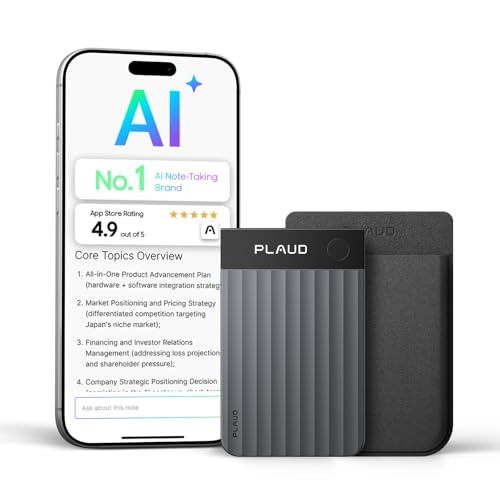
- AI recording modes for calls and meetings
- Transcription, summaries, and Ask Plaud insights
- Slim design with up to 50 hours of recording
Best For: Interview research and organized AI-assisted podcast notes
Best Multitrack Option

- Four-track recording with 32-bit float audio
- Two XLR/TRS inputs for external mics or instruments
- USB-C recording or streaming with SD backup
Best For: Podcasters building a flexible, multitrack recording setup
Best for Voice Notes
EVISTR L357 Digital Voice Recorder

- 64GB storage with MP3 and WAV support
- Voice activation with seven sensitivity levels
- USB-C transfer and up to 32 hours of continuous recording
Best For: Portable interviews, lectures, meetings, and spoken notes
Best Compact Stereo Recorder

- Lightweight recorder with X/Y stereo microphones
- 32-bit float recording for clip-free audio
- USB-C microphone mode for calls, streaming, and podcasts
Best For: Solo podcasters and mobile content creators
High-Capacity Pick
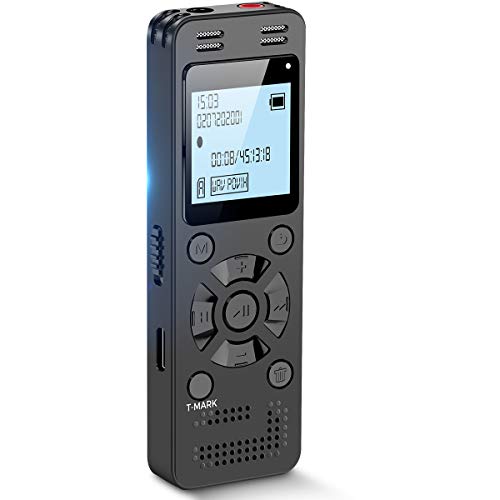
- 1536kbps PCM WAV recording
- 128GB storage and up to 54 hours of battery life
- Voice activation, playback, and password protection
Best For: Podcasters needing a versatile recorder for interviews and everyday audio
Podcast-Focused Pick
Zoom PodTrak P2 Podcast Recorder

- Two USB mic inputs and two headphone outputs
- Mix-Minus for echo-free remote guests
- AI noise reduction and simultaneous streaming
Best For: Two-person podcasts and mobile recording with remote guests
Portable Storage Pick
Qunifyed 136GB Magnetic Recorder

- 136GB storage with up to 100 hours of continuous recording
- AI noise filtering and voice activation
- Magnetic design with USB-C and OTG transfers
Best For: Long interviews and portable field recording
Best Multitrack Podcast Recorder – Zoom PodTrak P4
The Zoom PodTrak P4 is a strong choice among voice recorders for podcasts when you need to connect several microphones and monitor a live discussion. Its four XLR inputs, separate headphone controls, phone connectivity, and battery-powered design make it practical for both in-person shows and remote interviews.
Best For: Small podcast teams recording up to four microphone sources, including phone-based guests.
Pros:
- Four XLR microphone inputs with phantom power support
- Four headphone outputs with individual volume controls
- Automatic mix-minus for phone and remote interviews
- Multitrack recording, sound pads, and USB audio interface mode
Cons:
- Battery life is rated at up to 3.5 hours on two AA batteries
- Designed more for multi-person podcast production than pocket note-taking
The P4 offers a flexible podcast-focused setup without requiring a separate mixer, especially if multiple hosts or guests need their own microphone and headphone connection.
Best AI Note-Taking Recorder – EVISTR L359
The EVISTR L359 is a compact option among voice recorders for podcasts when transcription and post-recording organization matter as much as capturing audio. It combines HD recording, noise reduction, voice activation, and app-based AI transcription in a lightweight design.
Best For: Podcasters who want a portable recorder for interviews, research, and quick AI-generated transcripts or summaries.
Pros:
- Transcription in 113 languages with summaries, mind maps, and speaker identification
- 128GB storage and up to 33 hours of continuous recording
- Up to 3072Kbps recording with intelligent noise reduction
- OTG connection supports wired transfers to a phone
Cons:
- Its built-in microphone and mono speech mode are less suited to multi-microphone podcast production
- AI processing depends on the AI DVR Link app
The L359 is better suited to capturing interviews and planning material than producing a full multi-person podcast mix, but its storage, portability, and transcription tools can streamline preparation and review.
Best AI-Enhanced Podcast Recorder – Zoom PodTrak P4next
The Zoom PodTrak P4next is built for creators comparing voice recorders for podcasts and wanting more assistance with sound cleanup. It supports four XLR microphones, four headphone outputs, multitrack recording, and AI noise reduction tools for clearer, more balanced production.
Best For: Podcast teams recording up to four people who want integrated noise reduction and tone-enhancement features.
Pros:
- Four XLR inputs with up to +70dB of gain
- Four headphone outputs with separate volume controls
- AI noise reduction, tone enhancement, and compression tools
- Phone connection for recording audio directly into video
Cons:
- It is a specialized podcast recorder rather than a general-purpose pocket dictaphone
- Battery requirements and battery life are not specified in the supplied details
The P4next adds useful processing to an already capable multi-person podcast layout, making it appealing when you want flexible inputs and monitoring with less manual mixing.
Best Premium AI Recorder – Plaud Note Pro
The Plaud Note Pro is a slim AI recorder for podcasters who need organized meeting, call, and interview material rather than a traditional multi-input studio setup. Its directional audio, multimodal notes, transcription tools, and long battery life make it useful for capturing research and turning recordings into actionable content.
Best For: Podcasters recording interviews, calls, and research sessions who want searchable AI-assisted notes.
Pros:
- Automatically switches between call and meeting recording modes
- Supports transcription, summaries, questions, email drafts, and next-step suggestions
- Four MEMS microphones plus a VPU microphone for directional capture
- Up to 30 hours in Enhance Mode or 50 hours in Endurance Mode
Cons:
- No headphone jack and no multi-XLR microphone inputs
- Transcription use is tied to plan allowances, including the included 300 monthly minutes
- Cloud and app-based features require attention to consent and privacy requirements
The Note Pro is best viewed as an intelligent capture and organization tool, not a replacement for a dedicated podcast mixer or multitrack recorder. Its main advantage is helping turn recorded conversations into usable podcast material.
Best Multitrack Option – Zoom H4 Essential
The Zoom H4 Essential is a flexible choice among voice recorders for podcasts, especially when you need to record more than one source. Its built-in stereo microphones, two XLR/TRS inputs, four-track recording, and USB-C connectivity make it suitable for interviews, podcasts, music, and video audio.
Best For: Podcasters and creators who need external microphone inputs, multitrack capability, or a recorder that can also work with a computer, phone, or tablet.
Pros:
- Four-track recording supports larger projects.
- Built-in stereo microphones plus two XLR/TRS inputs provide flexible setup options.
- 32-bit float recording helps capture audio without distorted takes.
- Can record or stream over USB-C while saving a backup to an SD card.
Cons:
- Its broader feature set may be more than needed for simple voice notes.
- Uses two AA batteries.
- External microphones and other gear are not included.
Choose the H4 Essential if your podcast setup may expand beyond a single microphone. It is particularly well suited to field interviews, live recording, and projects that benefit from backup recording and multiple inputs.
Best for Voice Notes – EVISTR L357 Digital Voice Recorder
The EVISTR L357 is a practical pick among voice recorders for podcasts when portability, long recording capacity, and straightforward controls matter. It includes a built-in microphone, voice activation, adjustable gain, MP3 or WAV recording, and a 64GB storage capacity for interviews, meetings, and spoken notes.
Best For: Beginners, students, interviewers, and podcasters who want a compact recorder with voice activation, playback controls, and substantial built-in storage.
Pros:
- 64GB capacity can store up to 4,660 hours at 32Kbps.
- Voice activation can reduce silent sections and conserve storage.
- Supports MP3 and WAV recording, playback, A-B repeat, and variable-speed playback.
- USB-C transfers files to Windows and Mac computers.
Cons:
- It has a built-in microphone rather than inputs for external microphones.
- Voice activation may not suit every podcast recording style.
- Its feature set is focused on portable voice recording rather than multitrack production.
The L357 makes sense for spoken-word recording where ease of use and storage are priorities. It is less suitable if you need a multi-microphone podcast setup, but its voice activation and playback tools can be useful for interviews and recorded notes.
Best Compact Stereo Recorder – Zoom H1 Essential
The Zoom H1 Essential is a lightweight option among voice recorders for podcasts, interviews, and creator workflows. Its X/Y stereo microphones capture voices and ambient sound, while USB-C microphone mode lets you connect it to a computer or smartphone for calls, livestreams, voiceovers, and podcast recording.
Best For: Solo podcasters, mobile creators, and anyone who wants a compact recorder that can also serve as a USB microphone.
Pros:
- Lightweight 92-gram design is easy to carry.
- X/Y stereo microphones support podcasts, interviews, voiceovers, and ambient recordings.
- 32-bit float recording helps protect against clipped audio.
- USB-C microphone mode works with computers and smartphones.
Cons:
- It does not list XLR/TRS inputs for external microphones.
- Uses two AAA batteries.
- Its single stereo recording setup is less suited to multitrack projects.
The H1 Essential is a strong fit when portability and simple stereo capture matter more than expandable inputs. Its USB microphone mode also makes it convenient for creators who switch between field recording and desk-based podcasting.
High-Capacity Pick – EVIDA 128GB Voice Recorder
For shoppers comparing voice recorders for podcasts, the EVIDA 128GB model is a flexible option when storage capacity and simple file management matter. It supports PCM WAV recording up to 1536kbps, MP3 formats, playback, voice activation, and computer file transfers.
Best For: Podcasters who also need a high-capacity recorder for interviews, meetings, lectures, or general audio notes.
Pros:
- Supports WAV recording up to 1536kbps alongside 128kbps and 192kbps MP3 options.
- 128GB of storage can hold up to 9,296 hours of recordings according to the supplied specifications.
- Includes voice activation, password protection, A-B repeat, bookmarks, playback, and four-folder file organization.
- Offers up to 54 hours of continuous recording and USB computer compatibility.
Cons:
- Its built-in mono microphone is less tailored to multi-microphone podcast production than a dedicated podcast recorder.
- The supplied details list no headphone jack.
- It uses USB 2.0 rather than the newer USB-C interface.
The EVIDA is best viewed as a general-purpose recorder with useful podcast-adjacent features rather than a full podcast mixer. Its large storage capacity, voice activation, and high-resolution WAV setting make it practical for recording interviews or backup audio.
Podcast-Focused Pick – Zoom PodTrak P2 Podcast Recorder
The Zoom PodTrak P2 is purpose-built for simple two-person podcast recording. It accepts two USB microphones, provides two headphone outputs, supports remote call-ins with Mix-Minus, and can record separate tracks to an SD card while streaming.
Best For: Two-person podcasts, mobile interviews, and creators who want built-in voice processing without a complicated setup.
Pros:
- Two USB microphone inputs and two headphone outputs simplify two-person recording.
- Mix-Minus helps prevent echo and feedback when adding a phone or computer guest.
- AI noise reduction, tone shaping, compression, and de-essing help keep voices prominent.
- Can stream while saving individual tracks to an SD card, with battery, USB, and AC power options.
Cons:
- It is limited to two USB microphone inputs, so larger panels require another setup.
- Battery life is listed at up to four hours when using four AA batteries.
- The supplied details identify WAV recording and SD-card storage but do not specify an included SD card.
Among these voice recorders for podcasts, the PodTrak P2 is the most directly aligned with podcast workflows. Its two-mic layout, dual monitoring, remote-guest handling, and onboard processing make it the strongest fit for creators who want to record or stream with minimal post-production.
Portable Storage Pick – Qunifyed 136GB Magnetic Recorder
The Qunifyed 136GB recorder suits podcasters who prioritize portability, long unattended recording, and easy file transfer. It combines voice activation, AI smart noise filtering, USB-C and OTG connectivity, and a double-sided magnetic design for hands-free placement.
Best For: Podcasters recording interviews, research, or field audio who want long battery life and a compact recorder that can attach to metal surfaces.
Pros:
- 136GB of internal memory supports up to 18,800 hours of stored recordings according to the supplied notes.
- Up to 100 hours of continuous recording supports extended sessions.
- AI noise filtering and DSP processing are designed to reduce background interference.
- USB-C and OTG support enables file transfers with iPhone, Android, Mac, and Windows devices.
Cons:
- The built-in microphone is a general-purpose design rather than a dedicated multi-mic podcast setup.
- The supplied specifications do not identify a dedicated headphone monitoring output beyond a listed 3.5mm jack.
- Its magnetic attachment is most useful around compatible metal surfaces.
This Qunifyed model is a practical companion recorder for podcast interviews and fieldwork. Its standout advantages are the 100-hour continuous-recording claim, large internal storage, compact magnetic design, and broad USB-C transfer compatibility.
How We Picked the Best Voice Recorders for Podcasts
We compared these recorders by looking at the features that matter most during real podcast production: microphone connectivity, recording quality, portability, monitoring options, storage, battery practicality, and ease of transferring files. We also considered specialized tools such as multitrack recording, sound pads, phone or USB inputs, noise reduction, voice activation, playback, and AI transcription.
Because podcast workflows vary widely, this list includes both dedicated podcast systems and general-purpose voice recorders. A device designed for lectures or meetings may suit solo creators who prioritize long battery life and automatic transcription, while a PodTrak or handheld recorder is generally better for microphones, live interviews, and music-quality audio.
Quick Comparison
- Best for four-person podcasts: Zoom PodTrak P4 or P4next.
- Best for two USB microphones: Zoom PodTrak P2.
- Best handheld all-rounder: Zoom H4 Essential.
- Best compact creator recorder: Zoom H1 Essential.
- Best for AI transcription and summaries: Plaud Note Pro or EVISTR AI recorder.
- Best for simple, high-capacity recording: EVISTR, EVIDA, or the 136GB magnetic voice recorder.
Key Buying Factors for Voice Recorders for Podcasts
Microphone Inputs and Guest Count
Count how many people you expect to record at once. XLR inputs are the flexible choice for traditional dynamic or condenser microphones, while USB inputs can simplify a computer-based setup. Four inputs provide room for a host and several guests; two may be enough for a solo show or two-person interview.
Audio Quality and Monitoring
Look for a recorder that supports the microphones you already own and lets you monitor with headphones. Separate headphone outputs are especially useful when several guests need to hear the conversation. Handheld stereo recorders are convenient for ambient audio, field interviews, and backup tracks.
Portability, Storage, and Battery Life
For travel, prioritize compact dimensions, straightforward controls, dependable battery performance, and removable or generous internal storage. Large-capacity voice recorders are useful for lectures and long interviews, but advertised recording-hour figures vary with audio format and quality settings.
Transcription and Noise Reduction
AI transcription and summaries can save time after meetings or interviews, but they do not replace a clean recording. Noise reduction is helpful in untreated rooms, while microphone placement and a quiet environment remain more important to final sound quality.
Who Should Buy Which Voice Recorders for Podcasts?
Choose the Zoom PodTrak P4 or P4next if you host guest-heavy shows and want multiple inputs, headphone monitoring, and podcast-focused controls. Pick the PodTrak P2 for a simpler two-microphone USB setup.
The Zoom H4 Essential fits creators who need microphones plus handheld flexibility, while the H1 Essential is a lighter option for solo recording, field work, and content creation. For searchable notes and automated summaries, consider the Plaud Note Pro or an AI-enabled EVISTR model. If your priority is basic recording for classes, meetings, or interviews, the high-capacity EVISTR, EVIDA, and magnetic voice recorders offer a straightforward alternative.