
A DJ mixer with Bluetooth input makes it easy to stream music from a phone or tablet while keeping microphones, instruments, and wired sources connected. The best option depends on your channel needs, output setup, and how much control you want over mixing and effects.
We selected 10 models spanning compact two-channel mixers, flexible party and karaoke boards, and larger consoles with USB interfaces, phantom power, and built-in effects.
Best 10 Dj Mixer with Bluetooth Input Picks for 2026
Feature-Rich Pick
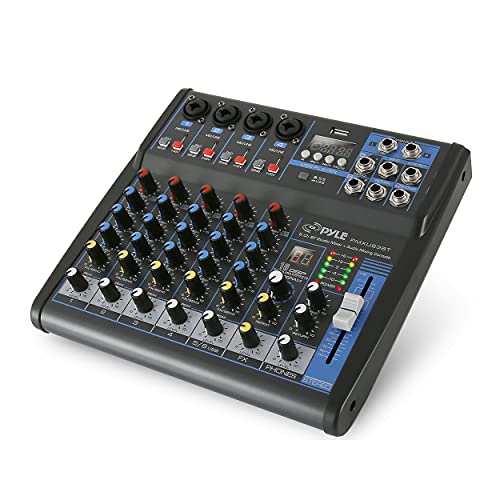
- Six channels with Bluetooth, USB, and MP3 support
- 48V phantom power and 3-band EQ
- Steel chassis with DSP effects
Best For: Bands, karaoke, live events, and multi-source setups
Portable DJ Pick

- Bluetooth and RCA mixing in a compact design
- 45mm crossfader with 2-band EQ and gain
- Metal housing with mic and headphone cue
Best For: Traveling DJs, practice, livestreams, and house parties
Recording Versatility Pick

- USB PC recording and USB-drive playback
- Three XLR inputs with 48V phantom power
- Bluetooth plus EQ, echo, and delay effects
Best For: Livestreaming, podcasting, small bands, and computer recording
Turntable-Friendly Pick

- Bluetooth, phono/line, USB, and AUX inputs
- Dual mic inputs with gain and talkover
- Cue monitoring and crossfader for DJ mixing
Best For: Mobile DJs, karaoke hosts, and turntable-based setups
Best All-Around Choice
Pyle 8-Channel Bluetooth Mixer

- Eight channels for flexible setups
- Bluetooth, USB MP3, and DSP effects
- XLR and 1/4-inch inputs with phantom power
Best For: Live performers, karaoke, and versatile home audio setups
Best for Ultra-Thin Design
FULUODE CT-80S 8-Channel Mixer

- Bluetooth 5.0 and USB/MP3 playback
- Eight channels with 48V phantom power
- Ultra-thin chassis and large LED display
Best For: Home KTV, conferences, and compact event setups
Best Compact DJ Controller

- Compact three-channel DJ layout
- Bluetooth, phono/line, and USB playback
- Crossfader plus microphone talk-over control
Best For: Mobile DJs, parties, karaoke, and small setups
Best Compact Pick

- Bluetooth input for wireless playback
- USB recording and MP3 playback
- Compact design with 48V phantom power
Best For: Portable recording, streaming, karaoke, and small DJ setups
Best Feature-Packed Compact Pick
Pyle 4-Channel Bluetooth Mixer

- Bluetooth 5.0 with up to 50-foot range
- Echo, EQ, pan, and peak controls
- USB, XLR, RCA, and AUX connectivity
Best For: Creators and performers needing flexible desktop mixing
Best for Larger Setups
Pyle 6-Channel Bluetooth Mixer

- Six channels with four XLR mic/line inputs
- 16 preset DSP effects
- USB, AUX, MP3 player, and sub output
Best For: Larger home rigs, karaoke, small venues, and effects-focused mixing
Feature-Rich Pick – Pyle PMXU63BT 6-Channel Mixer
If you need a dj mixer with bluetooth input for a band, karaoke setup, or home studio, the Pyle PMXU63BT offers six channels plus USB, flash-drive, computer, and Bluetooth connectivity. Its 3-band EQ, 48V phantom power, LED peak indicators, and built-in DSP effects provide useful control for more involved setups.
Best For: Bands, karaoke, live events, and users who need multiple inputs with recording and playback options.
Pros:
- Six channels with XLR and unbalanced 1/4-inch inputs
- Bluetooth streaming works with phones, tablets, and services such as Pandora or Spotify
- USB, flash-reader, MP3, and computer connectivity for playback and recording
- 48V phantom power, 3-band EQ, and 16-bit DSP effects
Cons:
- More features than needed for simple two-source DJ mixing
- The supplied details do not specify a software-update policy
The PMXU63BT is a flexible choice when Bluetooth is only one part of a broader audio system. Its steel chassis and multi-voltage power supply also suit users who want a compact mixer for regular performance use.
Portable DJ Pick – Gemini MM1BT 2-Channel Mixer
The Gemini MM1BT is a compact dj mixer with bluetooth input designed for portable setups. It combines Bluetooth with RCA sources, a microphone input, headphone cueing, 2-band EQ, gain controls, and a 45mm crossfader in a small metal housing.
Best For: Traveling DJs, practice sessions, livestreams, and small house-party systems.
Pros:
- Bluetooth input can be mixed with RCA sources simultaneously
- Compact 2-pound design fits easily in a backpack
- Includes microphone input, headphone cue, and Master and Booth RCA outputs
- Rugged metal housing with durable knobs and crossfader
Cons:
- Two channels and 2-band EQ offer less expansion than larger mixers
- Outputs are RCA rather than XLR
Choose the MM1BT when portability and straightforward source blending matter more than a large channel count. It is especially practical for mobile practice and small-format DJ use.
Recording Versatility Pick – Aveek 5-Channel Mixer
The Aveek 5-channel mixer is a practical dj mixer with bluetooth input for streaming, podcasting, small performances, and computer recording. It includes three XLR inputs, stereo line connections, USB recording, USB-drive playback, 48V phantom power, EQ, gain, echo, delay, and headphone monitoring.
Best For: Livestreamers, podcasters, small bands, and users who want Bluetooth alongside USB recording features.
Pros:
- Three XLR inputs with switchable 48V phantom power
- Built-in PC recording interface through USB-B
- Bluetooth streaming and USB-drive MP3 playback
- Includes 2-band EQ, gain, echo, delay, and headphone monitoring
Cons:
- Bluetooth, USB, and 4/5-channel functions cannot be used simultaneously
- Bluetooth range is listed at approximately 15 feet
- Output connections are intended for powered speakers or power amplifiers
The Aveek stands out for users who need recording and streaming functions in addition to Bluetooth playback. Be sure its mode-sharing limitation fits your intended workflow before buying.
Turntable-Friendly Pick – Pyle PMX8BU 3-Channel Mixer
The Pyle PMX8BU is a dj mixer with bluetooth input that also supports turntables, line-level sources, USB/MP3 playback, and auxiliary audio. Its cue monitoring, crossfader, dual microphone inputs, and talkover controls make it suited to DJ and karaoke-style event setups.
Best For: Mobile DJs, karaoke hosts, and users connecting turntables with microphones.
Pros:
- Built-in phono preamps allow direct turntable connection on channels 1 and 2
- Bluetooth, USB/MP3 playback, and 3.5mm AUX provide multiple source options
- Dual balanced microphone inputs include independent gain and talkover controls
- Cue headphone monitoring keeps pre-listening separate from the main output
Cons:
- Three channels provide less capacity than larger performance mixers
- The listed output connector is a 3.5mm headphone jack, while other outputs are not fully detailed
The PMX8BU is a strong match for setups that combine wireless playback with vinyl and spoken announcements. Its phono inputs and cue controls give it a more DJ-focused layout than a general-purpose audio mixer.
Best All-Around Choice – Pyle 8-Channel Bluetooth Mixer
If you need a dj mixer with bluetooth input that can handle microphones, instruments, and streamed music, the Pyle PMXU83BT is a versatile 8-channel option. It combines Bluetooth streaming with XLR and 1/4-inch inputs, USB MP3 playback, 3-band EQ controls, and built-in DSP effects for live performance, karaoke, or basic recording setups.
Best For: Live performers, karaoke setups, and users who want multiple inputs plus wireless music streaming.
Pros:
- Bluetooth streaming from a smartphone
- Eight channels with XLR and unbalanced 1/4-inch inputs
- +48V phantom power, USB MP3 playback, and 16-bit DSP
- Rugged steel chassis with sealed rotary controls
Cons:
- Requires corded power
- Its larger feature set may be more than needed for a simple three-channel setup
The PMXU83BT is a strong fit when flexibility matters more than minimal size. Its channel count and input variety make it adaptable, while Bluetooth adds convenient playback without another cable.
Best for Ultra-Thin Design – FULUODE CT-80S 8-Channel Mixer
The FULUODE CT-80S is a practical dj mixer with bluetooth input for home KTV, small performances, conferences, and studio-style use. Its eight-channel layout supports microphones and instruments, while Bluetooth 5.0, USB/MP3 playback, reverb, and a large LED display add convenient control features.
Best For: Users who want an eight-channel mixer with wireless playback, USB functions, and an ultra-thin chassis.
Pros:
- Built-in Bluetooth 5.0 wireless connection
- Eight-channel design with 48V phantom power
- USB/MP3 input and recording support
- Ultra-thin 1.57-inch design with a large LED display
Cons:
- Supplied notes specify a 110V American plug
- The unit weighs about 3.3 kg, so it is not the lightest option
This model emphasizes features and a slim profile, making it appealing for organized home entertainment or event setups. Confirm the power requirements before purchasing, especially if you plan to use it outside the specified 110V configuration.
Best Compact DJ Controller – Pyle PMX7BU 3-Channel Mixer
For straightforward DJ mixing, the Pyle PMX7BU is a compact dj mixer with bluetooth input and three independent channels. It supports wireless playback from phones, tablets, laptops, and PCs, while phono/line switching, USB flash-drive playback, microphone inputs, and talk-over controls cover common party and karaoke needs.
Best For: Mobile DJs, casual parties, karaoke, and users who prefer a small mixer with phono and Bluetooth support.
Pros:
- Bluetooth pairing with smartphones, tablets, laptops, and PCs
- Independent channel volume controls and crossfader
- Switchable phono/line inputs for turntables or playback devices
- USB reader, two microphone inputs, and headphone jack
Cons:
- Three channels offer less expansion than the eight-channel models
- Listed warranty is 90 days
- USB audio input is specified in the product details
The PMX7BU is best when portability and familiar DJ controls are priorities. It provides useful source flexibility in a smaller format, though larger live setups may benefit from a higher channel count.
Best Compact Pick – 4-Channel Bluetooth USB Mixer
If you need a compact dj mixer with bluetooth input, this four-channel model combines wireless music streaming with USB recording, XLR and 6.35mm inputs, and +48V phantom power. Its small footprint makes it practical for desktop setups, mobile podcasting, karaoke, and small DJ sessions.
Best For: Portable home recording, podcasting, livestreaming, karaoke, and small-party DJ mixing.
Pros:
- Bluetooth input supports music streaming from smartphones, tablets, and laptops.
- USB interface supports plug-and-play recording, livestreaming, and USB flash-drive MP3 playback.
- Includes +48V phantom power for compatible condenser microphones.
- Compact 7.87-by-6.7-inch design is easy to carry.
Cons:
- Bluetooth supports input only and cannot send audio to a Bluetooth speaker.
- It has four channels, which may be limiting for larger setups.
This is a practical choice when portability and straightforward Bluetooth playback matter more than extensive channel capacity or advanced effects.
Best Feature-Packed Compact Pick – Pyle 4-Channel Bluetooth Mixer
This Pyle model is a versatile dj mixer with bluetooth input for users who want wireless playback, PC recording, and hands-on channel controls in a rugged desktop chassis. Bluetooth 5.0, multiple analog connections, built-in echo, and per-channel EQ give it more control than a basic compact mixer.
Best For: Podcasting, karaoke, home studios, streaming, and small DJ setups that need effects and flexible connections.
Pros:
- Bluetooth 5.0 provides wireless streaming with a stated range of up to 50 feet.
- USB supports plug-and-play PC recording and playback on Windows and Mac.
- Built-in echo, two-band EQ, pan control, gain controls, and peak indicators support detailed adjustments.
- Offers XLR/6.35mm combo inputs, RCA connections, 3.5mm AUX, and headphone output.
Cons:
- The compact four-channel layout may not suit larger events or complex multi-source setups.
- Bluetooth range and performance depend on the surrounding wireless environment.
Choose this mixer if you want a small, sturdy control surface with useful effects and broad connectivity rather than the simplest possible interface.
Best for Larger Setups – Pyle 6-Channel Bluetooth Mixer
For a more expandable dj mixer with bluetooth input, the Pyle PMX466 provides six channels, four XLR mic/line inputs, a USB interface, an AUX connection, and a built-in MP3 player. Its metal chassis and DSP section make it suited to users who need more inputs and onboard processing.
Best For: Larger home setups, small venues, karaoke systems, and DJ applications requiring six channels and digital effects.
Pros:
- Six-channel layout provides more input capacity than the four-channel alternatives.
- Includes four XLR mic/line inputs and a USB interface.
- Built-in DSP offers 16 preset effects.
- Features a rugged metal chassis, sub output, and MP3-player EQ controls.
Cons:
- Its 9.06-by-11.22-inch footprint is less portable than the compact models.
- The supplied notes do not specify the Bluetooth range or detailed Bluetooth controls.
- No warranty is listed in the supplied product details.
This is the strongest fit when channel count and onboard effects take priority over a small desktop footprint and clearly documented Bluetooth specifications.
How We Picked the Best Dj Mixer with Bluetooth Input
We focused on the features that matter most in real-world DJ, karaoke, home-studio, and small-event setups. Each mixer was evaluated by its channel count, Bluetooth playback, microphone and line-level connectivity, monitoring controls, USB or computer support, portability, and available sound-shaping features.
We also considered whether a model is best suited to casual wireless playback or more involved setups involving multiple microphones, instruments, turntables, recording, and powered speakers. Bluetooth is useful for convenience, but it should complement—not replace—the wired inputs and controls you rely on for live sound.
Quick Comparison
| Best For | What to Look For |
|---|---|
| Simple home mixing | Two to four channels, Bluetooth, straightforward EQ, and compact controls |
| Parties and karaoke | Multiple microphone inputs, talkover, echo or reverb, and easy source switching |
| Recording and streaming | USB audio interface support, computer connectivity, and dependable monitoring |
| Small events | Six or more channels, balanced outputs, phantom power, and flexible routing |
| Mobile setups | Compact construction, built-in media playback, and simple input selection |
Key Buying Factors for a Dj Mixer with Bluetooth Input
Channel Count and Input Types
Choose enough channels for every source you may use at once. Two-channel models suit basic DJ playback, while four- to eight-channel mixers provide room for microphones, instruments, turntables, and additional media players. Check whether inputs are RCA, 1/4-inch, XLR, or combo jacks before buying.
Bluetooth, USB, and Playback Features
Bluetooth is convenient for streaming music wirelessly, but connection controls and source switching vary. A USB port may play MP3 files, connect to a computer, or both, so verify its intended function. If recording or livestreaming is important, look specifically for USB audio-interface support.
Microphone Support and Phantom Power
For announcements, karaoke, or live vocals, prioritize dedicated microphone channels, independent level controls, and talkover. Mixers with 48V phantom power can support compatible condenser microphones, but phantom power should be used carefully with equipment that does not require it.
Outputs, Monitoring, and Effects
Confirm that the mixer has the outputs your speakers or amplifier require. Balanced outputs can help reduce noise over longer cable runs. Headphone cue monitoring is valuable for previewing tracks, while DSP effects, reverb, and echo can be useful for vocals and event applications.
Who Should Buy Which Dj Mixer with Bluetooth Input?
Choose a compact two- or three-channel model for casual home DJing, phone playback, and basic parties. Choose a four- or five-channel mixer if you need more microphones, wired sources, or a flexible karaoke setup. Choose a six- or eight-channel console for small events, bands, multiple performers, or installations where expansion matters.
If recording, streaming, or computer-based playback is central to your setup, prioritize a model with a clearly specified USB audio interface. For portable use, focus on simple controls and manageable size; for permanent setups, channel capacity, balanced connectivity, phantom power, and output flexibility are usually more important than portability.