
The right car ramps can make oil changes, inspections, and underbody maintenance easier without requiring a full vehicle lift. For home garages, the best choice balances load capacity, approach angle, stability, storage, and the amount of clearance you actually need.
This roundup compares 10 portable ramp options, from compact plastic ramps to heavy-duty and hydraulic designs, so you can match the equipment to your vehicle and typical maintenance tasks.
Best 10 Car Ramps for Home Garages Picks for 2026
Heavy-Duty Lift Pick

- 6.25-inch lift for underbody access
- 6,500-pound pair capacity
- Ridged surface and rubber base stops
Best For: Routine home-garage maintenance on a variety of vehicles
High-Capacity Poly Pick

- 12,000-pound pair capacity
- High-impact, corrosion-resistant poly construction
- Non-skid tread and rubber feet
Best For: Cars, trucks, SUVs, and vans needing substantial rated support
Low-Profile Choice
- Gentle approach for low-clearance cars
- Six rubber anti-slip pads
- Compact, stackable 5,500-pound pair capacity
Best For: Lowered cars and compact garage storage
Tall Garage Service Pick

- 6.7-inch lift for underbody work
- 12,000-pound stated vehicle capacity
- Anti-slip base and 17-degree incline
Best For: Home-garage oil changes and maintenance requiring extra clearance
Best Overall Value

- 9,500-pound pair capacity
- Non-slip platform and feet
- Stackable for compact storage
Best For: Home mechanics seeking portable ramps for routine maintenance
Best for Tight Garages

- 7.3-inch lift for underbody work
- 16,000-pound pair capacity
- Stackable design saves 50% space
Best For: Large vehicles and garages where storage space is limited
Best Adjustable Lift
Hydraulic Vehicle Service Ramps
- Adjusts from 11.61 to 16.21 inches
- 5-ton stated load capacity
- Includes hydraulic jack
Best For: Garage users needing flexible clearance for cars, trucks, and trailers
Heavy-Duty Hydraulic Pick

- 11,065-pound pair capacity
- 9- to 14.3-inch adjustable lift
- Welded steel with locking safety features
Best For: Heavy vehicles and demanding home-garage maintenance
Low-Profile Maintenance Pick

- 11,000-pound pair capacity
- 10.6- to 14.7-inch lift range
- Pin lock and low-profile design
Best For: Routine oil changes and maintenance in home garages
Low-Chassis Portable Pick

- 2.6-inch lift for low-clearance cars
- 10-inch width for wider tires
- 5.3-pound pair with traction features
Best For: Sports cars, tuners, and compact garage storage
Heavy-Duty Lift Pick – MaxxHaul 50515 Car Ramps
For shoppers comparing car ramps for home garages, the MaxxHaul 50515 stands out with a 6.25-inch lift and substantial stated capacity. Its ridged driving surface and rubber base stops are designed to help with stable positioning during routine underside maintenance.
Best For: Home mechanics who need elevated access for oil changes, inspections, and repairs on a range of vehicles.
Pros:
- Rated for up to 6,500 pounds per pair.
- Provides 6.25 inches of underbody clearance.
- Ridged traction surface and rubber stops help improve stability.
- Heavy-duty plastic construction is suitable for repeated use.
Cons:
- The 6.25-inch lift may not provide as much access as taller ramps.
- The supplied warranty is limited to 90 days.
With its wide vehicle compatibility and traction-focused design, the MaxxHaul is a practical choice when dependable lift and a high capacity matter more than portability or maximum clearance.
High-Capacity Poly Pick – Ironton Poly Car Ramp Set
The Ironton Poly Car Ramp Set is a strong option among car ramps for home garages when vehicle capacity is a priority. Its high-impact poly construction keeps the pair relatively light while the non-skid tread and rubber feet support a more secure loading setup.
Best For: Owners of cars, trucks, SUVs, and vans who want high-capacity ramps for oil changes, brake work, and inspections.
Pros:
- Rated for 12,000 pounds per pair.
- High-impact poly construction resists corrosion and weighs 20.6 pounds per pair.
- Non-skid tread pattern helps maintain tire grip.
- Rubber feet help reduce shifting on the ground.
Cons:
- The ramps are 8.5 inches tall, which may be more clearance than some low-profile applications need.
- They are designed for tires no wider than the 12-inch tread surface can accommodate, so fit should be checked before purchase.
The Ironton is especially compelling for larger vehicles and frequent garage use, combining a high pair rating with a corrosion-resistant, portable poly design.
Low-Profile Choice – Portable 3.15-Inch Car Ramps
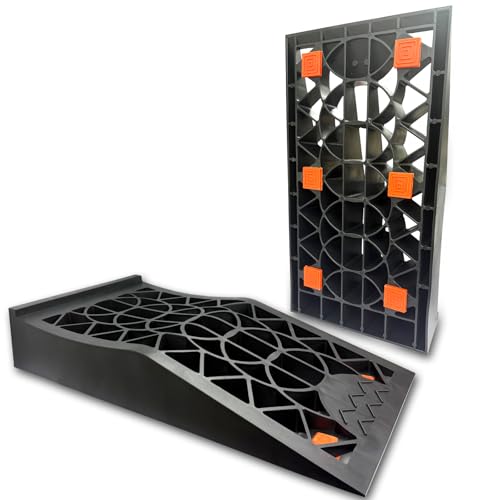
These compact portable ramps target a specific need in the car ramps for home garages category: creating modest clearance for low-profile cars. A gentle approach, six rubber base pads, and a textured tread are intended to make positioning easier without requiring a tall service ramp.
Best For: Lowered or low-clearance sedans and coupes needing limited lift for jack access and routine maintenance.
Pros:
- Low 3.15-inch lift and gentle approach suit low-clearance vehicles.
- Six high-grip rubber pads help reduce sliding on smooth garage floors.
- Textured tread and a curved wheel stop support controlled positioning.
- Compact, stackable design weighs 5.9 pounds and is easy to store.
Cons:
- The stated 5,500-pound capacity per pair is lower than the other listed ramps.
- The 9.4-inch maximum tire width limits fitment for some vehicles.
- The 3.15-inch lift provides less underbody clearance than taller ramps.
Choose this set when approach angle and storage convenience are more important than maximum lift. Its specifications are particularly aligned with low cars that need just enough room for a floor jack or light maintenance access.
Tall Garage Service Pick – Garvee 6.7-Inch Ramps
The Garvee Low Profile Plastic Car Service Ramps offer a taller 6.7-inch lift for drivers comparing car ramps for home garages. Their anti-slip base, 17-degree incline, and stated 12,000-pound total vehicle capacity are aimed at convenient routine service work.
Best For: Home-garage users who want substantial clearance for oil changes and other under-vehicle maintenance.
Pros:
- Provides a 6.7-inch lift for improved underside access.
- Rated for vehicles up to 12,000 pounds.
- Anti-slip base is designed to help reduce movement.
- 17-degree incline is intended to ease entry for low-clearance vehicles.
Cons:
- Maximum tire width is 9 inches, limiting fitment for some vehicles.
- The 6.7-inch lift may be more than needed for tasks requiring only minimal clearance.
- The supplied dimensions indicate a relatively large ramp footprint for storage.
Garvee makes sense for shoppers seeking a high-lift service ramp with a substantial stated capacity. Confirm tire width and available garage storage space before choosing this set.
Best Overall Value – Portable 6-Inch Car Ramps
For shoppers comparing car ramps for home garages, the PR1ME pair offers a practical balance of capacity, clearance, and portability. Its 6-inch rise provides useful access for oil changes and underbody work, while the stackable polypropylene construction is suited to regular DIY maintenance.
Best For: Home mechanics who need lightweight ramps for cars, SUVs, vans, and light trucks.
Pros:
- Supports up to 9,500 pounds GVW as a pair.
- Textured tire platform and rubberized feet help reduce slipping.
- Stackable, relatively lightweight design stores easily.
- Wide track accommodates vehicles ranging from compact cars to light trucks.
Cons:
- The 6-inch lift is lower than some heavy-duty alternatives.
- Plastic construction may be less suitable for buyers seeking metal ramps.
The PR1ME ramps are a sensible choice when easy handling and storage matter as much as lifting capacity. They provide dependable everyday clearance without taking up excessive garage space.
Best for Tight Garages – 16,000-Pound Stackable Ramps
These stackable car ramps for home garages emphasize high capacity and efficient storage. The 7.3-inch lift is useful for oil changes and inspections, while the interlocking design reduces the storage footprint by 50% compared with traditional ramps.
Best For: Owners of full-size pickups, SUVs, and vans who need substantial capacity and compact storage.
Pros:
- Pair is rated for up to 16,000 pounds.
- 7.3-inch lift and 17-degree incline provide increased underbody clearance.
- Stackable design helps save garage or trunk space.
- 18 rubber feet per ramp and aggressive tread support traction and stability.
Cons:
- Its larger capacity may be more than needed for smaller vehicles.
- Plastic construction may not appeal to buyers who prefer steel equipment.
With its unusually high stated capacity, multiple anti-slip feet, and storage-focused design, this pair stands out for demanding vehicles and crowded workspaces. The raised stop curbs also provide tactile alignment feedback when driving onto the ramps.
Best Adjustable Lift – Hydraulic Vehicle Service Ramps
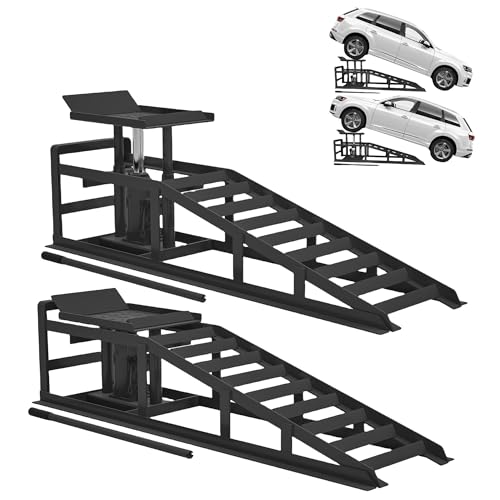
For buyers who want adjustable height rather than a fixed drive-up platform, these hydraulic car ramps for home garages offer a more flexible setup. Dual hydraulic cylinders and the included hydraulic jack adjust the lift from 11.61 to 16.21 inches for repairs and inspections beneath cars, trucks, and trailers.
Best For: DIYers and professionals who need significantly adjustable clearance for varied under-vehicle work.
Pros:
- Hydraulic adjustment provides 11.61 to 16.21 inches of lift.
- Rated for up to 5 tons, or approximately 11,000 pounds.
- Includes a hydraulic jack and uses a 9.5-inch-wide platform.
- Designed for cars, trucks, trailers, home garages, and professional shops.
Cons:
- At 83.8 pounds, the set is substantially heavier than portable plastic ramps.
- Its larger dimensions may be less convenient for compact storage.
- The hydraulic mechanism adds complexity compared with fixed ramps.
This is the most versatile option of the three when adjustable height is a priority. Its heavier, larger design is better suited to a dedicated garage workspace than frequent transport.
Heavy-Duty Hydraulic Pick – 5-Ton Hydraulic Car Ramps
For shoppers comparing car ramps for home garages, this welded-steel hydraulic set combines substantial capacity with adjustable lifting height. The pair supports up to 11,065 pounds and raises vehicles from 9 to 14.3 inches, making it suited to oil changes and undercarriage work.
Best For: DIY users who need high-capacity hydraulic ramps for trucks, SUVs, and heavier home-garage repairs.
Pros:
- Reinforced welded alloy-steel construction with a protective coating.
- Dual 5-ton hydraulic pumps support loads up to 11,065 pounds.
- Adjustable 9- to 14.3-inch lift range.
- Anti-slip treads and automatic locking mechanisms add stability.
Cons:
- The 45-inch length and steel construction may require dedicated storage space.
- Hydraulic lifting requires setup on level ground and proper wheel positioning.
This is the most capable option of the three for substantial lifting needs. Its safety features and broad height range are practical advantages, though its heavy-duty construction is less portable than lightweight plastic ramps.
Low-Profile Maintenance Pick – 5-Ton Hydraulic Car Ramps
These car ramps for home garages offer hydraulic lifting in a low-profile format, with an 11,000-pound pair capacity and a 10.6- to 14.7-inch lift range. They are designed for routine maintenance such as oil changes and tire rotations while remaining compact enough for garage use.
Best For: Home mechanics seeking a high-capacity hydraulic ramp pair with a low-profile design and straightforward assembly.
Pros:
- Supports up to 11,000 pounds as a pair.
- Hydraulic system helps raise vehicles to the desired height.
- 10.6- to 14.7-inch lift range provides undercarriage access.
- Pin lock and alloy-steel construction support secure, repeated use.
Cons:
- At about 80 pounds, the pair is not especially easy to move.
- The 47-inch length may need more storage room than smaller ramps.
This set balances a substantial load rating with useful hydraulic height adjustment. It is a practical middle ground for garage maintenance, especially if you value lifting range and capacity more than portability.
Low-Chassis Portable Pick – 2.6-Inch Plastic Car Ramps
For low-clearance vehicles, these compact car ramps for home garages provide a 2.6-inch lift with a 17-degree slope. The lightweight polypropylene pair weighs 5.3 pounds, making it easy to carry and store while creating room to position a jack beneath a low chassis.
Best For: Low-profile cars, sports cars, and tuners needing modest lift and portable garage access ramps.
Pros:
- Low 2.6-inch lift is designed for low-chassis vehicles.
- Wide 10-inch footprint accommodates wider modified tires.
- Honeycomb traction pattern, curved sides, drainage, and bottom pads improve grip.
- Lightweight 5.3-pound pair is easy to carry and store.
Cons:
- The 2.6-inch lift may not provide enough elevation for every repair task.
- Plastic construction is intended for low-profile access rather than high lifting.
- Vehicle ground clearance and maintenance needs must be checked before purchase.
This is the most portable choice and the most specialized. It works well when a small amount of extra clearance is enough, but shoppers needing substantial undercarriage room should choose one of the hydraulic steel alternatives.
How We Picked the Best Car Ramps for Home Garages
We evaluated these ramps by looking at stated weight capacity, lift height, ramp profile, construction, traction features, portability, storage design, and intended use. We also considered whether each style is better suited to low-clearance cars, larger vehicles, routine oil changes, or heavier garage work.
Capacity figures should be treated as a starting point, not a reason to operate at the absolute limit. Always account for the vehicle’s loaded weight, axle distribution, ramp placement, floor condition, and the manufacturer’s safety instructions.
Quick Comparison
| Ramp Type | Best For | Main Advantage | Potential Trade-Off |
|---|---|---|---|
| Standard plastic or steel ramps | Routine maintenance | Simple setup and lower cost | Fixed lift height |
| Low-profile ramps | Sports cars and low vehicles | Easier approach angle | May provide less underbody clearance |
| Stackable ramps | Small garages | Efficient storage | May require careful alignment |
| Hydraulic ramps | Adjustable-height service | More lift flexibility | Heavier, more complex, and typically costlier |
Key Buying Factors for Car Ramps for Home Garages
Weight Capacity
Check the ramp’s gross vehicle weight rating and compare it with your vehicle’s full operating weight, not just its curb weight. Leave a meaningful safety margin, especially for trucks, SUVs, trailers, or vehicles carrying tools and cargo.
Lift Height and Clearance
Measure the clearance you need for the job. A low-profile ramp may be ideal for vehicles with limited approach clearance, while a taller or hydraulic ramp can provide more room for drains, exhaust work, and inspections.
Construction and Traction
Steel ramps generally offer high strength but add weight. Reinforced plastic ramps are easier to move and resist corrosion. Look for deep grooves, textured surfaces, retaining lips, and a design that keeps the tire centered during ascent.
Floor and Vehicle Compatibility
Use ramps on a hard, level, clean surface. Confirm that the ramp width accommodates the tires and that the approach angle does not cause bumper, splitter, or underbody contact. Wheel chocks may add security, but they do not replace proper ramp positioning.
Storage and Setup
Stackable or compact ramps are useful when garage space is limited. Hydraulic models can offer adjustable height, but their extra components require more storage and inspection. Choose a pair you can safely position without straining or improvising.
Who Should Buy Which Car Ramps for Home Garages?
Choose standard heavy-duty ramps for straightforward oil changes and general maintenance on ordinary cars, crossovers, and trucks. Choose low-profile ramps if your vehicle has a low front bumper or reduced ground clearance. Choose stackable ramps when storage space matters most. Choose hydraulic ramps if adjustable height and additional clearance justify their greater weight and complexity.
Before every use, inspect the ramps for cracks, bent parts, damaged hydraulic components, or worn traction surfaces. Drive on slowly, center the tires, set the parking brake, and verify stability before working beneath the vehicle. Never rely on ramps alone if the manufacturer requires additional supports or safety equipment.