
Choosing the right equalizer can make a live system clearer, more balanced, and easier to control under changing room conditions. The best option depends on your channel count, feedback strategy, control preferences, and available rack space.
This roundup compares 10 audio equalizers for live sound, including dual-channel graphic EQs, automatic feedback processors, spectrum analyzers, and compact budget-friendly units.
Best 10 Audio Equalizers for Live Sound Picks for 2026
Flexible Graphic Control
Behringer FBQ3102HD 31-Band Equalizer

- 31-band stereo graphic EQ
- Sweepable high- and low-cut filters
- FBQ feedback detection and subwoofer output
Best For: Live rigs needing detailed EQ and system flexibility
Visual Monitoring Specialist
Nobsound AK2515 Spectrum Analyzer

- 25x15 VFD spectrum display
- 20Hz–20kHz frequency coverage
- MIC and AUX inputs with adjustable modes
Best For: Visual sound monitoring and frequency analysis
Classic Dual-Channel Control

- Dual 31-band constant-Q EQ
- Selectable 6 or 12dB boost/cut
- XLR and 1/4-inch TRS I/O
Best For: Traditional dual-channel live-sound EQ
Automatic Feedback Control
Behringer FBQ2496 Feedback Destroyer

- 40 automatic FBQ filters
- Single-shot filter locking mode
- Parametric EQ with 96kHz performance
Best For: Live systems prioritizing fast feedback suppression
Feature-Rich Rack Hub
EQ8100 20-Band Graphic Equalizer
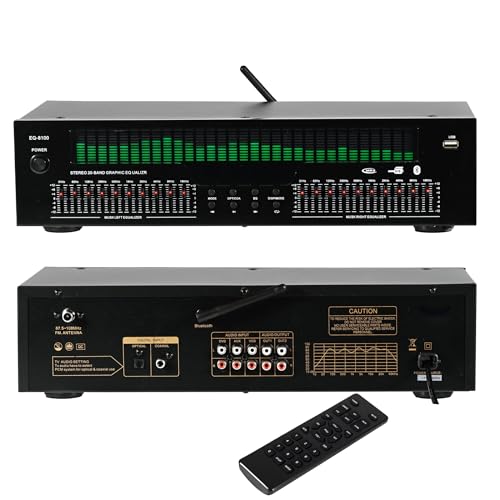
- 20-band EQ with 31-band spectrum display
- Optical, coaxial, USB, Bluetooth, and RCA connectivity
- Slim 1U aluminum chassis with presets
Best For: Flexible stage, studio, DJ, and home audio systems
Professional Dual-Channel Control

- 31 bands per channel with up to ±12 dB adjustment
- Low-cut filter reduces rumble, wind noise, and hum
- XLR and 1/4-inch TRS input/output options
Best For: Live rigs, installations, and studios needing detailed stereo EQ
Subwoofer-Ready Live Tuning
15-Band Stereo EQ with Sub Out
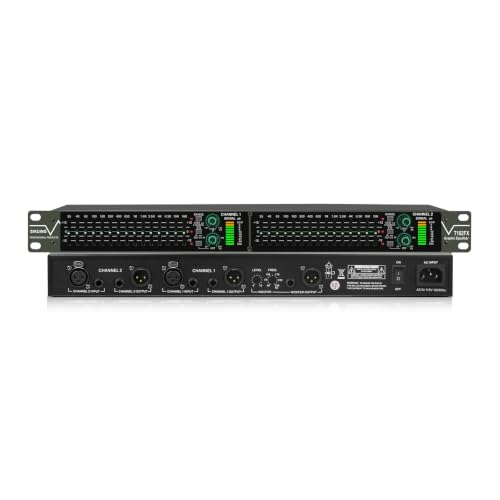
- 15-band dual-channel EQ from 25 Hz to 16 kHz
- Adjustable dedicated subwoofer output from 50–250 Hz
- 1U metal chassis with LED metering and rack kit
Best For: Compact live systems needing stereo EQ and subwoofer control
Feature-Rich Choice
31-Band Bluetooth Graphic Equalizer

- 31-band control with spectrum monitoring
- 12 customizable modes and noise reduction
- Optical, coaxial, and USB connectivity
Best For: Flexible live, studio, DJ, and home audio setups
Rackmount Workhorse
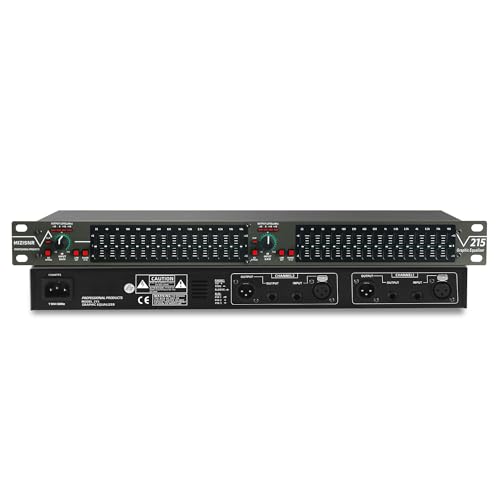
- 15 bands per channel with ±12 dB range
- Low-cut filter reduces unwanted low-frequency noise
- XLR and 1/4-inch TRS connectivity
Best For: Live applications, installations, and studio racks
Subwoofer Control Pick

- 15-band dual-channel EQ with ±12 dB range
- Adjustable low-cut frequency control
- Dedicated adjustable bass output
Best For: Live and installed systems with subwoofer integration
Flexible Graphic Control – Behringer FBQ3102HD 31-Band Equalizer
For live sound setups that need detailed tonal shaping, the Behringer ULTRAGRAPH PRO FBQ3102HD combines dual-channel 31-band graphic equalization with sweepable high- and low-cut filters. Its FBQ feedback detection system can help identify critical frequencies, while the dedicated mono subwoofer output adds useful system-routing flexibility.
Best For: Live sound systems requiring detailed stereo EQ, feedback identification, and subwoofer integration.
Pros:
- 31-band stereo graphic equalization provides fine frequency control.
- High- and low-cut filters help remove unwanted rumble and hiss.
- Dedicated mono subwoofer output has an adjustable crossover frequency.
- FBQ system can reveal critical frequencies and function as an audio analyzer.
Cons:
- Rack-style dimensions may be more equipment than compact setups need.
- The supplied details identify analog signal formatting rather than digital processing.
This is a strong all-around choice among audio equalizers for live sound when you want hands-on stereo shaping plus practical filtering and subwoofer control in one rack unit.
Visual Monitoring Specialist – Nobsound AK2515 Spectrum Analyzer
The Nobsound AK2515 is primarily a visual monitoring tool rather than a conventional equalizer. Its 25×15 VFD display, 20Hz–20kHz frequency coverage, MIC and AUX inputs, and adjustable gain and display modes make it useful for observing sound behavior while configuring audio equalizers for live sound.
Best For: Musicians and audio enthusiasts who want visual spectrum and level monitoring with flexible display customization.
Pros:
- 25×15 VFD display provides detailed frequency-band visualization.
- Supports a broad 20Hz–20kHz frequency range.
- MIC and 3.5mm AUX inputs accommodate different monitoring sources.
- Adjustable gain, filtering, brightness, and display modes offer customization.
Cons:
- It is a spectrum analyzer and sound-level meter, not a traditional 31-band EQ.
- Its numerous display settings may be unnecessary for simple live setups.
Choose the AK2515 when visual feedback is the priority. It can complement live-sound EQ work by making frequency activity easier to observe, but it does not replace a dedicated equalizer.
Classic Dual-Channel Control – dbx 231s 31-Band Equalizer
The dbx 231s offers straightforward, rack-ready control for live sound applications. Its dual 31-band, 1/3-octave constant-Q design supports precise frequency adjustments, while selectable 6 or 12dB boost/cut ranges, front-panel bypass, and multiple balanced connector options suit conventional professional signal chains.
Best For: Live sound engineers who want a traditional dual-channel graphic EQ with clear level monitoring and flexible I/O.
Pros:
- Two independent 31-band channels provide detailed stereo or dual-mono control.
- Constant-Q 1/3-octave bands support predictable adjustments.
- Selectable 6 or 12dB boost/cut ranges accommodate different correction needs.
- XLR and 1/4-inch TRS inputs and outputs support varied connections.
Cons:
- It lacks the automatic feedback features listed for the FBQ2496.
- Its 7.9-pound rack-unit format may not suit highly portable rigs.
The 231s is a dependable fit for buyers seeking conventional audio equalizers for live sound, especially when hands-on dual-channel control and familiar rack connections matter more than automated processing.
Automatic Feedback Control – Behringer FBQ2496 Feedback Destroyer
The Behringer FBQ2496 focuses on fast feedback suppression and parametric EQ rather than broad graphic equalization. Its 40 FBQ filters, 96kHz audio performance, automatic detection, and single-shot mode make it a practical processing option for live sound systems where feedback control is a central concern.
Best For: Live performers and sound operators who need automatic feedback detection and locked filters for quick setup.
Pros:
- Up to 40 FBQ filters target problematic feedback frequencies.
- Single-shot mode detects feedback and locks filters until manually reset.
- Set-and-forget operation and a Panic button support fast intervention.
- Provides parametric EQ with 96kHz audio performance.
Cons:
- It is designed for feedback suppression and parametric EQ, not 31-band graphic control.
- Its specialized feature set may be excessive for systems without feedback issues.
For live rigs where microphone feedback can disrupt a performance, the FBQ2496 is a focused companion to other audio equalizers for live sound, offering automated control instead of relying solely on manual frequency hunting.
Feature-Rich Rack Hub – EQ8100 20-Band Graphic Equalizer
For buyers comparing audio equalizers for live sound, the EQ8100 combines 20-band graphic control with a 31-band real-time spectrum analyzer. Its optical, coaxial, USB, Bluetooth, and RCA connectivity makes it adaptable to stage, studio, DJ, and home audio systems.
Best For: Mobile DJs, stage setups, studios, and users who want visual spectrum monitoring alongside flexible digital and analog connectivity.
Pros:
- 20-band graphic equalization with 12 customizable modes and auto-save presets.
- 31-band spectrum display helps monitor frequency levels in real time.
- Supports optical, coaxial, USB, Bluetooth, and RCA connections.
- Ultra-thin 1U aluminum chassis suits portable or rack-mounted installations.
Cons:
- The feature set may be more extensive than necessary for a basic analog live rig.
- Supplied dimensions are listed as 19 inches in each direction, so verify rack-fit details before installation.
The EQ8100 stands out when connectivity and visual feedback matter as much as hands-on EQ adjustment. It is a versatile choice for users moving between live sound, recording, and home audio applications.
Professional Dual-Channel Control – EQ-231 31-Band Stereo EQ
The EQ-231 is a practical option among audio equalizers for live sound when detailed dual-channel control is required. Each stereo channel provides 31 adjustable bands, while balanced XLR and unbalanced 1/4-inch TRS connections support varied live, installation, and studio configurations.
Best For: Live applications, permanent audio installations, and studios needing extensive stereo frequency adjustment and straightforward monitoring.
Pros:
- Dual-channel 31-band design offers detailed stereo shaping.
- Adjustable range of up to ±12 dB per band provides substantial control.
- Low-cut switch helps reduce wind noise, rumble, and electrical hum.
- Includes bypass control and four-segment LED monitoring for easier troubleshooting.
Cons:
- It does not list a dedicated subwoofer output.
- The extensive 31-band layout may require more setup time than a simpler equalizer.
With its broad adjustment range, low-cut filtering, and mixed balanced/unbalanced I/O, the EQ-231 is suited to users who prioritize precise stereo system tuning over extra digital features.
Subwoofer-Ready Live Tuning – 15-Band Stereo EQ with Sub Out
This 15-band stereo equalizer is a focused choice among audio equalizers for live sound, combining feedback control, low-cut filtering, and an independent adjustable subwoofer output. Its dual-channel design and rack-mountable metal chassis keep the setup practical for live systems and studios.
Best For: Live sound users who need straightforward stereo EQ, subwoofer management, and clear signal-level monitoring in a compact rack unit.
Pros:
- Independent 15-band channels cover 25 Hz to 16 kHz.
- Dedicated subwoofer output supports adjustment from 50 Hz to 250 Hz.
- Low-cut filter, EQ bypass, clip light, and multi-segment LED metering aid live setup.
- Full-metal 1U chassis includes rack-mounting brackets.
Cons:
- Provides fewer EQ bands than the 31-band alternatives in this roundup.
- Connectivity is analog, using XLR and TRS ports rather than digital inputs.
The T102FX is a sensible pick when bass-system integration is important. Its dedicated sub output and monitoring features offer useful control without adding the broader digital connectivity found on more feature-heavy models.
Feature-Rich Choice – 31-Band Bluetooth Graphic Equalizer
For shoppers comparing audio equalizers for live sound, this 31-band graphic equalizer offers detailed frequency shaping plus real-time spectrum monitoring. Its customizable modes, noise reduction, and broad connectivity make it adaptable to live stages, DJ setups, studios, and home systems.
Best For: Users who want extensive EQ control, spectrum visualization, and flexible device connectivity.
Pros:
- 31 independently adjustable bands cover bass through treble.
- Real-time spectrum analyzer and 12 customizable modes support quick adjustments.
- Optical, coaxial, and USB connectivity supports multiple audio sources.
- Portable design suits gigs, DJ events, studios, and home entertainment setups.
Cons:
- The many controls and features may be more than casual listeners need.
- The supplied notes do not specify detailed input/output connector types beyond optical, coaxial, and USB.
This is the most feature-heavy option in the group. Choose it when visual monitoring, numerous adjustment bands, and multi-device connectivity matter more than a straightforward rack-only design.
Rackmount Workhorse – 15-Band Dual-Channel EQ-215
This 15-band dual-channel unit is a practical option for audio equalizers for live sound, installations, and studio systems. Its balanced XLR and unbalanced 1/4-inch connections, low-cut filter, bypass switch, and 1U rack format focus on dependable signal shaping and integration.
Best For: Live applications, fixed installations, and studios needing a conventional 1U dual-channel equalizer.
Pros:
- Provides 15 adjustable bands per channel with up to ±12 dB adjustment.
- Low-cut switch helps reduce wind noise, floor rumble, and electrical hum.
- XLR balanced and 1/4-inch TRS unbalanced inputs and outputs support varied systems.
- Bypass switch simplifies troubleshooting and machine debugging.
Cons:
- Offers fewer bands than the 31-band model in this roundup.
- It does not list a dedicated subwoofer output.
With a standard 1U rack-mount footprint and conventional connections, the EQ-215 is well suited to users who prefer hands-on controls and straightforward signal-chain installation.
Subwoofer Control Pick – EQX-215S 15-Band Stereo EQ
For audio equalizers for live sound that need additional low-end routing, the EQX-215S combines dual 15-band control with an adjustable low-cut frequency and dedicated bass output. Its rack-ready design and XLR/TRS connectivity make it suitable for live events, studios, and installations.
Best For: Systems that need precise stereo EQ plus dedicated, adjustable subwoofer or bass-output control.
Pros:
- Provides 15 adjustable bands per channel with a ±12 dB range.
- Adjustable low-cut frequency offers more control than a fixed low-cut switch.
- Dedicated bass output has adjustable frequency for low-end management.
- Includes XLR and 1/4-inch TRS cables and carries a listed two-year warranty.
Cons:
- Its 15-band layout provides less frequency detail than a 31-band equalizer.
- The dedicated bass output may be unnecessary for simpler stereo systems.
The EQX-215S stands out when subwoofer integration is a priority. Its adjustable low-cut and bass-output controls give live and installation systems more low-frequency flexibility while retaining a familiar 1U rack format.
How We Picked These Audio Equalizers for Live Sound
We selected products across the main categories used in live audio: traditional graphic equalizers, automatic feedback suppression processors, spectrum-analysis tools, and affordable DJ or home-audio rack units. We considered the number of bands, channel configuration, feedback-control features, display or monitoring options, connectivity, rack compatibility, and likely use case.
Because specifications and build quality vary widely, buyers should verify the exact inputs, outputs, operating level, and included accessories before ordering. Some models are better suited to professional balanced systems, while others are more appropriate for smaller stages, rehearsal rooms, DJs, or home setups.
Quick Comparison
| Type | Best For | What to Look For |
|---|---|---|
| 31-band graphic EQ | Detailed system tuning | Balanced I/O, fader range, bypass, and rugged controls |
| 15- or 20-band EQ | Simple tonal shaping | Useful frequency spacing, low noise, and easy operation |
| Feedback processor | Fast feedback control | Automatic filters, filter count, resolution, and response time |
| Spectrum analyzer | Visual monitoring | Accurate display, microphone input, AGC, and readable metering |
| DJ or home-audio EQ | Budget systems | Input compatibility, subwoofer output, Bluetooth features, and noise performance |
Key Buying Factors for Audio Equalizers for Live Sound
Band Count and Control Style
More bands provide finer correction, especially when taming room resonances or feedback. A 31-band unit offers precise adjustment, while a 15- or 20-band model can be faster to operate and sufficient for smaller systems.
Graphic EQ Versus Automatic Feedback Control
A graphic equalizer gives the engineer direct, predictable control. An automatic feedback processor can identify and notch problem frequencies quickly, making it useful for speech, inexperienced operators, or fast-moving events. It should complement—not replace—proper microphone placement, gain structure, and monitor positioning.
Connections, Noise, and System Matching
Check whether the unit uses balanced XLR or TRS connections, unbalanced RCA inputs, or a mixture. Professional mixers and amplifiers generally benefit from balanced signal paths. Also consider maximum input level, bypass behavior, noise reduction, and whether the unit supports stereo linking or independent channels.
Rack Space and Visibility
For touring or installed systems, a sturdy 1U rack design, clear markings, and reliable switches matter. Bright spectrum displays can help in dark venues, but unnecessary visual features should not outweigh signal quality and compatibility.
Who Should Buy Which Audio Equalizers for Live Sound?
Live engineers and bands: Choose a dependable dual-channel 31-band graphic EQ for detailed main or monitor tuning.
Venues and speech systems: Consider an automatic feedback processor when rapid, repeatable feedback suppression is a priority.
Sound hobbyists and small DJs: A 15- or 20-band unit with straightforward controls may deliver the needed tonal shaping at lower cost.
Technicians who need visual diagnosis: Pick a spectrum analyzer with a clear display and suitable microphone or line-level input.
Home, rehearsal, and hybrid systems: Models with Bluetooth, subwoofer outputs, or consumer-style connections can be convenient, but confirm they integrate cleanly with the rest of the signal chain.