
Adding an amplifier to a factory stereo can deliver louder, cleaner sound without requiring a complete dashboard upgrade. The right model can restore headroom, improve speaker control, and add power for a subwoofer or upgraded door speakers.
These 10 options cover compact two-channel amps, flexible four-channel designs, and dedicated monoblocks. Before choosing, confirm your vehicle’s wiring, speaker impedance, available mounting space, and whether the amplifier can accept your factory system’s signal.
Best 10 Car Amplifiers for Factory Stereos Picks for 2026
Balanced Four-Channel Upgrade

- Four-channel Class AB design
- 60W RMS x 4 at 4 ohms
- Variable high-/low-pass filters
Best For: Flexible front/rear speaker upgrades
Dedicated Bass Power

- Single-channel Class AB design
- 1100W max at 2 ohms
- RCA and speaker-level inputs
Best For: Adding a powered subwoofer to a factory system
Factory-Radio Integration Pick

- High-level inputs with auto turn-on
- 4 x 110W RMS at 2 ohms
- Class D, bridgeable four-channel design
Best For: Keeping a factory radio while upgrading multiple speakers
Simple Two-Channel Upgrade

- Two-channel Class AB design
- 60W RMS x 2 at 2 ohms
- Automatic signal sensing and turn-on
Best For: Straightforward two-speaker or bridged upgrades
Best Flexible Upgrade

- 400W RMS Class D output
- High-level auto turn-on for OEM stereos
- Four channels with built-in crossover
Best For: Flexible factory-stereo and aftermarket upgrades
Best Straightforward Four-Channel Value

- Four-channel Class A/B design
- Supports 2- to 8-ohm speakers
- Full-range operation for speakers and subwoofer
Best For: Basic multi-speaker system upgrades
Best Compact Two-Channel Option

- Bridgeable two-channel design
- Bass boost, crossover, and subsonic controls
- Slim chassis with protection circuits
Best For: Compact RCA-based speaker or subwoofer installations
Best OEM Upgrade
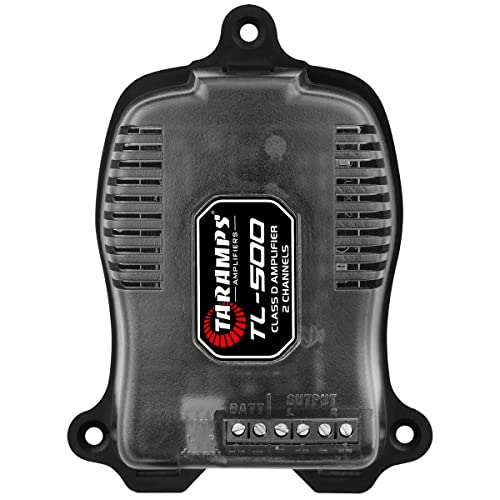
- 2 x 45W RMS at 2 ohms
- Works with factory audio signals
- Built-in thermal and short-circuit protection
Best For: Door-speaker upgrades using the original radio
Best Four-Channel Option
GoolRC 80Wx4 Full-Range Amplifier

- Four-channel full-range design
- Listed 80W x 4 configuration
- Aluminum-alloy construction
Best For: Android car players needing four amplified channels
Best Compact Budget Pick

- Compact two-channel chassis
- 100W maximum output
- Six-year parts-and-labor warranty
Best For: Space-limited basic two-channel installations
Balanced Four-Channel Upgrade – Pioneer GM-A6704
Pioneer GM-A6704 1000W Max Class AB Bridgeable 4-Channel Car Amplifier | High-/Low-Pass Filters
Check Price On AmazonFor drivers seeking car amplifiers for factory stereos, the Pioneer GM-A6704 offers a versatile four-channel setup with high- and low-pass filters. Its Class AB design provides 60 watts RMS per channel at 4 ohms, with additional bridging flexibility for a more customized system.
Best For: Factory-stereo upgrades that need front/rear speaker control or a flexible speaker-and-subwoofer configuration.
Pros:
- Four channels support front/rear speaker balancing and varied system layouts.
- Delivers 60 watts RMS x 4 at 4 ohms or 190 watts RMS x 2 bridged.
- Variable high- and low-pass filters help tailor frequency ranges.
- Class AB design is intended to balance performance and efficiency.
Cons:
- Its 4.9-pound, 14-inch-wide chassis may require careful installation planning.
- Class AB operation may be less compact or efficient than a Class D alternative.
The GM-A6704 is a practical choice when you want more than a simple two-channel boost. Its channel count and filtering make it especially adaptable for phased audio upgrades.
Dedicated Bass Power – BOSS R1100M Monoblock
The BOSS Audio Systems R1100M is a monoblock option for car amplifiers for factory stereos when the main goal is adding power to a subwoofer. It accepts both RCA and speaker-level inputs, helping it work with a range of factory or aftermarket audio sources.
Best For: Bass-focused systems using a subwoofer and a compatible 2-ohm or 4-ohm load.
Pros:
- Monoblock design dedicates one channel to subwoofer power.
- Rated at 1100 watts maximum at 2 ohms and 550 watts maximum at 4 ohms.
- Speaker-level inputs can simplify connection to a factory radio.
- Includes low-pass filtering, bass boost, and a remote subwoofer control.
Cons:
- Single-channel design is not intended to power a full-range speaker system.
- Its listed output is maximum power rather than RMS power.
- Professional installation is strongly encouraged by the manufacturer.
With protection circuits and subwoofer-oriented controls, the R1100M is best viewed as a dedicated bass-building component rather than an all-purpose amplifier.
Factory-Radio Integration Pick – Taramps DS 440X4
The Taramps DS 440X4 is designed specifically for straightforward car amplifiers for factory stereos integration. Its high-level speaker inputs and automatic turn-on can help retain the factory radio, while four channels and full-range controls support broader system upgrades.
Best For: Factory-radio installations needing compact, efficient four-channel amplification without extra input converters.
Pros:
- High-level inputs and automatic turn-on support factory-radio integration.
- Provides 4 x 110 watts RMS at 2 ohms or 2 x 220 watts bridged.
- HPF, LPF, full-range, and independent level controls offer setup flexibility.
- Class D design includes short-circuit protection.
Cons:
- The supplied notes do not specify physical dimensions or detailed installation hardware.
- Its 1-year manufacturer warranty is shorter than some competing warranty offerings.
The DS 440X4 stands out for factory integration and configuration flexibility. It is a strong fit when you want to keep the original radio while powering multiple speakers.
Simple Two-Channel Upgrade – Pioneer GM-A3702
The Pioneer GM-A3702 is a straightforward choice among car amplifiers for factory stereos when you need to power two speakers or bridge the amp for a single setup. It delivers 60 watts RMS per channel at 2 ohms and includes automatic signal sensing and turn-on.
Best For: Basic two-speaker upgrades or compact systems that may later use bridged output for bass.
Pros:
- Two-channel layout keeps installation and system planning relatively simple.
- Provides 60 watts RMS x 2 at 2 ohms or 190 watts RMS x 1 bridged.
- Automatic signal sensing and turn-on can suit factory-radio installations.
- Selectable low-pass filtering helps shape bass output.
Cons:
- Two channels offer less expansion flexibility than a four-channel amplifier.
- Class AB construction may be less space-efficient than a Class D design.
- Its maximum output rating is 500 watts, so it is aimed at modest system upgrades.
The GM-A3702 is a sensible entry point for adding cleaner, louder amplification without moving to a more complex multi-channel setup.
Best Flexible Upgrade – Taramps TS 400X4
The Taramps TS 400X4 is a practical choice among car amplifiers for factory stereos because its high-level auto turn-on input can work with OEM systems as well as aftermarket radios. Its compact Class D design provides four-channel flexibility for upgrading a vehicle’s speakers without requiring a complete audio-system replacement.
Best For: Drivers who want a compact, flexible amplifier for factory or aftermarket stereos, multiple speakers, or bridged channels.
Pros:
- Delivers 4 x 100W at 2 ohms or 2 x 200W bridged at 4 ohms.
- High-level auto turn-on and RCA inputs support OEM and aftermarket stereos.
- Built-in HPF, LPF, and full-range crossover modes support varied speaker setups.
Cons:
- Its 2-ohm and 4-ohm configuration options require careful system matching.
- The supplied details do not specify included wiring or installation accessories.
With four channels, bridgeable output, and crossover controls, the TS 400X4 is well suited to custom installations where space and input flexibility matter. Its one-year manufacturer warranty is shorter than some competing options.
Best Straightforward Four-Channel Value – BOSS R1004 Riot
The BOSS Audio Systems R1004 Riot is a straightforward four-channel option for shoppers comparing car amplifiers for factory stereos. It offers high-level system flexibility through full-range operation and can power speakers at 2 to 8 ohms, making it suitable for basic multi-speaker upgrades when the installation is matched correctly.
Best For: Budget-minded buyers seeking a conventional four-channel amplifier for speakers and a possible subwoofer setup.
Pros:
- Rated at 100 watts maximum per channel at 2 ohms or 50 watts at 4 ohms.
- Full-range operation can support speakers plus a subwoofer.
- Compact 7.75 x 9 x 2-inch design and a six-year parts-and-labor warranty for eligible purchases.
Cons:
- Class A/B topology is generally less compact and efficient than a Class D design.
- The supplied notes do not list a high-level input or automatic OEM turn-on feature.
- Warranty coverage is limited to products sold and shipped by Amazon.com.
The R1004 focuses on conventional four-channel amplification with broad speaker-impedance compatibility and full-range functionality. Confirm the factory stereo’s output connection requirements before choosing it for an OEM installation.
Best Compact Two-Channel Option – Pyle PLA2200
The Pyle PLA2200 is a compact two-channel amplifier for shoppers considering car amplifiers for factory stereos through a low-level RCA-based installation. It combines bridgeable output with gain, bass boost, crossover, and subsonic controls, giving users several ways to shape a small speaker or subwoofer system.
Best For: Space-conscious installations needing a two-channel amplifier with bridgeable output and adjustable bass controls.
Pros:
- Provides up to 1400 watts of advertised bridgeable output.
- Includes variable gain, switchable bass boost, crossover, and subsonic filtering.
- Thermal, overload, and short-circuit protection are built in, along with a slim 1.38-inch profile.
Cons:
- The supplied specifications do not provide RMS output figures.
- Its listed inputs are low-level RCA inputs, so factory-radio integration may require additional equipment.
- It is a two-channel design rather than a multi-channel speaker amplifier.
The PLA2200 makes the most sense when a slim chassis, bridgeable operation, and bass adjustment are priorities. Because the notes identify low-level inputs rather than high-level OEM inputs, verify compatibility with the factory stereo before purchasing.
Best OEM Upgrade – Taramps TL 500 2 Ohms
If you want car amplifiers for factory stereos without replacing the original radio, the Taramps TL 500 is a compact two-channel option designed for everyday door-speaker upgrades. It delivers 2 x 45W RMS at 2 ohms and can connect to factory audio signals without requiring RCA outputs.
Best For: Drivers upgrading factory door speakers while keeping the original head unit.
Pros:
- 90W RMS stereo output, rated at 2 x 45W RMS at 2 ohms
- Factory-radio-ready A.R.T. auto turn-on activates from the audio signal
- 80Hz-40kHz frequency response supports clear mids and detailed highs
- Thermal and output short-circuit protection are built in
Cons:
- Two-channel design is not suited to powering four separate channels
- 90-day warranty is shorter than some competing options
- Installation still requires appropriate wiring and mounting
The TL 500 is a straightforward choice for a modest OEM audio upgrade, particularly when simple factory-signal integration matters more than high-output system expansion.
Best Four-Channel Option – GoolRC 80Wx4 Full-Range Amplifier
The GoolRC full-range amplifier is a four-channel choice for car amplifiers for factory stereos and Android car-player systems. Its listed 80W x 4 configuration and Class A/B design provide a way to add amplification across four channels, though the supplied specifications do not describe factory-radio turn-on or RCA integration.
Best For: Android car-player installations needing four-channel amplification in an aluminum-alloy chassis.
Pros:
- Four-channel configuration supports broader system coverage
- Listed 80W x 4 output configuration
- Full-range amplifier design is intended for general audio use
- Aluminum-alloy construction is specified
Cons:
- Supplied notes do not confirm direct factory-radio integration
- Power details are listed as maximum output rather than RMS output
- Minimum and maximum supply voltage are both listed as 14.4 volts
This model is most compelling when a four-channel setup and Android-player compatibility are priorities. Verify signal connections and vehicle voltage requirements before installation.
Best Compact Budget Pick – BOSS Audio Systems CE102
The BOSS Audio Systems CE102 is a compact two-channel amplifier for shoppers considering car amplifiers for factory stereos or simple aftermarket upgrades. Its supplied specifications list 100W maximum output, a small chassis, and a broad 4- to 16-volt supply range.
Best For: Space-conscious installations that need a basic two-channel amplifier.
Pros:
- Compact 5.25 x 4.13 x 1.83-inch dimensions
- Two-channel configuration with 100W maximum output
- Listed 4- to 16-volt supply range
- Six-year parts-and-labor warranty is specified
Cons:
- Output is listed as maximum power, not RMS power
- Supplied notes do not confirm factory-signal or RCA integration features
- Professional installation is strongly advised
The CE102 makes sense for a small, uncomplicated two-channel installation, but buyers seeking confirmed OEM integration should verify compatibility and signal connections before ordering.
How We Picked These Car Amplifiers for Factory Stereos
We selected models across several common installation needs: powering factory or aftermarket speakers, driving a subwoofer, bridging channels for additional output, and fitting budget-conscious upgrades. We considered channel count, stated power ratings, impedance compatibility, amplifier topology, crossover flexibility, and the practical requirements of integrating an amp with an original head unit.
Power figures should be compared carefully. RMS output is more useful than maximum or peak wattage because it better represents sustained performance. Actual results also depend on the vehicle’s electrical system, speaker sensitivity, wiring, and installation quality.
Quick Comparison
| Best For | Recommended Type | Why It Matters |
|---|---|---|
| Front and rear speakers | Four-channel amplifier | Provides separate power to multiple speakers |
| One subwoofer | Monoblock amplifier | Designed for bass-focused output |
| Front speakers only | Two-channel amplifier | Simple installation with room for bridging |
| Small factory-system upgrade | Compact, lower-output amp | Easier mounting and lower electrical demand |
Key Buying Factors for Car Amplifiers for Factory Stereos
Signal Compatibility
Factory stereos often lack traditional RCA preamp outputs. Look for speaker-level inputs, or plan to use a line output converter. Some installations require a remote-turn-on adapter so the amplifier powers on with the original radio.
Channels and Power
Choose two channels for a pair of speakers or a bridged setup, four channels for front-and-rear speakers, and a monoblock for a dedicated subwoofer. Match the amplifier’s RMS output to the speakers’ RMS handling and verify the impedance before wiring.
Size, Cooling, and Installation
Measure the mounting area before buying. A compact amp may fit beneath a seat, while larger units need trunk space and better airflow. Use appropriately sized power and ground cables, protect the power wire with a fuse near the battery, and avoid mounting the amplifier where moisture or loose cargo can damage it.
Controls and System Tuning
Adjustable gain is essential, but it is not a volume control. Crossovers help keep deep bass away from small door speakers and can focus a monoblock on subwoofer frequencies. Bass boost should be used sparingly because excessive boost can cause clipping.
Who Should Buy Which Car Amplifiers for Factory Stereos?
Choose a four-channel model if you want balanced output for a complete speaker upgrade. A two-channel amplifier suits a simpler front-stage installation or a bridged pair of speakers. Select the monoblock option when your primary goal is powering a subwoofer. For a modest factory-stereo improvement, prioritize compact dimensions, speaker-level integration, and conservative RMS output over impressive peak-wattage claims.