
Sharing a monitor mix with several musicians or listeners does not require a large console or expensive headphone system. The best headphone distribution amplifiers under $500 provide multiple outputs, dependable level control, and the connectivity needed for studios, rehearsal spaces, classrooms, and live setups.
This roundup compares compact four-channel splitters, higher-capacity rack-style units, and flexible stereo or mono designs so you can choose the right balance of output count, control, durability, and value.
Best 10 Headphone Distribution Amplifiers Under 500 Picks for 2026
Best for Large Monitoring Setups

- Eight headphone channels
- Professional stage and studio design
- TRS input and output connectivity
Best For: Large recording sessions and stage monitoring
Best Compact Four-Way Splitter
- Four individually controlled outputs
- Compact metal construction
- 12V adapter included
Best For: Small studios and four-person monitoring
Best Simple Session Splitter
Mackie HM-4 Headphone Amplifier

- Four independent headphone outputs
- Individual level controls
- Compact metal enclosure
Best For: Tracking sessions and rehearsals
Best for Bass Boost and Flexible Connections
LZSIG LHA2 4-Channel Headphone Amp
- Four independently controlled outputs
- 3.5mm and 6.35mm compatibility
- Stereo/mono switch and bass boost
Best For: Flexible home-studio monitoring
Best Budget Pick

- Four independent stereo headphone outputs
- Low-noise amplification with dedicated level controls
- Ultra-compact design with 12V adapter included
Best For: Home studios and four-person monitoring sessions
Most Flexible Outputs

- Eight outputs across 3.5mm and 6.35mm jacks
- Mono/stereo switch for varied monitoring needs
- Compact metal housing with illuminated volume control
Best For: Small groups using mixed headphone connector sizes
Best USB-Powered Option

- Eight headphone connections in four channels
- Individual volume controls plus stereo/mono switching
- Compact metal housing with USB-A power
Best For: Studios, podcasts, and portable USB-powered monitoring
Best Flexible Splitter
8-Channel Stereo Headphone Amp

- Eight independently controlled stereo outputs
- Mono/stereo switch and audio distribution
- Includes nine 1/4-inch-to-3.5mm adapters
Best For: Home studios and shared-source recording setups
Best for Professional Monitoring
8-Channel Mixing Distribution Amp

- Eight channels and 16 headphone outputs
- Mono/stereo modes with dual input routing
- 1U rack mount and LED meters
Best For: Studio and live-sound monitoring racks
Best Compact Option
Pyle PHA40 4-Channel Headphone Amp

- Supports four headphones at once
- Independent volume for every output
- Small, portable 1/4-inch TRS design
Best For: Small sessions and portable monitoring
Best for Large Monitoring Setups – Behringer HA8000 V2
The Behringer HA8000 V2 is a practical choice when you need headphone distribution amplifiers under 500 for a stage or studio setup with many listeners. Its eight channels, TRS connectivity, and corded design make it suited to professional monitoring applications.
Best For: Studios, stages, and sessions that need up to eight headphone outputs.
Pros:
- Provides eight independent headphone channels.
- Designed for professional stage and studio applications.
- Uses TRS inputs and outputs for compatible audio equipment.
Cons:
- Its larger eight-channel format may be more than a small setup needs.
- Requires corded power.
The HA8000 V2 stands out among headphone distribution amplifiers under 500 for capacity. Choose it when your priority is connecting many headphones in a professional environment rather than keeping the system especially compact.
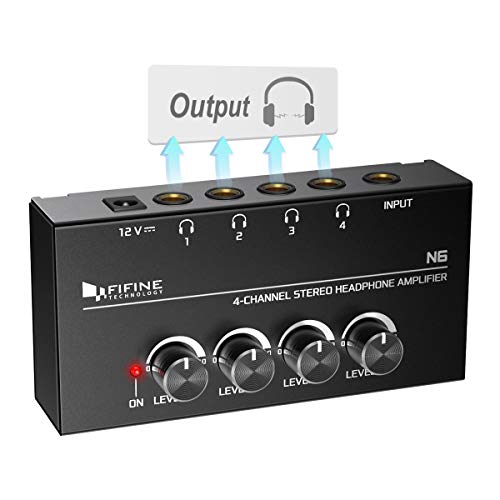
Best Compact Four-Way Splitter – FIFINE N6 4-Channel Amplifier
The FIFINE N6 is one of the more compact headphone distribution amplifiers under 500, providing four separately controlled outputs from one stereo source. Its metal construction and included 12V adapter make it a straightforward option for tracking, live use, or shared listening.
Best For: Small studios, rehearsals, and setups where up to four people need individual volume control.
Pros:
- Offers four outputs with a separate volume knob for each listener.
- Metal construction is compact and portable.
- Includes a 12V DC power adapter and power indicator.
- Supports stereo or mono connections with compatible 1/4-inch cables.
Cons:
- It has one input and four outputs, so it is not a mixer.
- TRS/TS cables are not included.
- All input and output ports are 6.35mm.
For buyers comparing headphone distribution amplifiers under 500 for a four-person setup, the N6 offers useful individual control in a small package. Confirm your cable requirements before purchasing.
Best Simple Session Splitter – Mackie HM-4 Headphone Amplifier
The Mackie HM-4 is a compact option among headphone distribution amplifiers under 500, driving four headphones from a single source. Each output has its own level control, making it useful for tracking sessions and rehearsals where listeners need different volume settings.
Best For: Home studios, rehearsals, and compact tracking setups with four listeners.
Pros:
- Drives four headphones from one source.
- Provides independent level control for each output.
- Compact metal enclosure can be attached to a desk, rack, or stand.
- Accepts a 1/4-inch or 1/8-inch source output.
Cons:
- Provides four channels rather than the higher capacity of an eight-channel unit.
- Its listed connector type is a 6.35mm jack, so adapters or appropriate cables may be needed.
The HM-4 is a sensible pick if you want a no-frills four-channel solution. Its small metal housing and individual controls make it especially convenient when desk space is limited.
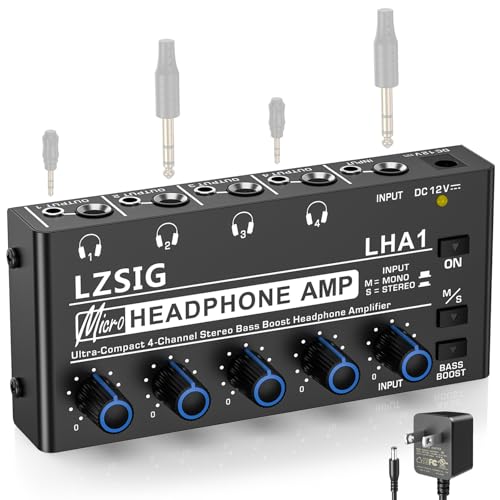
Best for Bass Boost and Flexible Connections – LZSIG LHA2 4-Channel Headphone Amp
The LZSIG LHA2 brings useful flexibility to headphone distribution amplifiers under 500, combining four independently controlled outputs with stereo/mono switching and bass boost. It supports both 3.5mm and 6.35mm connections, making it suitable for home studios and shared monitoring with compatible headphones.
Best For: Home-studio users who want four-way distribution, multiple plug sizes, and selectable bass enhancement.
Pros:
- Provides four outputs with independent volume controls.
- Supports 3.5mm and 6.35mm TS/TRS plugs.
- Includes stereo/mono switching and a bass-boost function.
- Uses a solid metal chassis with durable control knobs.
Cons:
- Supports up to four pairs of 32–100Ω headphones according to the supplied notes.
- It is a headphone amplifier and distributor, not a mixer.
- The bass-boost function may not suit every monitoring application.
The LHA2 is a versatile choice when connection compatibility matters. Its switchable modes and bass boost add options beyond a basic splitter, while the four independent outputs keep shared listening practical.
Best Budget Pick – Behringer HA400
For shoppers comparing headphone distribution amplifiers under 500, the Behringer MICROAMP HA400 is a compact, straightforward option for sharing one stereo mix with up to four listeners. Each output has its own level control, making it practical for tracking, playback, and small monitoring setups.
Best For: Home studios, recording sessions, and users who need four independently controlled headphone outputs in a very small enclosure.
Pros:
- Supports up to four pairs of stereo headphones simultaneously.
- Individual phones-level controls allow each listener to set a preferred volume.
- Uses low-noise 4580 operational amplifiers and includes a 12V DC adapter.
- Works with studio headphones, audio interfaces, mixers, and other monitoring equipment.
Cons:
- Offers four output channels rather than the eight headphone connections provided by some competing models.
- Uses a dedicated DC adapter instead of USB power.
The HA400 focuses on essential distribution features rather than extras. Its ultra-compact size, four independent controls, and included power supply make it a practical money-saving choice when four listeners are enough.
Most Flexible Outputs – Bolanle PH400
Among headphone distribution amplifiers under 500, the Bolanle PH400 stands out for combining four 3.5mm and four 6.35mm outputs in a compact metal housing. It is designed for shared monitoring where users may have different headphone plug sizes.
Best For: Small bands, podcasting, home recording, gaming, and monitoring setups that need both standard headphone jack formats.
Pros:
- Provides eight total outputs: four 3.5mm and four 6.35mm connections.
- Mono/stereo switching supports different monitoring preferences and applications.
- Individual volume control is paired with a seven-color illuminated knob for visibility in dim spaces.
- Compact metal enclosure measures 5.75 by 3.11 by 0.98 inches and uses a 5V/3A power input.
Cons:
- It is wired only, with no wireless connectivity.
- The supplied information does not specify separate detailed volume controls for every output.
The PH400 is a useful choice when connection flexibility matters as much as channel count. Its mixed jack types, mono/stereo switch, and compact illuminated control make it adaptable for small desktop or portable setups.
Best USB-Powered Option – Rockville RHPA4
The Rockville RHPA4 is a practical candidate among headphone distribution amplifiers under 500 for desktop, studio, and portable recording environments. It combines eight headphone connections, individual channel volume controls, and USB-A power in a compact metal enclosure.
Best For: Studios, podcasts, and portable setups that need multiple headphone connections and convenient USB-powered operation.
Pros:
- Supports up to eight headphones through four 1/4-inch and four 3.5mm outputs.
- Each of the four channels has its own volume knob.
- Stereo/mono switching adds monitoring flexibility.
- Compact metal housing with rubber feet supports stable placement, and USB-A power suits laptops or USB wall adapters.
Cons:
- Requires a USB power source or adapter rather than operating independently.
- The supplied notes do not list additional features such as tone controls or wireless operation.
The RHPA4 is especially appealing when a setup needs both eight-user capacity and USB-powered convenience. Its individual controls and dual jack formats cover common studio and podcast monitoring needs without taking much desk space.
Best Flexible Splitter – 8-Channel Stereo Headphone Amp
If you need headphone distribution amplifiers under 500 for a compact studio, rehearsal space, or recording setup, this STABCL model provides eight independently adjustable stereo outputs. Its mono/stereo switch and included 6.35mm-to-3.5mm adapters add flexibility for mixed headphone connections.
Best For: Home studios, recording sessions, and setups that need eight listeners with individual volume control.
Pros:
- Eight high-power stereo amplifier channels with separate volume controls.
- Accepts 1/4-inch and, with adapters, 1/8-inch TS/TRS headphone plugs.
- Offers audio distribution, mono/stereo switching, and a metal unibody enclosure.
- Includes nine 6.35mm-to-3.5mm jack adapters.
Cons:
- Requires the included 12V AC adapter for power.
- The unit has one audio input, so it is designed primarily for shared-source distribution.
Choose this model when straightforward eight-way distribution and broad headphone compatibility matter more than rack integration or multiple discrete mixes.
Best for Professional Monitoring – 8-Channel Mixing Distribution Amp
Among headphone distribution amplifiers under 500, this 1U rack-mountable unit is the most feature-focused option for studio and live monitoring. It combines eight amplifier channels, 16 front-and-rear headphone outputs, independent controls, dual input routing, and LED level meters.
Best For: Rack-based studios, live sound rigs, and monitoring workflows requiring multiple outputs or discrete mixes.
Pros:
- Eight channels provide up to 16 headphone outputs.
- Supports mono/stereo operation, IN1/IN2 switching, and dedicated rear inputs.
- Six-segment LED meters show signal levels for all eight channels.
- 1U rack design, independent channel volume controls, and master input volume suit permanent installations.
Cons:
- Its rack-oriented design is less convenient for casual portable use.
- Uses 6.35mm headphone connections, so smaller plugs require an adapter.
This is the strongest fit when signal routing, visual level monitoring, and rack integration are priorities rather than minimal size.
Best Compact Option – Pyle PHA40 4-Channel Headphone Amp
For buyers seeking headphone distribution amplifiers under 500 in a small, simple format, the Pyle PHA40 powers four pairs of headphones from a single source. Each output has its own level control, while the compact enclosure makes it easy to carry between studio and live applications.
Best For: Small recording sessions, basic rehearsal monitoring, and portable setups with up to four listeners.
Pros:
- Powers up to four headphones simultaneously.
- Provides independent volume controls for each listener.
- Uses 1/4-inch TRS input and four 1/4-inch TRS stereo outputs.
- Compact design measures approximately 4.07 by 1.18 by 2.24 inches.
Cons:
- Four channels offer less capacity than the eight-channel alternatives.
- All connections are 1/4-inch, limiting direct compatibility with smaller headphone plugs.
- The enclosure is plastic rather than metal.
Pick the PHA40 when you need an uncomplicated four-person monitor distribution system that occupies very little space and is easy to transport.
How We Picked the Best Headphone Distribution Amplifiers Under 500
We focused on practical features that affect day-to-day monitoring: the number of independent channels and outputs, input and output formats, stereo or mono flexibility, individual volume controls, construction, portability, and compatibility with common 3.5mm and 6.35mm headphones. We also considered whether each design suits a compact personal setup, a rehearsal room, a recording studio, or a more demanding stage installation.
Because specifications and included accessories can vary by seller, confirm the current listing before buying—especially power requirements, adapter sizes, maximum headphone impedance, and whether cables are included.
Quick Comparison
| Best For | Recommended Configuration | What to Look For |
|---|---|---|
| Small desktop or home studio | Four-channel amplifier | Independent level controls and compact housing |
| Several musicians or listeners | Eight-channel distribution amp | More outputs, stronger power supply, and reliable cooling |
| Live or rehearsal monitoring | Rack-mountable multi-channel model | Durable chassis, clear routing, and mono/stereo modes |
| Portable use | Mini stereo splitter amp | Lightweight construction and convenient power |
Key Buying Factors for Headphone Distribution Amplifiers Under 500
Channel and Output Count
Count the people who need simultaneous monitoring, then leave room for expansion. A four-channel unit is often sufficient for a small band or podcast setup, while eight-channel models are better for ensembles, classrooms, and larger tracking sessions. Check whether the advertised channel count means independent amplifier channels or simply physical headphone jacks.
Inputs, Connectors, and Routing
Most units accept a stereo line-level input, but connector formats differ. 6.35mm TRS inputs and outputs suit studio equipment, while 3.5mm connections are convenient for consumer headphones. Adapters can solve mismatches, but native connections reduce clutter and accidental signal loss. If you need separate mixes, verify that the amplifier supports multiple inputs rather than merely duplicating one stereo feed.
Power, Impedance, and Controls
Individual volume controls are essential when listeners use headphones with different sensitivities. Bass-boost switches can be useful, but they are not a substitute for a balanced monitor mix. Check the supported impedance range and power requirements, particularly when driving high-impedance studio headphones or using the unit away from a standard outlet.
Build Quality and Installation
Metal enclosures generally withstand frequent transport better than lightweight plastic. For permanent studio or stage use, look for rack-mount compatibility, clearly labeled controls, and a power supply that can handle every channel simultaneously. Compact models are easier to carry but may provide fewer routing and mounting options.
Who Should Buy Which Headphone Distribution Amplifiers Under 500?
Choose a four-channel desktop model if you are splitting one stereo mix among a few people for recording, streaming, lessons, or casual rehearsal. Choose an eight-channel unit when several performers need reliable access at once or when you want room for future expansion. Choose a rack-mountable model for a fixed studio, venue, or professional rehearsal rig where durability and organized cabling matter most. Choose a portable mini amplifier when low weight, simple operation, and quick setup are more important than advanced routing.
Before ordering, match the amplifier’s input and headphone connectors to your existing equipment, confirm the number of truly independent volume controls, and verify that the included power adapter meets your local requirements.